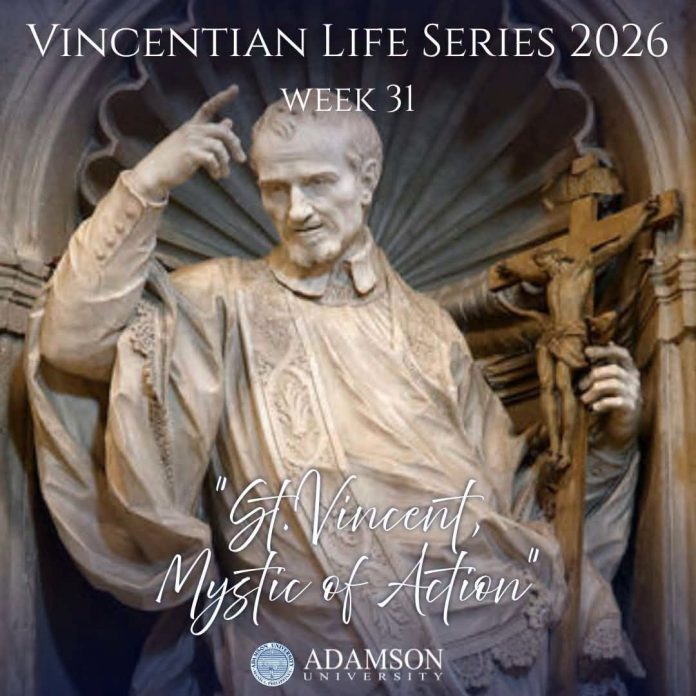
Is St. Vincent a “mystic”? Yes. He is a mystic of action!
To understand Vincentian spirituality, we also need to understand the various currents of mysticism that were popular in 17th-century France. There were three influential mystical currents: the Italian school; the Spanish mystical school, which reflected on the works of St. Teresa of Ávila, St. John of the Cross and Luis de Granada; and Rheno-Flemish mysticism from the Netherlands, which influenced the Jansenist heresy. All these mystical schools shaped French spirituality in the 17th century.
Among the more enduring influences were the second and third currents, which had a taste for metaphysical abstraction and an aspiration toward direct union with the divine essence. This tradition came to be called the “Abstract School.” Among its best-known figures were Madame Acarie, André Duval, Michel de Marillac and Dom Beaucousin.
St. Vincent became familiar with this group. Madame Acarie became famous for promoting the Carmelite reform of Teresa of Ávila in France. She sponsored regular meetings in her Parisian salon, which prominent Church figures regularly attended. It is not certain whether Vincent attended these meetings, but some of his friends certainly did.
The leading theologian of this group was the Capuchin Benedict of Canfield (1562–1610), whose famous work, The Rule of Perfection (1592), greatly influenced St. Vincent. He was also the spiritual director of Madame Acarie. Born in Canfield, Essex, England, Benedict converted from Puritanism, crossed over to France and joined the Order of Friars Minor Capuchin. The Rule of Perfection was popular among professors at the Sorbonne. André Duval, who was one of them, introduced the book to Vincent de Paul.
While Francis de Sales’ synthesis of the Christian life is the “love of God,” Canfield’s central point is the “will of God.” He presented two basic principles.
The first is “purity of intention.” We should have no intention throughout our lives and in all our actions other than to obey the will of God. This is the “rule of perfection.” It is the basis of the entire spiritual life.
The second is “conformity of the human will with the divine will.” We obey the will of God when we pattern our wills after God’s will. This conformity culminates in the “real absorption” of the human will into the divine essence. As we can see, we already find ourselves in highly abstract mystical language.
The “will of God” is crucial to Vincent de Paul’s spirituality. This emphasis can be found in the Common Rules of the Congregation of the Mission and throughout his letters and conferences.
The virtues found in The Rule of Perfection—humility, meekness, simplicity, mortification and zeal for souls—are the five important characteristics of Vincentian missionaries. The daily examen, or examination of conscience, was also part of their daily schedule.
The Vincentians were also encouraged to be mystics and ascetics. They should be “Carthusians at home and apostles in the field.” Vincent de Paul was also devoted to “Divine Providence.” He taught that people should not “go ahead of Divine Providence.”
Vincent’s emphasis on “obedience to the will of God” is very important. In the Common Rules of the Congregation of the Mission, he says: “Doing the divine will always and in all things is a means for acquiring Christian perfection.”
But beyond Canfield and the mystical preoccupations of the French school, Vincent found the “will of God” revealed not in mystical abstraction but in the social, economic and religious dimensions of human life. The will of the Father is fulfilled not in the heights of visions—miradas—or in lofty contemplation, but in praxis: the commitment to serve the well-being of humanity, especially the poor.
St. Vincent was serious in his warnings against chasing “lofty and elevated thoughts.” He tells us that God’s will is not found in the heights of visions but in praxis—in the commitment to serve the well-being of the poor.
“The perfection of love does not consist in ecstasies,” Vincent asserts, “but in fulfilling the will of God. Whoever would be the most perfect of all is the one who has best conformed his own will to God’s.”
Was St. Vincent a “mystic”? Yes, but he was a mystic of action.
Robert Maloney, CM, has this to say: “Vincent was a mystic who didn’t know he was one. He was not a visionary. Nor was he an activist. He simply pushed people to see. And the only way in practice to ‘see’ people as they are is to represent them as they are in reality, that is to say, in God.”
It is said that Vincent exhausted himself each day in the service of the poor, yet he could hold and contemplate the crucifix for hours. Vincent’s mystical experience, in both its vertical and horizontal dimensions, points to his deep experience of God.
This interplay between contemplation and action is very clear in Vincent’s life. He tells his followers to act, but also to pray; to pray, but also to act.
On the one hand, he responds to the objection that there are so many things to do, including household duties and other forms of service: “No, but we have to sanctify those activities by seeking God in them, and do them in order to find Him in them rather than to see that they get done.”
On the other hand, he also advised the sisters and missionaries: “If you have to leave prayer to go to a patient, go ahead, and in that way you’ll leave God in prayer and find Him with that sick person.”
Father Daniel Franklin Pilario, C.M., is the President of Adamson University in Manila. He is a theologian, professor, and pastor of an urban poor community on the outskirts of the Philippine capital. He is also the Vincentian Chair for Social Justice at St. John’s University in New York.