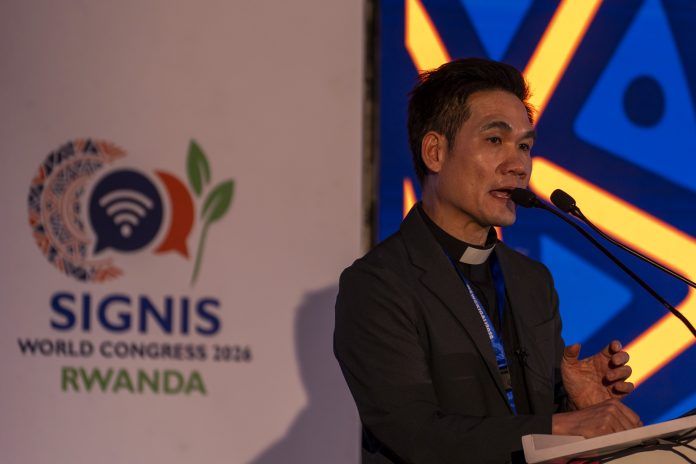
Artificial intelligence (AI) is no longer merely a tool but a force shaping what people accept as true, desire as good, and understand about human relationships, a Thai Catholic scholar warned at a global media congress in Rwanda.
Father Anthony Le Duc urged Catholic communicators to resist digital systems that reduce people to data, manipulate behavior, and weaken genuine human connection.
The priest, who serves as the executive director of the Asian Research Center for Religion and Social Communication at St. John’s University in Thailand, said AI should no longer be regarded as a passive instrument controlled entirely by its users.
“AI isn’t neutral,” Le Duc said during the SIGNIS World Congress in Kigali on Aug. 6, adding that “the traditional toolbox model no longer applies.”
Unlike a hammer that remains passive until someone uses it, AI monitors habits, studies choices, tracks movements, and predicts a user’s next step, he said.
Le Duc described the digital world as a “digitally mediated moral ecology” in which technology influences how people understand truth, decide what is good, and relate to one another.
Digital systems, he said, “actively restructure how we direct our attention, determine the common horizon through which we perceive truth, reshape what we desire as good, and redefine how we belong to one another.”
He warned that digital platforms driven by the pursuit of profit are reducing “the deep mystery of the human person to raw data and performance metrics.”
Citing Pope Leo’s message for World Communications Day, Le Duc said, “The ultimate challenge today isn’t technical but anthropological.”
He proposed “Christian digital humanism” as a response to the growing influence of AI. The approach affirms the dignity of the whole person — body and soul — regardless of productivity, social utility, or machine performance.
Technology “must not be used for monopolistic manipulation or dehumanization,” he said, but must serve “the common good, empathy, solidarity and authentic communion among human beings and with all creation.”
Le Duc said human dignity is a gift from the Creator and cannot be measured by efficiency or usefulness. Artificial intelligence must not reduce people to tools or fragment human identity into behavioral data points.
“Human value is completely independent of cognitive or mechanical efficiency,” he said. When efficiency becomes the highest standard, people are treated “merely as resources to be optimized or discarded based on immediate utility.”
Le Duc also challenged the idea that automated communication can replace relationships grounded in physical presence.
“True relationality requires physical presence,” he said, pointing to “a touch, a gaze, a face-to-face encounter which can never be replaced by automated digital connectivity.”
Digital presence has value, he said, but “can never replace physical presence.”
Large language models can imitate human speech and empathy with striking accuracy, Le Duc said, but they lack the depth and complexity of human relationships.
He warned that treating machines as human could trap users in “personalized mirror worlds,” replacing difficult real-world encounters with simulated relationships and weakening genuine community.
Digital progress, he said, must serve the common good rather than corporate monopolies and should foster encounter, empathy, and solidarity.
Le Duc called for greater accountability for technology platforms and firm boundaries against allowing algorithms to make life-and-death decisions.
Schools, families, churches, and policymakers should work together to promote AI literacy, protect people from deepfakes and fraud, and preserve spaces for silence, reflection, and face-to-face interaction, he said.
Catholic media practitioners must first deepen their understanding of the Church’s theological, anthropological, and social teachings before rushing to adopt new platforms or software, Le Duc said.
“Every journalist, editor, producer, and digital specialist must discern where we can serve most effectively,” he said.
For some communicators, that could mean rejecting “algorithmic outrage” and disarming harmful speech. Others could work to mend digital communication networks, create spaces for authentic encounter, or speak “prophetically against new forms of digital colonialism.”
“In the end, the human person is always vastly greater than the largest data set,” Le Duc said.
He urged Catholic communicators to help audiences move beyond the noise of digital screens and reconnect with what he described as “God’s algorithm of grace.”