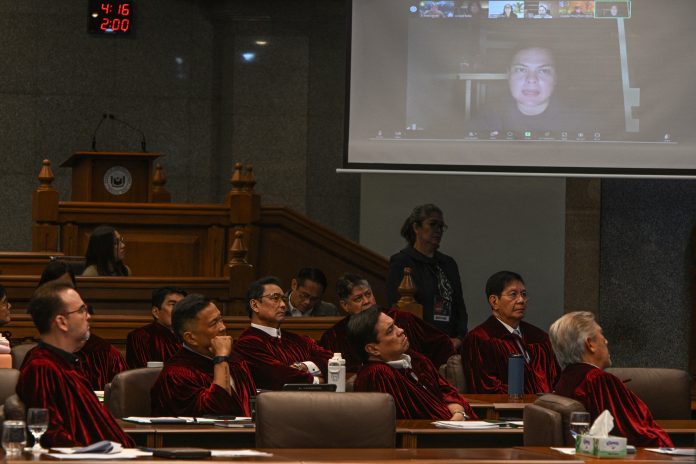
When Sara Duterte threatened during a late-night online interview to have the president killed by a hired assassin, was the threat real? The answers are sharply polarized, depending on where one stands on the sociopolitical spectrum.
The NBI presented a four-factor analysis: (1) Her manner of delivery was serious, angry, and furious; (2) the instructions were very clear; (3) the statement had explicit targets; and (4) the relationship between her and her enemies was adversarial.
The defense panel responded with a different set of arguments: (1) It was a response, not a real threat; (2) it was a justified emotional reaction from a mother and wife trying hard to defend her family against “Operation Romanov”; (3) there was no actual assassin; and (4) the command was conditional: “Kung patayin nila ako.”
Since the debate centers on the “utterance,” a word the NBI frequently mentions, let me contribute to the discussion from the perspective of the philosophy of language.
J.L. Austin, a prominent Oxford philosopher, sought to shift the philosophy of language from its focus on theoretical semantics to the pragmatics of speech acts. His seminal work, “How to Do Things with Words,” published in 1962, argued mainly that language does not merely describe facts. It also performs actions.
For instance, when a boss says, “You are fired,” the human resources department closes the person’s employment record. When a priest or minister says, “I pronounce you husband and wife,” the man and woman become a married couple. These words act. They do not merely describe; they perform. Speech act theory, the name of Austin’s proposal, argues that language is not only descriptive but also performative.
In Austin’s view, language has three dimensions: (1) locution, or the actual utterance; (2) illocution, or the intended meaning; and (3) perlocution, or the effect on the listener.
First, in the Duterte impeachment, the actual utterance, or locution, was: “Kapag pinatay ako, patayin mo si BBM, si Liza Araneta at si Martin Romualdez. No joke. No joke.” The NBI established the authenticity of the video, and neither side disputes this locutionary act.
Second, the intended meaning, or illocutionary act, is the real battleground of the impeachment process. What was the intended force of the utterance? For the prosecution, what she said was a real threat and an act of inciting to sedition. When she imagined cutting off Marcos’ head in another interview, she made her intentions clear. For the defense, however, her words were merely a “warning” or “an unconventional political response” that, in its view, lacked the genuine illocutionary force of an active threat.
Third, the perlocutionary act concerns the psychological and physical effects the words have on listeners. Were the utterances effective? When she appeared online and made the threats, the National Security Council declared them a national security issue, the NBI began an investigation, and people filed an impeachment case against her.
Did the statements affect Marcos? Did he feel threatened? We do not know. Did she really contact an assassin? Whether she did or not, the words themselves were enough to activate millions of trolls in that direction.
Are all utterances real? According to Austin, words act when certain conditions are met: The person must have the authority and power to say them, and the process must be performed properly. Not everyone, for example, can solemnize a marriage. The person must be a valid minister, and the formula used must be correct.
Beyond Austin’s discussion of performatives, however, French sociologist Pierre Bourdieu argued that the effectiveness of words does not reside only in the words themselves or in the rituals accompanying their pronouncement. When Queen Elizabeth says, “I name this ship Victoria,” it is given that name because she, as queen, has the power to do so. The statement’s effectiveness is founded on the social conditions and power relations between the speaker, the queen, and the hearers, her subordinates.
When Sara said she had contacted someone to kill the president, the social conditions and power relations between her and her subordinates made the utterance itself effective.
First, her political clout over the entire Duterte network makes it plausible that she has the capacity to contact a hitman. When she says, “No joke. No joke,” it is no joke if we consider the violent historical baggage of the previous Duterte administration.
Second, she wields power over 335 security personnel who are at her beck and call. They come from the Vice Presidential Security and Protection Group and are drawn from the Armed Forces of the Philippines and the Philippine National Police.
Third, the influence she holds over millions of trolls who need only to be activated makes the threat even more real. As revealed in the death of “Mima Alicia,” this network also has its own intelligence apparatus capable of deciding to kill.
The case of her father, Rodrigo Duterte, who said, “Kill the addicts,” can be understood in the same way. His words were effective not merely because he said them, but because President Duterte occupied a position of power over the PNP network and the country as a whole.
He had the power to promote police officers to higher positions and reward them with money if they performed. He also had the power to demote them, “assign them to Jolo” or other difficult locations, relieve them of their positions, or eliminate them by fabricating cases against them.
Even when powerful people like them do nothing directly to make their “threats” effective, the power-laden social conditions between speaker and hearer — between the commander in chief and the police, or between the vice president and her subordinates — can induce others to follow their words.
As Jeremy Lotoc, head of the NBI’s cybercrime division, said: “The utterances were serious, and the threat was actual and real.”
Father Daniel Franklin Pilario, C.M., is the President of Adamson University in Manila. He is a theologian, professor, and pastor of an urban poor community on the outskirts of the Philippine capital. He is also the Vincentian Chair for Social Justice at St. John’s University in New York.