The Catholic Church in Asia must confront economic structures that concentrate the benefits of development among a few while leaving poor communities to bear the costs of environmental destruction, Asian cardinals said at the opening of a regional bishops’ assembly.
Cardinal Pablo Virgilio David, vice president of the Federation of Asian Bishops’ Conferences (FABC), said Church social action must move beyond emergency relief and address the root causes of poverty, inequality, and ecological damage.
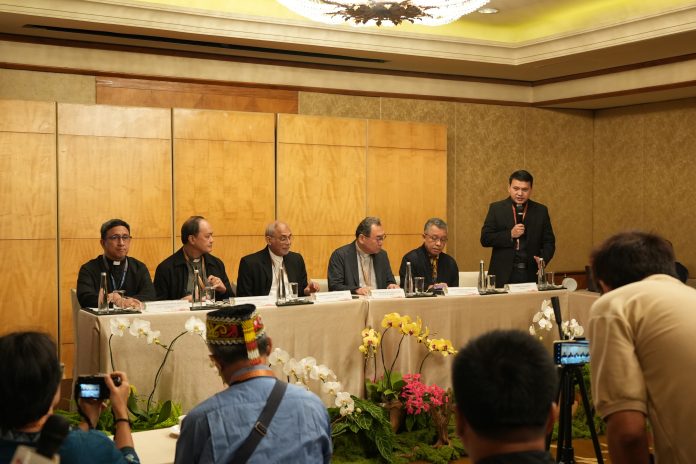
The Filipino prelate was responding to questions from LiCAS News during the opening press conference of the FABC’s 12th Plenary Assembly in Jakarta, Indonesia.
“In the Church, we used to really focus our social action work on conducting relief services for those who are immediately in need, especially in situations of disaster,” David said.
“But more and more, we are realizing that we cannot stay on that level only for social action,” he added.
David, the bishop of Kalookan, said social action in many local churches now includes “community development and action for social transformation by tackling, first of all, the root causes of poverty.”
“It takes a lot of wisdom to understand what structures are causing the huge disparities in our societies,” he said.
David said economic growth across Asia has not been shared equally, leaving many sectors excluded from the benefits of development.
“Yes, there is indeed a lot of progress going on in Asian societies, but we have to, at the same time, honestly admit that the progress is not equally distributed, and a lot of sectors in society remain excluded and are not really participants in development,” he said.
David connected those disparities with the environmental damage caused by extractive industries, saying the Church in the Philippines has discussed divestment from destructive businesses.
“We know that some businesses are really destructive to the environment, especially industries that are too extractive and destructive… We can no longer close our eyes to the climate crisis,” he said.
He said that the Asian bishops “intend to pursue” the issues of poverty and the climate crisis “more seriously in our conversations here in this plenary assembly.”
Cardinal Filipe Neri Ferrão, president of the FABC, said the climate crisis cannot be separated from its effects on poor communities.
“It was Pope Francis of revered memory who shook us up about the impact of the climate crisis, saying that the cry of the Earth and the cry of the poor go together,” Ferrão said.
“The climate crisis is not only an ecological crisis; it is a moral and ethical crisis,” he added.
Ferrão said the episcopal bodies of Asia, Africa, and Latin America prepared a common document ahead of COP30 in Belém, Brazil, and presented it to Pope Leo XIV.
He said representatives of the bishops’ conferences of the United States, Canada, and Europe later met with Church leaders from the Global South to discuss how they could take the process forward.
Ferrão also said the FABC’s Office for Integral Human Development has a climate desk headed by Bishop Allwyn D’Silva of Bombay, which works to raise awareness and promote collaborative action.
The plenary assembly runs through July 26 and brings together more than 120 cardinals and bishops representing 22 episcopal conferences and ecclesiastical jurisdictions across Asia.
The gathering is examining how the Church can respond to poverty, conflict, migration, environmental challenges, and rapid social change under the theme, “The Call to Synodal Conversion and the Mission to Be Bridges and Bridge Builders in Asia.”