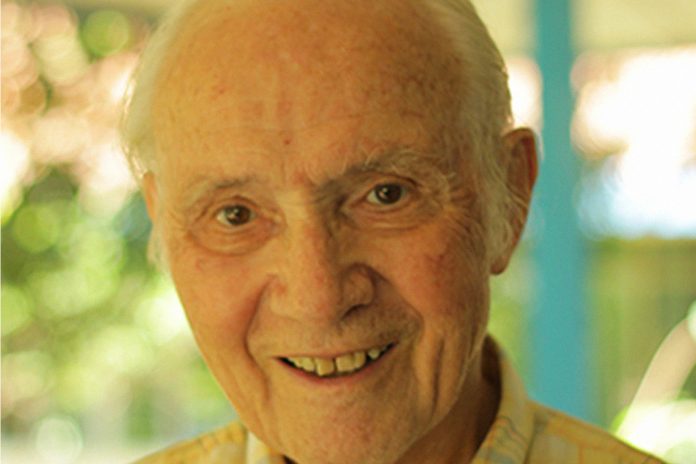
A German Jesuit priest who served as a spiritual adviser to Mary Jane Veloso during her years on death row in Indonesia has died.
Fr. Bernhard Kieser, who spent more than six decades in ministry in Indonesia, died June 6 at a hospital in Yogyakarta, his congregation said. He was 87.
He was laid to rest June 8 after a funeral Mass at the Maria Ratu Damai Cemetery Complex in Girisonta, Central Java.
Born in Bruchsal, Germany, Kieser arrived in Indonesia in 1963 and spent most of his priesthood in the Yogyakarta region, where he served in academic, pastoral and social ministries. He also served as coordinator of the Jesuits’ Commission on Peace and Social Justice.
He was widely recognized for helping establish the Pingit Social Settlement in Yogyakarta, where he regularly brought seminarians and Jesuit scholastics to live among and learn from poor and marginalized communities.
“Through his life, Father Kieser bore witness to the truth that faith without action is empty, and that standing alongside the poor and marginalized is an authentic expression of love,” the congregation said.
His commitment to people on the margins extended to prison ministry. Kieser regularly visited inmates at Yogyakarta’s Wirogunan Prison, work that brought him into contact with Veloso during her nearly 15 years on death row.
Veloso, a former domestic worker, was sentenced to death in 2010 after Indonesian authorities said she carried 2.6 kilograms (5.7 pounds) of heroin through Yogyakarta airport. She has long maintained she was tricked into carrying the drugs.
She was nearly executed in 2015 but received a last-minute reprieve after then-Philippine President Benigno Aquino III appealed to Indonesia, saying she was needed as a witness in a human trafficking case against her recruiters.
Kieser was supposed to administer her final rites had the execution been carried out.
Veloso was returned to the Philippines in December 2024 after both governments reached an agreement allowing her to serve her sentence at home.
She is currently detained at the Correctional Institution for Women in Mandaluyong City while courts hear the criminal cases she filed against her former recruiters.
Looking back on her years in prison and the priest who stood beside her in prayer and counsel, Veloso once reflected on how incarceration reshaped her faith.
“Before, I was not a good Catholic,” she said in a 2024 article in Asia News, the press agency of the Pontifical Institute for Foreign Missions. “But living behind bars has changed my life, transforming me into a person who has come closer to God.”