Families of victims of extrajudicial killings urged a newly launched civilian-led Truth Commission to investigate alleged continuing killings under President Ferdinand Marcos Jr., warning that accountability efforts should not stop with former President Rodrigo Duterte’s drug war.
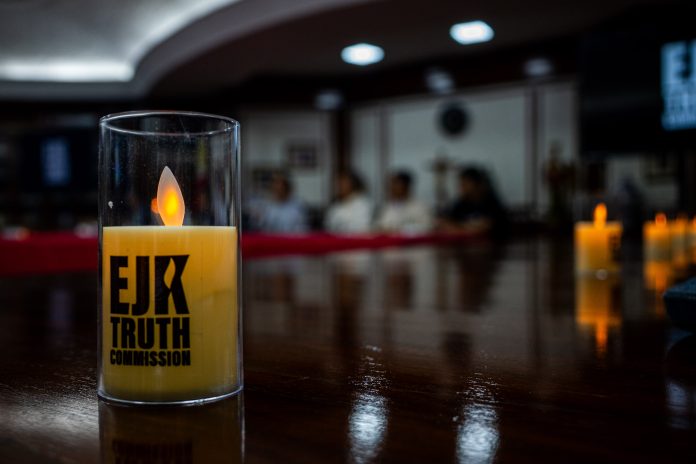
The appeal came after the launch of the Philippine Truth and Reconciliation Commission, an independent body backed by Cardinal Pablo Virgilio David of Kalookan and chaired by former International Criminal Court judge Raul Pangalangan.
The commission, which includes church leaders, human rights advocates, academics, and forensic experts, seeks to document abuses linked to the drug war and contribute to efforts toward truth, accountability, and institutional reform.
The commission was launched as Duterte faces proceedings before the International Criminal Court over alleged crimes against humanity tied to his anti-drug campaign, which rights groups say claimed thousands of lives.
HUSTISYA, an organization of families of victims of extrajudicial killings and other human rights violations, welcomed the initiative while calling for a broader examination of state violence beyond the Duterte years.
The group said it recognizes the importance of investigating the “structural and institutional roots” that led to the thousands of killings during Duterte’s anti-narcotics campaign.
At the same time, it urged the commission to examine reports of continuing drug-related killings under the current administration.
“Such killings reportedly continue under the Marcos Jr. administration, with at least 1,184 drug-related killings (as of March 6, 2026) referred to by the UP Third World Studies Center’s Dahas Project,” the group said.
HUSTISYA also pointed to the continued existence of what it described as arbitrary drug watchlists in communities and warned against limiting scrutiny to past abuses.
“It is imperative that no one, including the current administration and its State agents, is spared from scrutiny, as the majority of both direct and indirect perpetrators of killings and other rights violations committed in the name of the drug war remain free from accountability,” the group said.
Beyond the anti-drug campaign, HUSTISYA argued that truth-seeking efforts should also examine broader policies and conditions that enabled rights violations.
“It is also imperative that in truth-seeking efforts, the political, economic, and social contexts of the drug war, as well as that of the main blueprints of suppression of rights, are scrutinized,” the group said.
The organization said such scrutiny should include the conduct and impact of government policies related to counterinsurgency, the militarized response to the COVID-19 pandemic, and attacks against political opposition.
HUSTISYA also urged the commission to consider other forms of violence that occurred during Duterte’s presidency. The group cited the killing of 422 activists, hundreds of attempted killings, and cases of enforced disappearance during the period.
“This includes our loved ones, who were killed in cold blood by Duterte’s police and military,” it said.
The organization further alleged that rights violations have continued under the Marcos administration, citing at least 135 activists and civilians killed extrajudicially and at least 20 desaparecidos who remain missing.
It also called for greater transparency regarding the role of state security institutions in the killings.
“It is important that these efforts open the floodgates for all information and details into the operations of the Philippine National Police and the Armed Forces of the Philippines, who were behind these killings and have been operating systematically upon orders of Malacanang,” the group said.
The group further urged investigators to establish “how the Davao Death Squad operates within the PNP, the Department of Interior and Local Government as well as the National Police Commission from the Duterte to the Marcos Jr. administration.”
HUSTISYA said it remains committed to supporting efforts aimed at uncovering the truth behind the killings and securing accountability for victims and their families.
The group added that it will continue “the struggle for justice and accountability amid State-perpetrated violence” and monitor the commission’s initiatives and findings.