
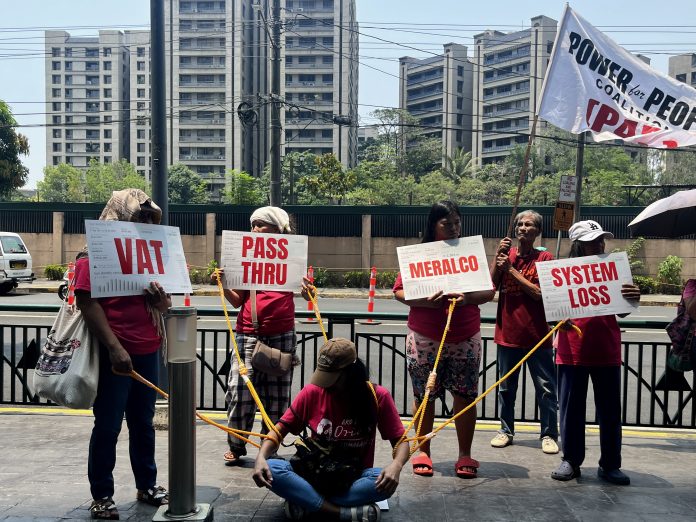
Consumer groups on Thursday urged the Energy Regulatory Commission (ERC) to stop allowing power firms to pass rising generation costs to consumers as repeated outages from coal and gas plants triggered fresh grid alerts across Luzon and the Visayas.
Members of the Power for People Coalition gathered at the ERC headquarters to press regulators to suspend pass-through charges in electricity bills, expand the no-disconnection policy, and penalize generation companies blamed for recent rotating brownouts.
The groups said current relief measures remain inadequate as households continue to absorb soaring electricity costs during what they described as an energy emergency.
“The no disconnection policy and staggered payment schemes were welcome moves, and should be expanded throughout the entirety of the energy emergency,” said Gerry Arances, convenor of P4P.
“But the ERC cannot stop at that. It needs to address the high costs passed onto consumers in the largest part of our electricity bills, or else it is simply allowing unjust charges to accumulate for consumers– whether today or at the end of the grace period,” he added.
The ERC earlier suspended electricity service disconnections for residential and non-residential consumers from May to July and temporarily halted collection of the Green Energy Auction charge.
Manila Electric Company, or Meralco, announced a slight decrease of P0.0151 per kilowatt-hour in May electricity rates, equivalent to around P3 for households consuming 200 kilowatt-hours monthly.
But P4P said the reduction barely offset the P107 increase imposed during the April billing cycle, with generation charges continuing to drive electricity prices upward.
Arances said the ERC should move beyond temporary relief and halt what he described as the long-standing practice of automatically passing coal and gas price spikes to consumers.
The coalition also asked regulators to include the March and April billing periods in the no-disconnection policy, pointing to major increases in electricity prices following the US-Israel attacks on Iran that disrupted global fuel markets.
“Serbisyong pampubliko ang kuryente, hindi negosyo na pagkakakitaan ng mga kompanya,” said Ka Leody de Guzman, president of Partido Lakas ng Masa.
“Sa panahon ng krisis, nagmamahal na nga ang kuryente – hindi tama na mayroong banta pa rin ng putulan nito. Hindi rin tama na pinapasalo pa rin sa atin ang gastos sa desisyon ng Meralco na tumangkilik ng mahal na coal at gas,” he added.
The coalition also raised alarm over fresh red and yellow alerts issued by the National Grid Corporation of the Philippines on May 12 and 13 after several coal and gas plants went offline or operated at reduced capacity amid extreme heat conditions.
P4P said gas plants accounted for 62.37 percent of unavailable generating capacity while 85.45 percent of derated capacity came from fossil fuel facilities.
Arances said gas plants jointly owned by Meralco, San Miguel and AboitizPower in Batangas City were also linked to the yellow alerts raised on April 16 and questioned whether the companies had been held accountable.
Red and yellow alerts indicate thin power reserves and increase the risk of rotating brownouts and higher electricity costs through spot market purchases.
“It is outrageous that we are experiencing red and yellow alerts and sky-high power rates in the middle of an energy emergency,” Arances said.
“This further emphasizes the importance of fast tracking our transition to clean, affordable, and reliable power sources that serve the interests of the people.”