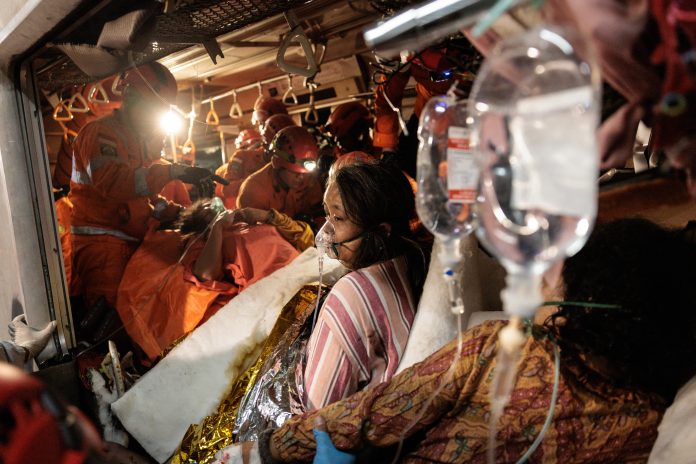
At least 14 people were killed and 84 others seriously injured after two trains collided near East Bekasi Railway Station, about 25 kilometres east of Jakarta, authorities said Tuesday.
All victims, both those who died and those seriously injured, were reported to be adult women, according to authorities. The figures may still rise as several passengers remain under medical care.
The collision, which occurred late Monday, has drawn renewed attention to safety conditions on Indonesia’s busiest commuter rail corridors, used daily by millions of workers traveling to and from the capital.
Collision sequence
The accident began when an electric car stalled at a railway crossing, blocking the tracks. A KRL Commuter Line train on the Jakarta to Cikarang route attempted to brake but still struck the vehicle.
Moments later, a long-distance train, Argo Bromo Anggrek, traveling from Jakarta to Surabaya, entered the same track section from behind at high speed. With limited distance to stop, it crashed into the rear of the commuter train.
The impact caused severe damage to several carriages. The last carriage sustained the heaviest destruction, with reports indicating that the locomotive of the second train penetrated its structure. The carriage was reportedly occupied entirely by female passengers.
Government response
Prabowo Subianto visited the scene and expressed condolences to the victims and their families.
He instructed PT Kereta Api Indonesia to provide compensation and ensure that all medical expenses for the injured are fully covered.
The government also committed to accelerating upgrades to railway crossing safety systems. Around 1,800 crossings across Java are set for improvement, with a budget of approximately Rp4 trillion.
“This is for public safety. We will build guard posts or flyovers at vulnerable points,” the president said while visiting victims at Dr. Chasbullah Abdulmadjid Regional Hospital.
Authorities also approved the construction of a flyover in the Bekasi area as a long-term measure to reduce risks at level crossings.
Daily commute under strain
The collision has also highlighted the daily conditions faced by commuters on Jakarta’s KRL network.
Each day before sunrise, stations across Jakarta and surrounding cities such as Bekasi, Bogor, Depok, and Tangerang fill with workers traveling from suburban areas into the capital. For many, the commute is tied directly to their livelihood.
During peak hours, train cars are often overcrowded. Passengers stand shoulder to shoulder with little room to move. Physical exhaustion and psychological stress have become part of daily travel.
For women, the journey can carry additional risks, including harassment and petty crime, adding another layer of vulnerability.
Monday night’s collision turned that routine into a site of loss and underscored how quickly an ordinary journey can become dangerous.
Infrastructure concerns
Officials said many railway crossings in Indonesia remain outdated, with some dating back to the Dutch colonial period. Many lack adequate safety systems or personnel to manage traffic.
Indonesia’s rail network is also unevenly developed. While Java carries most of the traffic, networks in other regions remain limited or absent.
Observers have pointed to ageing infrastructure, heavy passenger loads, and gaps in safety enforcement as continuing risks.
Past incidents
The East Bekasi collision is among the most serious railway accidents in recent years. Past incidents include:
- Padang Panjang, West Sumatra (1944): 200 dead
- Bintaro, South Tangerang (1987): 156 dead
- Citayam, Bogor (1968): 116 dead
- Brebes, Central Java (2001): 31 dead