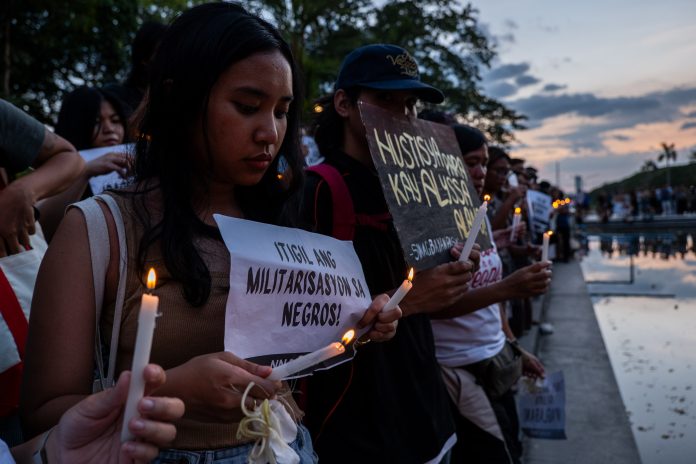
The killing of 19 people in Negros Occidental has prompted Bishop Gerardo Alminaza of San Carlos to call for truth and accountability, as conflicting accounts continue to raise questions about the victims and the circumstances of the incident.
In a reflection on the April 19 killings in Barangay Salamanca, Toboso, the bishop said the violence has left critical questions unresolved.
“The April 19 incident in Toboso has left not only lives lost, but questions that remain painfully unresolved. Who were the victims? What truly transpired? Were all those killed part of an armed encounter—or were some caught in circumstances that demand deeper scrutiny?” he said.
Alminaza urged caution in responding to competing narratives and stressed the need to listen before drawing conclusions.
“In situations like this, there is a temptation to choose sides too quickly—to cling to narratives that confirm our biases. Yet if we are to be faithful to truth, we must first learn to listen,” he said.
Authorities and communist rebels have issued conflicting claims about the incident. The Armed Forces of the Philippines said those killed were members of the New People’s Army (NPA), while the Communist Party of the Philippines said only 10 of the 19 fatalities were fighters and the rest were civilians.
CPP chief information officer Marco Valbuena said some of the civilians were “killed despite the fact they were unarmed or non-combatants.” He also alleged that drone footage showed one NPA commander “was summarily killed by the fascists, instead of being taken in as prisoner of war.”
The Commission on Human Rights said it would conduct an independent investigation into the incident. “In case of doubt, persons shall be presumed civilians,” the commission said.
Alminaza said human dignity must remain central regardless of the circumstances.
“Every human life is sacred,” he said. “No label—whether ‘combatant,’ ‘suspect,’ or ‘collateral’—can erase the fundamental dignity of a person.”
He said the use of force carries moral responsibility beyond legality. “If even one life was unjustly taken, it is not a minor error—it is a wound to the moral fabric of our society,” he said.
The bishop called for a credible and transparent investigation.
“And truth requires more than statements—it requires credible, independent, and transparent investigation,” he said.
He added, “Without truth, there can be no justice. Without justice, there can be no peace.”
Church-linked groups also issued statements following the incident.
The Promotion of Church People’s Response expressed its “deepest sympathies to the family, colleagues, and communities of RJ Ledesma, who not only helped in our common advocacy in the documentation of human rights abuses but also our shared commitment to ecological justice.”
The Philippine Ecumenical Peace Platform, a coalition of Christian organizations, called for the resumption of peace talks between the government and communist rebels and urged an independent probe.
“Peace cannot prosper if it is not rooted in truth and justice,” the group said.
Peace negotiations between the government and communist rebels have remained stalled since 2017, when former president Rodrigo Duterte terminated talks with the National Democratic Front of the Philippines, which represents the Communist Party of the Philippines and its armed wing, the New People’s Army.
The collapse followed rising violence and disagreements over ceasefire conditions, ending formal negotiations and leaving key issues unresolved.
Alminaza said the response to the incident will reflect broader national values.
“In times of crisis, the character of a nation is revealed not only in what happens—but in how we respond,” he said.