The first priests who worked with St. Vincent were called by the people the “priests of the mission.” This is because their main work was to give missions among the people (popular missions) in the French countryside. Later, they were formally organized as the “Congregation of the Mission.”
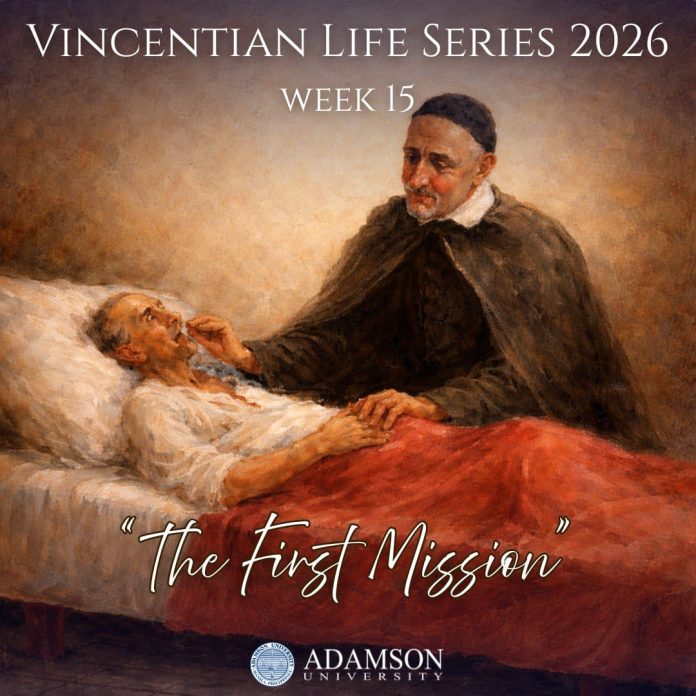
When did this work begin? St. Vincent looks back to January 25, 1617, in the small church of Folleville, which still exists today in the north of France, around 25 kilometers from the city of Amiens. In the words of St. Vincent himself, what happened there was the “first sermon of the Mission.”
Vincent’s biographer, Roman, told this story:
“One day in January 1617, we find Vincent accompanying Madame de Gondi to her castle in Folleville, in Picardy. From nearby Gannes, two leagues away, came the news that a dying peasant wished to see M. Vincent. Immediately he hurried to the sick man’s bedside. In that humble dwelling he sat down by the sick man’s bed to hear his confession. He urged the man to make a general confession of all the sins of his life. The peasant began to recite the sad rosary of his sins. It was worse than Vincent expected.”
The man was known as an honorable person in the locality, yet he had not been given the chance to make an honest confession. He was freed from the burden he had carried throughout his life. He later narrated to Madame de Gondi what had happened to him and thanked her for the gift of general confession. The man died three days later.
Without delay, the peasants under the estate of Madame de Gondi were gathered in the small church of Folleville, and Monsieur Vincent preached on the need for general confession. The people were so moved that additional help was needed to hear all their confessions.
“There was such a throng of people,” Vincent remembered, “that I had to send for two Jesuit Fathers to come to help me hear confessions, preach, and catechize. This led to doing the same thing for several years in the other parishes.”
In his old age, Vincent still spoke about this event with enthusiasm:
“It was January 1617, when all this happened, on the feast of the Conversion of Saint Paul … this lady asked me to preach in the church of Folleville to persuade the local people to make a general confession. I did this… and God blessed this sermon. All those present were moved by God and came to make their general confession… We next went to other villages in the vicinity which also belonged to Madame, to do the same as we had done in the first. We had large crowds, and God gave us his full blessing. This is how the first mission was accomplished. That it took place on the feast of the Conversion of Saint Paul was due solely to God’s design.”
Perhaps this was not the first mission that Vincent and his companions preached. There were also other groups giving missions elsewhere. However, this event moved Vincent so deeply that it led him to decide fully on the new direction of his life and mission.
Pierre Coste, one of Vincent’s biographers, wrote about this moment of insight:
“The mission at Folleville clearly revealed to Vincent de Paul what God expected from him. When so many souls in these country villages were endangering their eternal salvation, was it fitting that he should spend the greater part of his time within the narrow circle of a single family, giving lessons to two or three children? After a long and terrible struggle, God had set him free from temptations against the faith after he had made a resolution to devote the rest of his days to the service of the poor.”
What did Vincent do afterward?
First, he and his companions continued giving missions in the countryside, beginning in the estate of Madame de Gondi and later expanding to other places.
Second, Madame de Gondi established a foundation to support a number of priests who would continue this work:
“For this purpose, [she] obtained the College des Bons-Enfants, where M. Portail and myself went to live, taking with us a good priest to whom we paid fifty écus a year. The three of us used to go off to preach and give missions from village to village. When we were leaving, we’d give the key to one of the neighbors, or ask him to sleep in the house at night.”
Third, Vincent de Paul formally established a group of priests called the “Congregation of the Mission,” mainly for this purpose:
“to do what Our Lord came from heaven to earth to do, that is, to evangelize the poor.”
In our time, Pope Francis clearly expressed this missionary identity as our way of following Jesus:
“My mission of being in the heart of the people is not just a part of my life or a badge I can take off; it is not an ‘extra’… Instead, it is something I cannot uproot from my being without destroying my very self. I am a mission on this earth.” (Evangelii Gaudium, 273)
Father Daniel Franklin Pilario, C.M., is the President of Adamson University in Manila. He is a theologian, professor, and pastor of an urban poor community on the outskirts of the Philippine capital. He is also the Vincentian Chair for Social Justice at St. John’s University in New York.