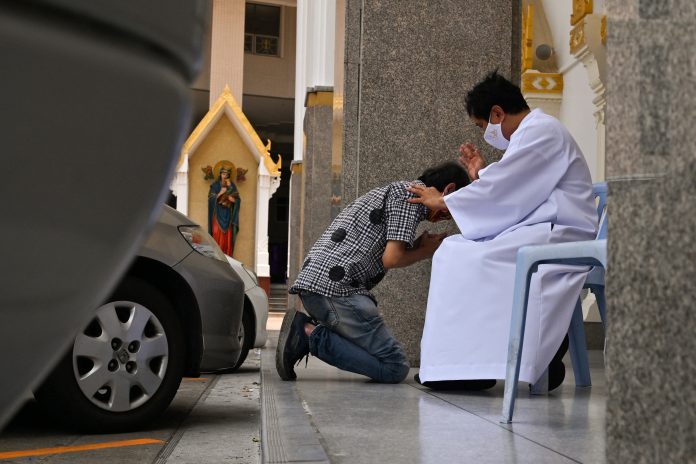
A Jesuit leader has warned that growing priestly burnout is a “hidden crisis” in the Church, urging clergy to confront what he described as a “sacred weariness” rather than ignore it.
Fr. Miguel A. Garaizabal, SJ, regional superior of the Thailand Jesuit Region, delivered the reflection during the one-week annual retreat for clergy of the Archdiocese of Bangkok, framing exhaustion not as failure but as a spiritual condition that calls for renewal.
“The talk was part of the renewal for priests to continue their ministry in a sustainable way,” Fr. Miguel told LiCAS News on March 12.
Drawing from the post-Easter season and the Church’s pastoral life, he said fatigue can become a place of encounter with Christ rather than a sign of weakness.
“Our fatigue is precious in the eyes of Jesus, who embraces and sustains us,” he said, emphasizing that fruitful ministry depends not only on dedication, but also on how priests rest and relate to God amid their weariness.
“Learning how to rest is difficult,” he added. “It involves trust and the ability to recognize that we, too, are sheep. We need the help of the Shepherd.”
The reflection comes as Pope Leo XIV has designated April 2026 as a month of universal prayer for priests experiencing vocational crises or deep loneliness, urging the faithful to move beyond viewing clergy as “functionaries” and instead accompany them spiritually and emotionally.
Fr. Miguel said the deepest wounds among priests often do not stem from major failures, but from the quiet accumulation of daily struggles — serving without affirmation, giving without being understood, and carrying burdens that remain unseen.
“Many priests are surrounded by people all day, yet no one truly knows how they feel,” he said. “The heaviest loneliness is not being alone but feeling that no one understands what we carry.”
He pointed to Christ’s own weariness, noting that Jesus did not conceal His suffering but expressed it openly. “This honesty before God is the beginning of healing,” he said.
Reflections shared by Fr. Natthapol Iamsetthee showed the talk resonated with participants, naming a reality often hidden beneath expectations placed on clergy.
In a culture that prizes productivity and perfection, priests are often seen primarily as leaders and providers, while their inner lives remain neglected.
Fr. Natthapol noted that fatigue is not only the result of heavy workloads but also of deeper imbalances, including neglect of prayer, lack of self-understanding, absence of genuine friendships, and a tendency to prioritize ministry over one’s relationship with God.
“Over time, these small imbalances can lead to discouragement, emptiness, and even doubts about one’s vocation,” he said.
He added that many priests do not seek recognition but long for understanding and authentic relationships.
“Many priests do not seek success or recognition,” Fr. Natthapol said. “They simply long for someone who listens, understands, and loves them as they are.”
When these needs go unmet, he warned, priests may seek consolation in less healthy ways.
Fr. Miguel also addressed priests in their 40s and 50s, describing this stage not as a crisis but as an “awakening of the heart,” where deeper questions about vocation and meaning emerge.
Questions such as “Do I still love God?” and “Does my ministry still have meaning?” are not signs of weakness, he said, but moments that can lead to renewal.
He cautioned that when the need for understanding and brotherhood is unmet, priests may begin to seek refuge elsewhere.
Despite these challenges, Fr. Miguel said fidelity to priestly vocation is sustained not by endurance alone but by a daily response to God’s faithfulness.
“Faithfulness is choosing God anew each day,” he said.
He pointed to the example of Vietnamese Cardinal Francis-Xavier Nguyễn Văn Thuận, who remained spiritually grounded even in prison, as a model of interior freedom rooted in deep communion with God.
Rather than proposing more activity, Fr. Miguel encouraged priests to return to the essentials — to rediscover God, rebuild relationships, and restore balance in their lives.
The reflection ended with a call to embrace priestly life not as a path free of fatigue, but as a journey sustained by grace.
“Ultimately, a priest is not someone who never gets tired,” Fr. Miguel said, “but someone who has the courage to walk with God until the finish line, knowing that his strength is a response to God’s eternal faithfulness.”