
A Philippine think tank urged the government to deliver immediate relief to electricity and fuel consumers, warning that the ongoing energy crisis continues to shift rising costs onto households and vulnerable sectors.
The Center for Energy, Ecology, and Development (CEED) made the call in a position paper sent to policymakers Friday, after Energy Secretary Sharon Garin said fuel prices are unlikely to normalize anytime soon, even if the US-Iran war ends.
The group said the country’s dependence on fossil fuels has left consumers exposed to volatile global prices, with costs passed down through power rates and transport expenses.
“Changes in fossil fuel costs in the global market manifest as highly volatile rates,” said CEED Executive Director Gerry Arances, pointing out that pass-through provisions in power agreements allow corporations to “relieve themselves of ballooning fossil fuel costs… while placing the financial responsibility on consumers.”
He added that the same pattern affects transport workers and small producers, with jeepney drivers, fisherfolk, and other sectors “shouldering higher fuel costs, value added tax, and excise taxes… while companies dictate costs in a deregulated oil market.”
CEED warned that recent spikes in global fuel prices could further drive up electricity rates. Based on the latest March 2026 figures from Meralco, a full pass-through of coal and gas price increases could raise blended generation rates by an estimated ₱5.01 per kilowatt-hour, following a 17 percent increase in Newcastle coal prices and a 91 percent surge in liquefied natural gas prices after the outbreak of war.
The impact is expected to be more severe in off-grid areas, where diesel-fired plants operated by the National Power Corporation supply electricity. Rising diesel prices could deplete operating budgets for these facilities much earlier than the projected September 2026 timeline, the group said.
CEED urged immediate policy intervention, including suspending cost mechanisms that pass fuel price increases directly to consumers.
“The national government must immediately suspend the inclusion of pass-through costs in our electricity bills,” Arances said, adding that power firms should absorb rising costs “that are part of their business model.”
He also called for the suspension of excise taxes and value-added tax on petroleum products “to ease costs for consumers and transport workers.”
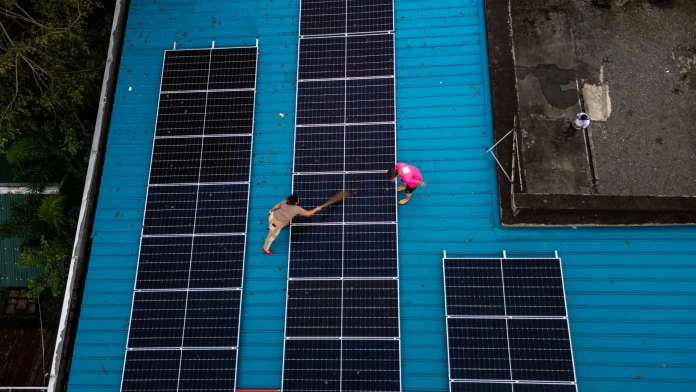
As a parallel measure, the group pushed for the rapid rollout of renewable energy solutions, particularly rooftop solar systems for vulnerable households.
“At a time of crisis, solar rooftops are an immediate and long-term reprieve for consumers,” Arances said, describing the technology as “a key and viable solution to ease costs for vulnerable communities, including off-grid and SPUG areas.”
He added that deploying 500-watt solar photovoltaic systems to at least one million households could generate an estimated ₱373.14 million in monthly electricity savings, urging the government to prioritize funding and fast-track more than 5,600 megawatts of pending solar projects.