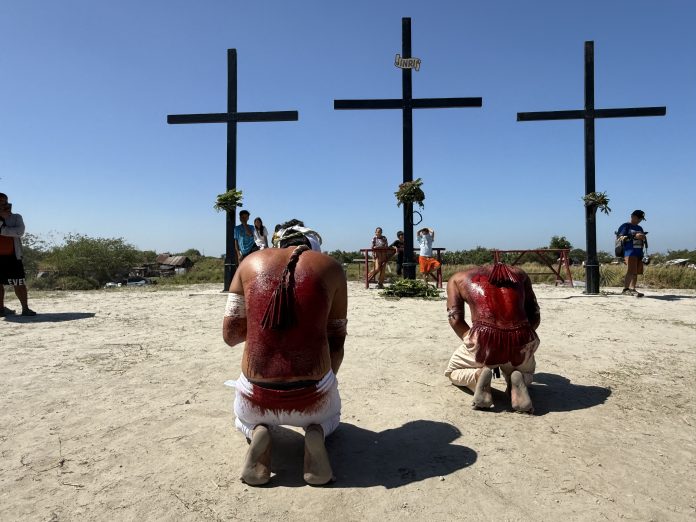
On Good Friday, the whole Christian world honors the crucifixion of Jesus. While people follow the Stations of the Cross, listen to Siete Palabras, or join the Santo Entierro processions, not everyone believes in it. We all suffer a violent world imposed on us by the powerful. The world of ritual is one thing; the world of realpolitik is another. They operate on very different logics.
On December 29, 2018, Duterte, the politician and then president, attempted to theologize about the cross.
“Paano ka maka-concentrate na ‘yung Diyos mo pinako sa cross? T*** ina ‘yan… Nakakawala ng bilib. Ako ang Diyos tapos ipako mo ako? P***** ina. Sabihin ko, ‘Lightning, ubusin mo ito. Sunugin mo lahat ng mga herejes,’” he said.
In the same year, he also said this infamous phrase about God: “Who is this stupid God? You created something perfect, and then think of an event that would tempt and destroy the quality of your work. How can you rationalize a God [like that]?”
Together with this, the pretending theologian talked about the Trinity as “silly” and Jesus as quite “unimpressive” for allowing himself to be crucified.
Duterte needs this theological misreading of the cross to support a certain type of violent politics that shows itself in the brutal and sadistic war on drugs, the denial of the rule of law, and the violation of human dignity, especially against the poor. These twisted theologies fail to take into account the reflexivity and vulnerability present in the life of Jesus and the way of the cross. These cruel and sadistic theologies can never lead to dialogue among contending viewpoints in plural societies.
Duterte’s followers amplified his positions by using Scripture quotes to justify the killing: “If your hand causes you to sin, cut your hand,” or “Let everyone be subject to the governing authorities… for there is no authority except that which God has established.”
The same logic operates in the present US-Israel war on Iran. Trump, his commanders, and their theologians exhort their soldiers that this war is “all part of God’s divine plan.” Using the Book of Revelation, this holy war, intensified to its culmination, hastens the end times and “the coming of the Messiah,” and Trump is the anointed instrument to make this happen. Hegseth, Trump’s defense secretary, called on them “to break their teeth” and kill enemies who “deserve no mercy” and be “delivered to the eternal damnation prepared for them.”
During the Jewish Passover season, Netanyahu, for his part, framed the Iran and Middle East war through the biblical imagery of the ten plagues before the Exodus. Iran has been struck with “plagues” — the destruction of its nuclear program, its missile forces, its political structures, and the annihilation of its senior leaders like the “firstborn of the Egyptians.”
Together with the strikes against Hamas, Hezbollah, the Houthis, and others, Israel is presented as on the path of liberation like the Exodus. It is now stronger than ever on its way to the Promised Land. “In every generation there have been those who sought to destroy us,” Netanyahu said, quoting the Passover poem. But he continued: “God always rescues us from their hands.”
But Jesus in the Gospels challenges the violent world with a nonviolent response. After being arrested, Jesus tells his disciples: “Peace I leave with you.” When his disciples reacted violently, Peter cut off the ear of Malchus, to which Jesus replied: “Put your sword back into its sheath.”
His disciples refused to understand the way to Calvary from the start. Peter remonstrated with him when Jesus said they were going up to Jerusalem to be crucified. The mother of John and James sought favor and power for her sons rather than a life of service. All of them fled at the moment of crisis.
Nonviolence is a difficult Christian position, but it is the only way. Because our God is a God of peace, not of war.
In the midst of war, Pope Leo XIV said in his Palm Sunday homily: “This is our God: Jesus, King of Peace, who rejects war, whom no one can use to justify war. He does not listen to the prayers of those who wage war but rejects them, saying: ‘Even though you make many prayers, I will not listen: your hands are full of blood.’”
No amount of theological justification can excuse their thirst for blood. About the leaders of the raging war, Pope Leo said: “As long as even a single child is crying beneath the rubble because of them, every ‘Amen’ they utter will be a blasphemy.”
Cardinal Pizzaballa, the Patriarch of Jerusalem, said: “Christ is not absent from Gaza. He is there — crucified in the wounded.”
Ironically, it is the victims themselves who — despite being crucified on the crosses imposed on them — teach us the way of peace and nonviolence. In my experience working with victims of extrajudicial killings, they teach me the difficult path of forgiveness.
“Sino po ang patatawarin namin na hindi naman namin alam kung sino ang pumatay. Wala rin pong humingi sa amin ng tawad. Mabuti pa si Jesus sa krus — kahit tinuya siya ng isang magnanakaw, may isa naman humingi ng tawad sa kanya. Pero kami, sino ang aming patatawarin? Wala namang umamin.”
“Kapatawaran? Siguro, turuan na lang namin ng maayos na buhay ang aming mga anak para hindi sila maghihiganti at maging mas mapayapa kahit konti ang mundong ito.”
Father Daniel Franklin Pilario, C.M., is the President of Adamson University in Manila. He is a theologian, professor, and pastor of an urban poor community on the outskirts of the Philippine capital. He is also the Vincentian Chair for Social Justice at St. John’s University in New York.