Several months after the young priest Vincent wrote his mother about the pain of his personal disasters, some opportunities for advancement appeared on the horizon.
In June 1610, Vincent signed a contract for a benefice, the Abbey of Saint Leonard de Chaumes, near the city of La Rochelle. At last, the assignment promised a regular income for someone who had been jobless for quite some time. Though not very promising financially, the honorific title to the abbey would hopefully rescue his name from shame and obscurity.
Around the same period, Vincent was also accepted as one of the chaplains of the ex-queen, Marguerite de Valois. Though still living in opulence, Marguerite stood on the margins of royal power. Beyond her life of pomp and pageantry, she gravitated toward a life of piety and religion. Vincent also worked as her almoner (aumônier), the one in charge of her charitable works. On the side, he now had the luxury of time to study, breathe the high Parisian culture, and meet famous men and women in the halls of power, no matter how marginal.
One author, Bernard Pujo, commented on this phase of Vincent’s life: “After two years of slavery and hardship, how he must have savored his new-found liberty in a world that opened itself to his insatiable curiosity!”
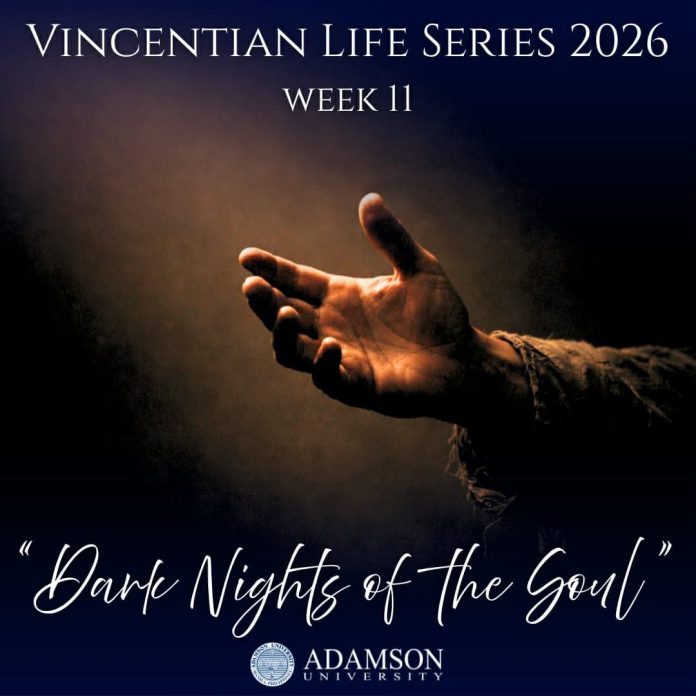
However, it was also in these halls where he suffered what the Carmelite tradition calls the “dark night of the soul.” Some spiritual writers describe it as Vincent’s “temptation against the faith.” Whatever name one gives it, Vincent endured an emotional and spiritual crisis for several years while in the palace.
Let us listen to how he described a parallel experience of one of his chaplain companions in a conference on faith he delivered to his priests.
“I once knew of a famous professor, who for a long time had defended the Catholic faith against heretics in the exercise of his role as a diocesan theologian. Since he no longer preached or catechized, he fell prey to serious temptations of faith.”
Vincent used this experience to warn against the danger of idleness both in mind and body. “Just as the fields,” he continued, “no matter how good the soil, will yield weeds and thorns if they are not cultivated, so too our souls cannot long remain at rest in idleness without feeling the passions and temptations which lead them to evil.”
The theologian was so tormented that he fell into despair and even felt suicidal, wanting to hurl himself from a window. He could no longer pray nor celebrate Mass. He was so exhausted from fighting against himself that he could no longer function well. In contemporary terms, this would be described as a serious mental health struggle.
When this temptation against faith attacked him, he was advised to point toward Rome or toward any nearby church to affirm his faith. Not long after, the theologian was freed from such misery. “God at length had mercy on this man,” Vincent recounted, “for when he fell sick, he was suddenly delivered from all his temptations and the blindfold fell from the eyes of his soul.”
After Vincent’s death, a testimony from a “trustworthy person” revealed that it was Vincent, who knew the theologian himself as part of Queen Marguerite’s household, who had taken it upon himself to help him. Vincent was the one who advised the man on what to do when those thoughts attacked him. Moreover, “Monsieur Vincent prayed earnestly that God in his goodness would deliver the sick man from this illness, and in the spirit of penance he offered to take upon himself whatever sufferings divine justice might require.”
God listened to Vincent. The theologian was cured of his illness, but Vincent’s own life fell into darkness with a suffering not far from what his theologian friend had experienced. “Three or four years passed in this severe trial which bore down upon Monsieur Vincent, and he groaned before God under its weight.”
Two things Vincent did during these dark years of trial. First, he wrote the Profession of Faith on a piece of paper and placed it in his chest pocket. Every time the temptation came, he would place his hand on his chest as a gesture of his profession of love and faith. Second, he promised to visit regularly the poor in the nearby hospital, San Juan de Dios Hospital, the exact opposite of the temptation that urged him to withdraw into misery.
“No sooner had he done this than, by a marvelous effect of grace, the suggestion of the evil one disappeared. His heart, which had been so troubled for such a long time, was suddenly freed.”
One author wrote: “Vincent’s faith was thus marked by this acute human crisis. The solution he found in the service of the poor, in the mystique of the poor. The price was three or four years of disarray and interior darkness. Afterward Vincent became a model of faith. This was forged in the crucible of suffering.”
There would still be more events that would bring Vincent de Paul closer to God and to the poor. But one incident may lead us to believe that he had already begun to change.
In October of that same year, Vincent signed a contract through which he voluntarily donated to the Hospital of Charity the sum of 15,000 livres that he had received from someone the previous day. This was not a small amount. In present purchasing power, it would be equivalent to about $265,000 to $318,000.
It is important to remember that at this time he had not yet been cleared of the robbery case previously brought against him. Though he already had a benefice in St. Leonard de Chaumes, it was beset with financial and legal troubles. He had not yet fulfilled the financial promise he had made to his mother and his family. Yet God’s hand was slowly leading Vincent from a world of personal concerns toward the world of the poor.
What we begin to see here is a different man from the one who had once sought opportunities for his own advancement.
Father Daniel Franklin Pilario, C.M., is the President of Adamson University in Manila. He is a theologian, professor, and pastor of an urban poor community on the outskirts of the Philippine capital. He is also the Vincentian Chair for Social Justice at St. John’s University in New York.