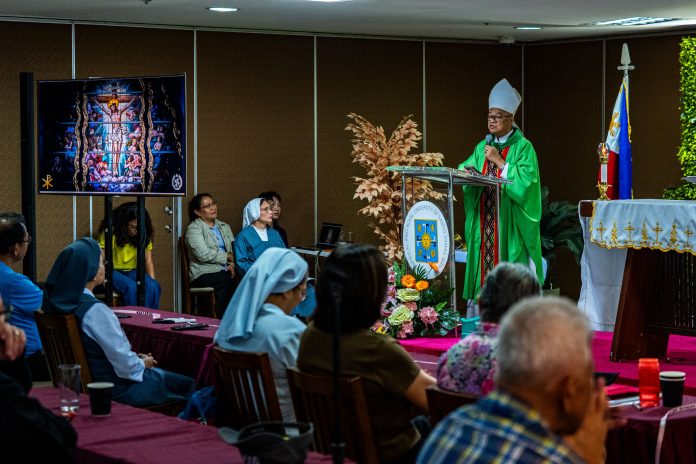
Bishop Gerardo Alminaza of San Carlos urged faith communities and social institutions to treat the Gospel as a mandate for collective action on ecological destruction, governance failures, and economic exclusion.
In his homily during the Hayuma convergence at the University of Santo Tomas on Jan. 16, Alminaza, who heads Caritas Philippines, said the gathering should not be understood as a conference but as “a collective act of faith.”
Hayuma is a faith-rooted convergence, led by Caritas Philippines, which brings the Church, civil society, labor, academe, business, and media together to translate shared faith into collective action for ecological healing, ethical governance, and a people-centered economy.
He called on different sectors to work together in confronting what he described as today’s broken social realities.
Drawing from the Gospel story of the paralytic lowered through the roof, he described Hayuma as a shared effort involving the Church, civil society, and people’s organizations, labor groups, the academe, business, and the media.
Each sector, he said, forms “a corner of the mat,” adding that “no one heals alone.”
Alminaza linked the biblical image of paralysis to present conditions, pointing to “forests stripped but unable to cry out,” “workers trapped in unjust conditions,” “communities drowned by floods yet unheard,” and “economies that move but leave many behind.”
“We are not observers,” he said. “We are carriers. We carry each other as friends… brothers and sisters.”
The bishop challenged participants to “break the roof” by crossing institutional silos and confronting structural barriers.
He said this includes “questioning unjust policies,” “opening closed conversations,” “challenging economic and political paralysis,” and “refusing to normalize ecological destruction.”
“This is not rebellion,” Alminaza said. “This is faith with courage.”
He emphasized that forgiveness in the Gospel points beyond individual morality toward systemic change. When Jesus says, “Your sins are forgiven,” Alminaza said it is a call to repentance “not only of persons, but of systems, cultures, and habits of governance and economy.”
He said Hayuma calls participants to pursue “ecological conversion,” “ethical governance,” and a “people-centered economy.”
Addressing participants as they prepared to return to their respective sectors, Alminaza said they were being sent not to remain in dialogue spaces but to act.
“Rise—with courage. Carry the mat—with responsibility. Go home—with commitment to transform your sectors,” he said.
In the Filipino portion of his homily, Alminaza underscored the communal nature of faith in the Gospel. “The Gospel did not say, ‘Jesus saw his faith.’ It said, ‘Jesus saw their faith,’” he said, stressing that healing occurred because faith was shared.
He described the world today as “paralyzed by the destruction of nature, by unjust governance, and by an economy that moves fast but leaves many behind.”
Like the friends in the Gospel, he said, healing begins “when we carry one another, when we open barriers, and when we refuse to normalize brokenness.”
Sending participants back to their communities, Alminaza reminded them that they return together. “You are not going back alone,” he said. “You are going back as carriers of one another.”
He urged participants to make their work a visible sign of hope. “May the world see, through your work, that healing is possible when faith becomes action, and hope becomes shared responsibility.”
Hayuma is a Visayan word that refers to patient, communal work. Among fisherfolk, it means carefully mending fishing nets torn by storms.