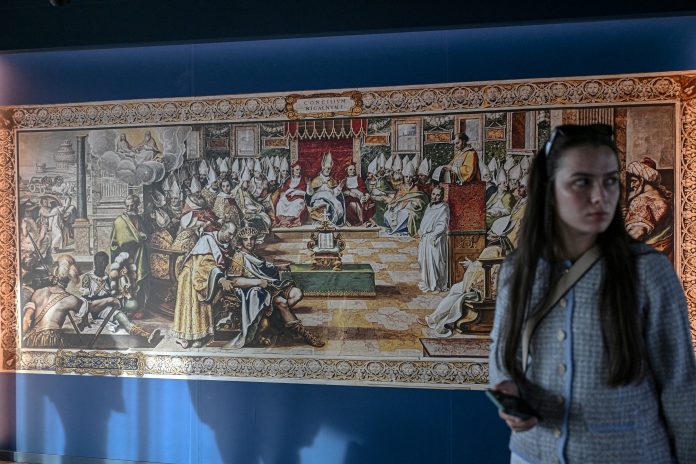
In the past few days, you must have seen Pope Leo XIV journeying to the Middle East, mainly Turkey and Lebanon. He prayed together with the patriarchs of the Greek Orthodox churches in the original place where the first ecumenical council was held in 325 AD in Nicaea, at present on the eastern shore of Lake Iznik, 90 miles southeast of Istanbul, Turkey.
1. Nicene Creed
When you go to a Sunday Mass and you recite a longer creed after the homily — longer than the Apostles’ Creed — that probably is the Nicene Creed, one that was composed 1700 years ago.
“I believe in one God,
the Father almighty,
maker of heaven and earth,
of all things visible and invisible.
“I believe in one Lord Jesus Christ,
the Only Begotten Son of God,
born of the Father before all ages.
God from God, Light from Light,
true God from true God, begotten, not made, CONSUBSTANTIAL with the Father; through him all things were made.”
The keyword here is a strange and difficult word, “consubstantial” (in Greek: homoousios, ὁμοούσιος) — the first time it was appropriated into theological language to explain who Jesus is.
Around 313 AD, when Constantine became Emperor and made Christianity a legal religion in the Roman Empire, there was a priest from Alexandria — his name was Arius — who became popular by saying that Jesus was the Son of God but was a “created being”; that there was a time when he did not exist. He was not of the same “essence” (ousios) as the Father.
If God the Father is divine, Jesus was then subordinate to the Father. This is no different from present groups who say that Jesus was only a prophet or a demi-god. This belief was called Arianism, and it gained popularity even among bishops. It politically divided the Empire. So Constantine, the new ruler, stepped in and called all the bishops of the Empire to hammer out a single faith expression: the Nicene Creed.
So now we recite, “God from God, Light from Light, true God from true God … begotten, not made … consubstantial with the Father.” This is the foundation of the doctrine of the Trinity.
2. Date of Easter and Canon Law
Beyond the divinity of Christ, the Council also established a uniform date for Easter throughout the whole Church. There was a time when Christian communities celebrated Easter at different times. But at Nicaea, the bishops decided that Easter be celebrated on a Sunday and linked to the date of the Jewish Passover.
At a later time, when Orthodox Christians based their count of the Passover on the Julian calendar and Catholics on the Gregorian calendar, Easter celebration in both churches no longer coincided (sometimes differing by one or two weeks).
This year, 2025, we celebrated on the same date — April 20, 2025 — because the two calendars aligned. Maybe the coincidence is also an invitation toward greater unity in our faith traditions.
The Council also promulgated several disciplinary canons. Some were very interesting provisions: prohibition of castration for clergy; prohibition of kneeling on Sundays and Easter time (standing remains the liturgical norm even among Orthodox churches today); prohibition of usury among the clergy; elders ordained without passing the exams were not to be recognized; prohibitions on priests and bishops going around neighboring parishes to celebrate the sacraments; and many others — some quite funny and some still relevant today.
3. Politics of faith in Nicaea
What relevance has Nicaea in our times? Why celebrate an event that happened 1700 years ago?
First, if the present Catholic Church speaks of “synodality,” this was the first ecumenical synod gathering since Christianity existed. Church leaders from different Christian faith traditions gathered — more than 300 of them — from different parts of the known world to discuss matters of the faith that united or divided them, the first since the apostles’ gathering in Jerusalem regarding the rule of circumcision. Most bishops were Eastern; but there were also some from the Middle East (Palestine, Syria), Africa (Egypt and Libya), and Asia Minor. They came with their cultural, linguistic, liturgical, and philosophical differences.
Such a tradition continues in our times. An ecumenical council holds the highest authority in Church matters, even beyond the authority of the popes. The same conciliar model is also practiced in Protestant and Orthodox churches.
Second, Nicaea tells us about the centrality of “creedal statements,” without which organizations collapse. Corporations formulate their vision–mission statements. Cultural or political groups gather to agree on common directions. Churches need to proclaim their common beliefs — adherence to them spells belonging. Nicaea formulated the Christian belief in the divinity of Jesus, which is the foundation of our Trinitarian faith. This universal statement of faith is proclaimed in all Catholic, Orthodox, Protestant, and evangelical churches. They may differ in other aspects, but not in this creedal expression.
Third, Nicaea displays the ambivalent relationship between the State and the churches. It was Constantine who financed Nicaea. He called the bishops to discuss matters of faith that ultimately affected the unity of the Empire — an obvious political motive. Schisms and heresies weakened imperial unity. Arius, who refused to honor the Creed, was excommunicated and sent to exile. His works were burned, and his supporters were considered enemies of Christianity and of the Empire. But the imposition was not permanent. Constantine later changed sides, as did many pro-Arian emperors and bishops after him — ironically under the banner of homoousios.
Nicaea is thus a paradigm of the complex, volatile, and often problematic relationship between the churches and political power — a continuing drama in our times. On one hand, political power instrumentalizes religion to lend legitimacy to its rule. On the other hand, religions wield political power to perpetuate themselves.
Fourth, Nicaea tells us that fidelity to authentic faith is preserved by the sensus fidei (sense of faith) of ordinary people. Emperor Constantine and his successors later sided with the Arians. But the orthodoxy of the laity preserved the authentic faith, as opposed to the Arianism of many bishops. St. Hilary said, “the ears of the people are holier than the hearts of the priests.”
Pope Leo XIV writes: “Mindful of the voices of the Fathers, the learned theologian, later Cardinal and now Saint and Doctor of the Church, John Henry Newman (1801–1890), investigated this dispute and came to the conclusion that the Nicene Creed had been preserved above all by the sensus fidei of the people of God” (In Unitate Fidei, 2025).
Father Daniel Franklin Pilario, C.M., is the President of Adamson University in Manila. He is a theologian, professor, and pastor of an urban poor community on the outskirts of the Philippine capital. He is also the Vincentian Chair for Social Justice at St. John’s University in New York.