
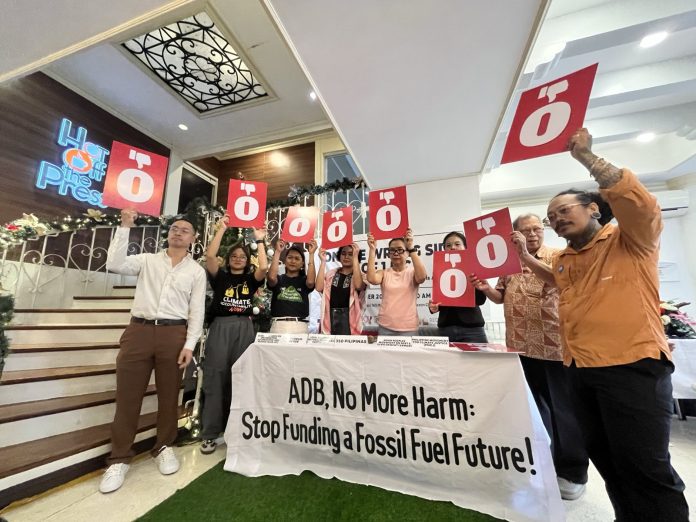
Civil society organizations renewed their call for the Asian Development Bank to halt its support for waste-to-energy incineration, arguing that the policy continues to back technologies that endanger communities rather than advance real climate action.
At a press briefing in Quezon City on the ADB Climate Scorecard, the Global Alliance for Incinerator Alternatives Asia Pacific (GAIA) and partner groups said the Bank remains the region’s biggest financier of incineration.
GAIA’s monitoring shows that since the Paris Agreement in 2015, ADB has funded 49 projects with incineration or co-incineration components amounting to USD 15.3 billion.
Data from the Climate Policy Initiative also indicate that more than 94 percent of climate finance for methane abatement in the waste sector still goes to incineration, despite mounting evidence of its environmental risks.
GAIA warned that money meant for climate mitigation is being funneled into methods that heighten pollution and burden local governments with high operating costs.
Brex Arevalo, Climate and Anti-Incineration Campaigner of GAIA Asia Pacific, said, “Incinerators remain polluters no matter the technology. While incineration reduces waste volume, the remaining ash, wastewater, and emissions are hazardous and must still be disposed of in landfills.”
He argued that incineration does not remove the need for dumpsites, noting that it produces hazardous ash, wastewater, and emissions that still require disposal.
He added that waste-to-energy remains a costly and inefficient technology and can be even more polluting than coal for the amount of energy it generates.
Communities across the region have raised similar concerns. In the Maldives, residents are facing what they say is a costly and risky project in a country already struggling with debt.
Afrah Ismail of Zero Waste Maldives noted, “ADB has backed waste-to-energy incineration through loans and grants for a major WtE plant in the Maldives, a climate-vulnerable archipelago whose public debt now exceeds 120% of GDP and which international financial institutions classify as being at high risk of debt distress.”
In South Asia, watchdog groups highlighted repeated failures of incinerators supported by government plans.
Chythenyen Kulasekaran of the Centre for Financial Accountability said, “The ADB should not be funding waste-to-energy incineration, which has a massive track record of failure across South Asia. All 21 waste-to-energy plants in India are highly polluting and do not comply with the environmental policy standards, as reported by the government itself.”
GAIA and its partners urged ADB to stop financing waste-to-energy incineration, chemical recycling, refuse-derived fuel, and all forms of co-incineration, calling instead for investments in proven zero-waste systems.
Mageswari Sangaralingam of the Consumers’ Association of Penang said, “By prioritising waste-to-energy incineration and critical minerals mining, the ADB’s Energy Policy thrusts clearly go against the tenets of circular economics and a real clean and just energy transition.”
From Indonesia, Wahyu Eka Setyawan of WALHI Jawa Timur added that national experience should guide stronger caution.
“(ADB) has significantly pushed waste-to-energy (WtE) incineration in Indonesia through policy influence and financing, yet evidence shows these projects harm communities and the environment. We urge the ADB to change course, as WTE incineration is not, and should not be, part of any country’s development and waste management plans,” said Setyawan.