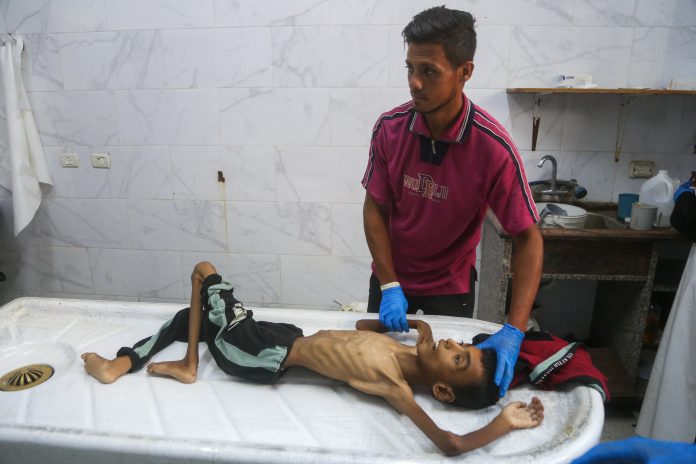
The world lacks strong, outspoken leaders willing to hold the Israeli government accountable for what its forces are doing in Gaza: killing Palestinian civilians through violence and starvation — an act many have condemned as genocide.
As many as 111 humanitarian organizations around the world have denounced Israel’s denial of adequate food, medicine, and humanitarian aid to Gazans. In a joint statement, these agencies “denounced the Israeli government’s ‘siege’ of Gaza and urged governments to act to open all land crossings; restore the flow of food, water, medicine, shelter items, and fuel into Gaza through a principled UN-led mechanism; end the siege; and agree to an immediate ceasefire.”
They highlighted the near-daily massacres of Palestinians at food distribution sites and cited UN data showing 875 people killed while seeking food and thousands more injured. “The starvation of civilians is a war crime,” the organizations declared.
The Integrated Food Security Phase Classification, a global hunger monitoring system, confirmed that the “worst-case scenario of famine” is now unfolding in Gaza. “Latest data indicates that famine thresholds have been reached for food consumption,” it said. “Under this international outcry and pressure, the Israeli government is allowing a trickle of aid to enter the Gaza Strip. It is far from what is needed to stop an impending famine. This is genocide by starvation; many UN officials have denounced it.”
Israeli voices of dissent are also growing. Israeli-Palestinian human rights group B’Tselem recently released a report titled “Our Genocide,” declaring that Israel is committing genocide in Gaza. The report stated: “An examination of Israel’s policy in the Gaza Strip and its horrific outcomes, together with statements by senior Israeli politicians and military commanders about the goals of the attack, leads to the unequivocal conclusion that Israel is taking coordinated action to intentionally destroy Palestinian society in the Gaza Strip. In other words, Israel is committing genocide against Palestinians in the Gaza Strip.”
Meanwhile, Hamas — whose attacks on southern Israel on Oct. 7, 2023, triggered the war — remains undefeated and continues to hold around 20 hostages as leverage in ceasefire talks. Several nations have called on Hamas to disarm and release the hostages.
Crimes worsening
Israeli armed forces and private mercenaries have been shooting civilians scrambling for limited food rations at distribution sites, killing and wounding them as if these areas were shooting galleries — Israel’s version of killing fields.
These war crimes worsen by the day. Yet, compassion and solidarity from developed nations remain scarce for the more than 2 million civilians in Gaza. There is talk, but no decisive action to end the suffering.
In a rare acknowledgment, US President Donald Trump urged Israel to allow “every ounce of food” into Gaza, admitting for the first time that “real starvation” was occurring. “We can save a lot of people, I mean, some of those kids,” Trump said. “That’s real starvation; I see it and you can’t fake that. So, we’re going to be even more involved.” But Israeli Prime Minister Benjamin Netanyahu dismissed the claim, calling it a “bald-faced lie.”
Whether Trump’s words translate into action remains to be seen. Will he halt the flow of bombs and weapons to Israel and force it to allow the UN to resume food distribution? The European Union and other nations remain hesitant to challenge Israel, fearing US retaliation in the form of tariffs.
Call for action
Governments and ordinary people must act. Boycotting Israeli products and blocking the flow of weapons and goods to the country are urgent steps. The EU grants Israel preferential trade status through agreements such as the European Neighborhood Policy, the Euro-Mediterranean Partnership, and the Union for the Mediterranean. These privileges should be revoked if Europe is to stand on moral ground.
The EU is Israel’s largest trading partner. In 2013, bilateral trade reached €27 billion, with 32 percent of Israeli exports going to the EU and 34 percent of imports coming from it. China follows with a 17.7 percent trade share worth $14.7 billion, the US with 12 percent worth $8.45 billion, and Germany with 6.28 percent worth $5.22 billion.
Momentum for Palestinian statehood is also growing. French President Emmanuel Macron announced his support for recognizing Palestine at the UN General Assembly in September. British Prime Minister Keir Starmer, along with Canada, Australia, and New Zealand, made similar pledges.
Currently, 147 of the UN’s 193 member states — roughly 75 percent — recognize Palestine, which has held nonmember UN state status since November 2012. These efforts bolster the push for a two-state solution, which Netanyahu’s government continues to reject.
After a three-day UN conference on reviving the two-state solution, participating states declared: “We reiterate our unwavering commitment to the vision of the two-state solution where two democratic states, Israel and Palestine, live side by side in peace within secure and recognized borders.” They also emphasized the “importance of unifying the Gaza Strip with the West Bank under the Palestinian Authority.”
Note: Any original information, stories, or news articles posted on this site that are authored by the Preda Foundation and Father Shay Cullen may be shared, copied, or reproduced without further permission, in support of truth, freedom of expression, and the public’s right to know.
LiCAS News was granted permission to republish and adapt this article by Father Shay Cullen in the spirit of truth-telling and the pursuit of justice.
Irish missionary Father Shay Cullen, SSC, founded the Preda Foundation in Olongapo City in 1974 to promote human rights and the rights of children, especially victims of sexual abuse.
The views expressed in this article are those of the author and do not necessarily reflect the editorial stance of LiCAS News.