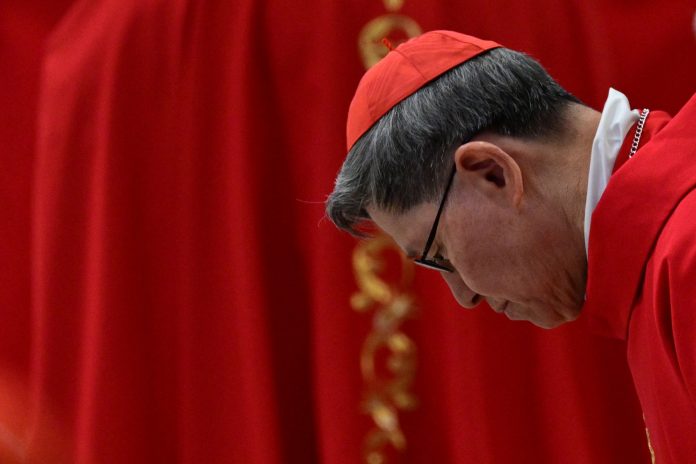
The dean of the College of Cardinals has recalled decades of discrimination against Chinese clergy within the Catholic Church, stressing the need for forgiveness and healing from past divisions and injustices.
Cardinal Luis Antonio Tagle said resistance to the appointment of Chinese bishops had persisted for decades before Pope Pius XI consecrated the first six Chinese bishops in modern times in 1926.
“Before that moment, and for many decades, there had been resistance, hostility and even acts of sabotage, including within the Church itself, on the part of those who, for various reasons, opposed the episcopal ordination of Chinese Bishops or regarded it as ‘premature’,” said Tagle.
The Filipino cardinal made the remarks Nov. 5 at the Pontifical Urbaniana University in Rome during an international conference marking the centenary of the consecrations, according to Fides News Agency.
Tagle, who also serves as pro-prefect of the Dicastery for Evangelization, said Chinese priests had faced unequal treatment within the Church.
“In everyday life, there were those who continued to treat Chinese priests as ‘second-class clergy’, in some cases subjecting them to outright discrimination,” he said.
He said such treatment failed to recognize the universal nature of the Church and confined Catholicism to a single culture and civilization.
The prelate described the 1926 consecrations as a milestone in the Church’s efforts to develop local leadership and distance missionary activities from Western colonial interests.
He said the Holy See had long recognized that the relationship between missionary work and the colonial strategies of Western powers had harmed the Church’s mission.
The appointment of bishops from local communities, he said, was not simply a response to changing political circumstances but reflected the Church’s universal character.
Reflecting on the divisions that had marked the Church’s history, Tagle acknowledged the failures of Church members and the suffering they had caused.
“The Church’s journey is marked by human frailty, external pressures, mistakes and old and new forms of clericalism. It is marked by compromises and falls. Yet there is always the possibility of a new beginning, of receiving forgiveness, and, through merciful forgiveness, of experiencing the pain for our own sins and betrayals,” he said.
Tagle said forgiveness remained essential to healing wounds within the Church.
“This experience of freely giving and receiving forgiveness can heal wounds even today. It can strengthen hearts and bring them joy amid the hardships and obstacles encountered along the way,” he said.
The cardinal said the Catholic Church in China could fully express its Chinese identity while maintaining communion with Rome and the wider Church.
He cited Pope Leo XIV’s message to the conference, which emphasized that unity within the Church did not require uniformity.
Tagle welcomed the growing participation of Chinese bishops in international Church gatherings, describing such encounters as opportunities to build trust and strengthen relationships.
“What until a few years ago could not take place is now becoming increasingly common: Chinese Bishops are participating in Synods, in meetings convened by the Pope, and also in conferences organized by our Dicastery,” he said.
He said the Church in China had gifts to share with Catholic communities worldwide and urged a move away from missionary relationships that treat some churches only as providers of assistance and others as recipients.