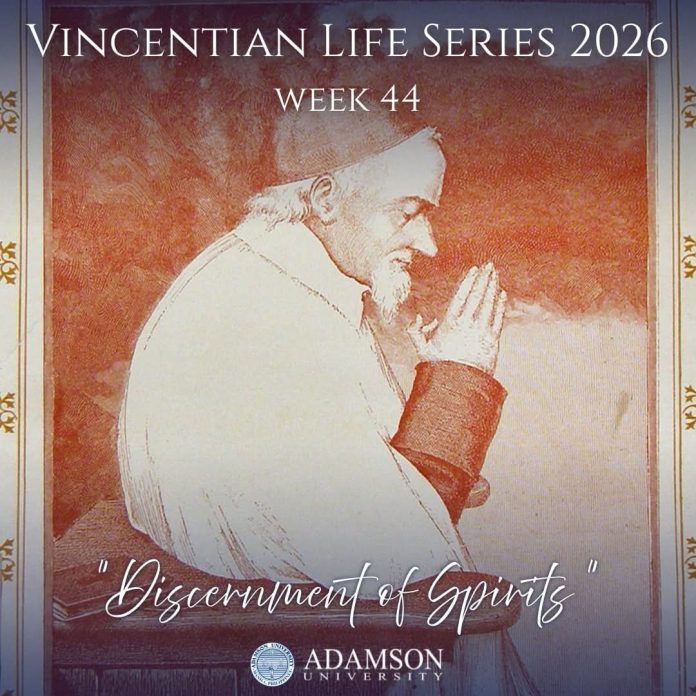
“Discernment of spirits” is the term that St. Ignatius of Loyola used to describe the formal discernment process. It is looking into the inner movements of our being — our thoughts, feelings and desires — in order to know where they come from and where they are leading us. In short, it is keeping in touch with our thinking and feeling because it is in these inner dictates of our “spirit” that God is speaking to us. God speaks to us through the stirrings of the Spirit in us.
To simplify, I am going to mention from the start the three steps of the Ignatian process of discernment.
1. The first step is awareness or consciousness of what I am going through at present. What thoughts are going on in my mind? Or what am I feeling inside my heart now?
2. The second step is interpretation. Where do these thoughts and emotions come from? Are they from natural causes like fatigue, stress or physical pain? Or from the “good spirit” that leads to joy, freedom and care? Or from the “bad spirit” that leads to division, anger or fear?
3. The third step is action. What does God want me to do now? Where do these thoughts and feelings lead me?
Using the categories of St. Ignatius — the founder of the Jesuits, to whom St. Vincent owed a great deal — the discernment of feelings is called the “second time,” while the discernment of thoughts and the mind is the “third time.”
In this article, we will first reflect on the third time.
There are moments in our lives when we feel unmoved by “motions of the heart.” There are no feelings that serve as the subject matter for our discernment. Like St. Ignatius, St. Vincent says that God’s will is also revealed in our reflection and analysis.
Ignatius of Loyola explains: “This (third time) is a time of tranquility… I said it is a time of tranquility, that is, a time when the soul is not agitated by different spirits and has free and peaceful use of its natural powers.”
In moments of dryness, in the absence of feelings, we can surmise God’s will through what appears reasonable to us.
God gives us intelligence to understand the world, other people, our surroundings and the movements of our lives. It would be an insult to God’s creation if he involved us in a guessing game. God is not a capricious God who acts according to his own whims.
God made our minds capable of understanding his own designs. Our understanding may be limited and, at this present moment, may not yet reach the entire width and depth of God’s ways.
God does not even expect us to be always “objectively right.” It is enough that we are honest with ourselves and honest about our best understanding of his will in each particular circumstance.
When God really wants something for us, he will make it clear to our minds and understanding in God’s own good time. God will not make us guess but will tell it to us in his own gentle ways.
We can cite one case, for example, from the Scriptures: the case of Job.
“Job is suffering because he has sinned.” This is what his friends — representatives of Jewish thought at that time — told him. They wanted him to repent because Yahweh was displeased with him.
But in all honesty, Job could not reproach himself. There was nothing in his life that he consciously knew might have displeased the Lord. God could not be so arbitrary and capricious as to make him suffer for something that he did not know. In all honesty, how could he do penance for something that he had not committed at all or at least for something of which he was not consciously guilty?
And Job was right. If he really had done something grave, the Lord himself would clarify it to him in his own time. But until such time, all he needed to do was to trust God and not bother himself with imaginary problems, unfounded guilt and baseless anxieties.
Such thinking is also present in many good and committed Christians even today. Many have not stopped asking themselves, “Where have I gone wrong? What sin have I committed to deserve such great misery? What does God really want me to do?”
People today call this “overthinking.” Many people across generations overthink.
It is good if these questions are part of healthy self-confrontation. For many, it has become an obsessive preoccupation that disturbs their entire lives to the point of not being able to fulfill their own responsibilities.
In such circumstances, all we can say is this: “Lord, show me what you really want. Make it clear to the best understanding of my mind in this present situation. You don’t want me to play a guessing game with you, right? If in all my honesty and capacity, this is what I understand as your will for me at this stage in my life, then let it be so. If you will otherwise, you will make it clear to me in your own time.”
To summarize, what St. Vincent is saying in this Rule is that God can also reveal himself and his will for us through our intellect, our minds, our understanding and our honest assessment of our situation.
“To do a thing which is reasonable is to do the Will of God,” St. Vincent says. However, at the end of his explanation of this part of the Rule, St. Vincent continues:
“This (doing what is reasonable) is, however, always to be understood with a grain of salt of Christian prudence, and with the counsel of those who direct us, because it may happen that what we are about to do may be essentially reasonable. But in its present circumstances of time, place and manner, it is not what is called for us to do, thus, in that case, it should not be done.”
In short, St. Vincent is open to questioning his own thoughts and opinions. In sociology, we call this “self-reflexivity.” In Christian theology, we call this “humility” — our willingness to be put into question. It is an acknowledgment that our limited selves do not have the last word. The last word belongs only to God. For our thoughts are not God’s thoughts; our ways are not God’s ways (Isaiah 55:8).
In the whole discernment process, pride is our number one enemy, and humility is our greatest companion. The devil always deceives us with ourselves, as he intends to blur God’s will from us. Humility is the devil’s greatest weakness, for pride is his only game.
“The most powerful weapon to conquer the devil is humility,” St. Vincent says. “For as he does not know at all how to employ it, neither does he know how to defend himself from it.”
Father Daniel Franklin Pilario, C.M., is the President of Adamson University in Manila. He is a theologian, professor, and pastor of an urban poor community on the outskirts of the Philippine capital. He is also the Vincentian Chair for Social Justice at St. John’s University in New York.