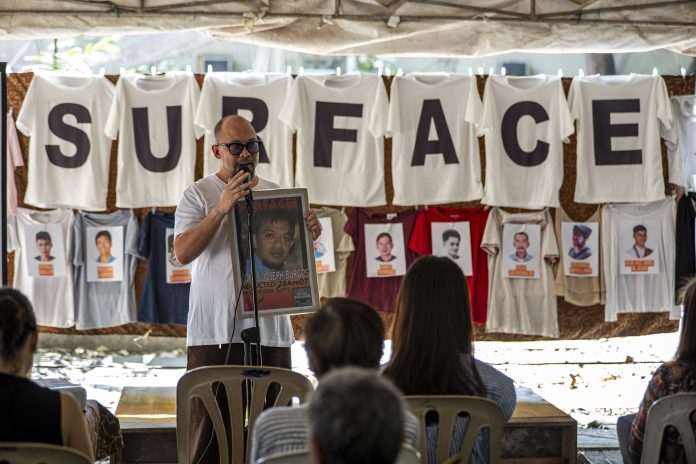
While most Filipinos flock to cemeteries to fondly relive the memories of their dearly departed on Undas (All Saints’ Day and All Souls’ Day), families of desaparecidos remain in suspension, carrying a unique kind of grief.
“Desaparecidos” is the Spanish and Portuguese word for “disappeared people” or victims of forced disappearance.
The United Nations Commission on Human Rights defined desaparecidos with three elements: (a) deprivation of liberty against the will of a person; (b) involvement of government officials, at least by acquiescence; and (c) refusal to acknowledge the deprivation of liberty or concealment of the fate or whereabouts of the disappeared person.
Desaparecidos are “neither dead nor alive” in a physical sense, leaving families with no body to bury or a specific cemetery, grave or known resting place to visit.
Since relatives cannot participate in the traditional cleaning and visiting of cemetery plots, they often gather at designated monuments and shrines across Metro Manila to offer flowers, light candles, and hold memorial services.
Bantayog ng mga Desaparecido (Flame of Courage Monument) is located on the grounds of the Baclaran Church (National Shrine of Our Mother of Perpetual Help) along Roxas Boulevard.
It depicts a woman carrying a torch and a child holding a picture of his missing father. There are plates around it with the names of more than 1,300 people who were forcibly disappeared during said military regime.
The Bantayog ng mga Bayani is a landscaped memorial center located in Quezon City honoring those individuals who lived and died in defiance of the repressive regime that ruled over the Philippines from 1972 to 1986.
A 14-meter Inang Bayan (Mother Philippines) Monument stands on the grounds of the memorial center, depicting the self-sacrifice of a fallen figure of a man, held in one hand by the rising figure of a woman who symbolizes the Motherland, while her other hand reaches for the glorious sun of freedom.
In the distance stands a Wall of Remembrance, where the names of martyrs are inscribed.
They also converge at Liwasang Bonifacio in Manila, where flowers are offered at the foot of the monument of Andres Bonifacio, whose remains have not yet been conclusively found.
The United Nations International Convention for the Protection of All Persons from Enforced Disappearance states that, when committed as part of a widespread or systematic attack directed at any civilian population, a “forced disappearance” qualifies as a crime against humanity. It gives victims’ families the right to seek reparations and to demand the truth about the disappearance of their loved ones.
The UN said that enforced disappearance has frequently been used as a strategy to spread terror within society.
The convention explicitly states there is no situation or circumstance that justifies the forced disappearance of a person.
It entered into force on December 23, 2010, and has been ratified by 58 countries so far. The Philippines has not yet ratified the convention.
The “International Day of the Victims of Enforced Disappearances,” or “Desaparecidos Day,” is observed annually on August 30 since 2011.
Under Republic Act 10353, or the Anti-Enforced or Involuntary Disappearance Act of 2012, an enforced involuntary disappearance does not only refer to the deprivation of liberty of a person by a state agent or upon state approval. What is also crucial is that there is a conscious effort to conceal information about the victim’s whereabouts.
Data from the human rights groups Karapatan and FIND indicated that more than 1,900 victims of enforced disappearance have been documented in the Philippines since the regime of the late dictator Marcos Sr.
There are 950 to 1,000 recorded desaparecidos during the Marcos Sr. administration, 206 cases during the Arroyo administration, 29 during the Aquino administration, 20 during the Duterte administration, and 17 under the Marcos Jr. administration.
The victims were usually activists, farmers, and those involved in the labor union struggle, among others, people regarded as “political dissenters.” Some are students or alumni of the University of the Philippines.
Families of victims and advocates are also urging the Philippine government to “ratify or directly accede” to the said UN convention on desaparecidos.
Peasant activist Jonas Burgos is one of the 206 desaparecidos under the Arroyo administration.
The film “Alipato at Muog” on Jonas’ involuntary disappearance won the FAMAS best picture award, along with the best director award for Jonas’ brother, JL Burgos.
The film received the Special Jury Award during the 2024 Cinemalaya Independent Film Festival “for its effective use of the resources of documentary cinema to shed light on an actual case of enforced disappearance and reveal dark truths about human rights in the Philippines.”
Peyups is the moniker of the University of the Philippines. Atty. Dennis R. Gorecho heads the Seafarers’ Division of the Sapalo Velez Bundang Bulilan Law Offices. For comments, email [email protected], or call 0908-8665786.