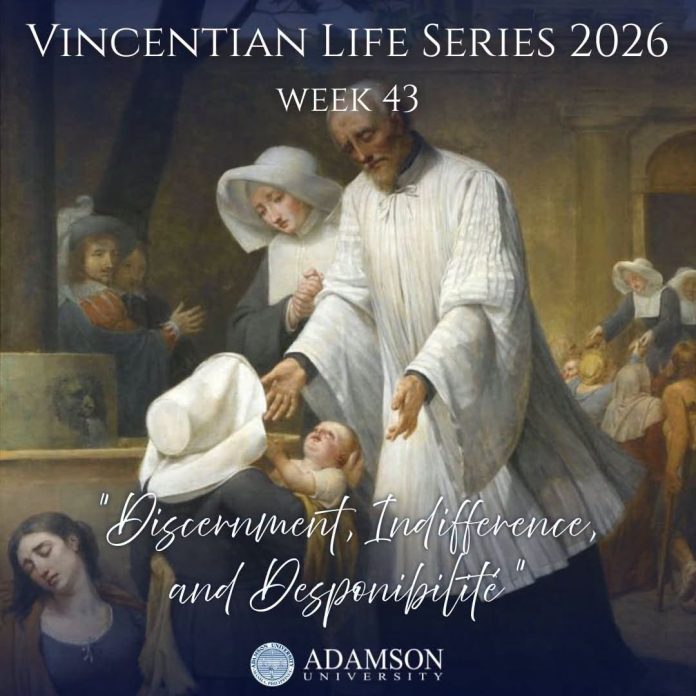
The second and the third moments of Vincentian discernment are more or less in the same category — under the virtue of “indifference” (or disinterestedness) and availability (disponibilité in French).
“When there is choice open to us in matters neither ordered nor forbidden,” St. Vincent writes, “we should choose the less palatable rather than the more pleasing. This does not apply, of course, if the more pleasing things, being in some sense necessary, have to be chosen. Still, though, in such cases our motivation ought not to be that we like them, but simply that they are more pleasing to God.”
In the history of Christian spirituality, this points to the virtue of “indifference.”
Indifference has both negative and positive senses. On the one hand, indifference points to the sin of apathy, lukewarmness or lack of zeal. It is connected with boredom, cynicism, indifferentism and spiritual “sloth” or laziness. In present language, it is related to the situation of burnout.
On the other hand, indifference is a positive virtue. It refers to a state of inner freedom and detachment. St. Ignatius talks about “complete indifference with regard to all created things” — health or sickness, poverty or wealth, honor or humiliation. These things are not important. One must be open to what God truly wants. We must be open only to what leads to God’s glory and praise, and we are “indifferent” to how the path unfolds.
St. Vincent continues: “When faced with a choice between things neither ordered nor forbidden there is no real element of personal preference between the options available, then any one of them may be chosen at random as coming from God’s providence.”
In the Vincentian tradition, we have a saying which we constantly repeat among ourselves: “Ask nothing, refuse nothing.” The phrase does not refer to food; it refers to our ministry and apostolic assignments.
I will never forget what our old Spanish novice director, Fr. Jesus Martinez, said in one of his sessions with us: “When you get a new assignment, you should be able to pack up your things in one hour and go. That is obedience and availability. That is openness to God’s will.”
In Christian spirituality, availability or “disponibilité” means total spiritual openness and readiness to be of service to God and the needs of others. This is the total opposite of someone who is consumed by self-interest, one’s plans, one’s anxieties, or preoccupation with one’s name or position.
Pope Francis has one word to describe this attitude — “self-referentiality.” One who is self-referential is self-absorbed. He or she is not open to serve God and others. His or her main life concern is mainly the self. In everyday language, “selfish.” And if he/she seemingly does things for others, s/he is ultimately doing it for oneself.
“Disponibilité” or availability is the total opposite. The main direction of one’s being is the other, not the self. This is the stance of the Good Samaritan as against the priest or the Levite. There was no pressure for the Samaritan to help. But he placed his life on the line, took care of the man, and promised to come back to pay.
This is also the same stance with Moses or Isaiah as against Jonah, or Mary as against Zechariah, and many others in the Bible. They placed their lives on the line despite their flaws and frailties — Moses had a speech impediment; Isaiah had “unclean lips”; Mary “had no relations with a man.” Yet in the spirit of total availability, they said: “Yes, Lord. Here I am. Send me.”
St. Vincent wrote: “When something unexpected happens to us in body or mind, good or bad, we are to accept it without fuss as from God’s loving hand. Our motive for putting the above three principles into practice is that they are God’s will. It is in this way that we can imitate Christ, the Lord. Christ always lived by these principles, and for that very motive. He tells us this himself: I always do what pleases the Father.”
It is the same attitude we should have towards “unexpected things and events.” St. Vincent talks about active and passive dimensions of God’s will. “It is active when we carry it out by observing His precepts, and doing what is pleasing to Him. And it is passive when we allow him to accomplish His Will in us by himself, without our action.”
When discernment is looked at as “the meeting point of prayer and action,” a search for what God wants us to do at specific moments of our lives, this part of the rule does not seemingly refer to discernment directly. It says that all we have to do is accept and submit that all these things come from the hand of God. But when we give it a second look, it reveals something deeper. It is true that there are “unexpected events” in our lives that really come from Him and have to be accepted as they are. We can say nothing but utter in submission: “Thy will be done.”
If I look back, these things really do happen — sickness in the family, death of a loved one, pain in our lives. Despite all the care we exerted, these events come unexpectedly.
But passive acceptance is not our only recourse because many of these so-called unexpected events are also caused by human greed, selfishness, and weakness.
Many ecological disasters like floods or typhoons are not natural but also human. Thus, doing the will of God also means working for the protection of our common home, protesting against development aggression and fighting against the dominant technocratic mentality that causes ecological destruction.
We do not just accept these disasters as they are. They call us to action. And to determine which event to accept and which to protest against is precisely the subject matter for further personal and communal discernment.
Father Daniel Franklin Pilario, C.M., is the President of Adamson University in Manila. He is a theologian, professor, and pastor of an urban poor community on the outskirts of the Philippine capital. He is also the Vincentian Chair for Social Justice at St. John’s University in New York.