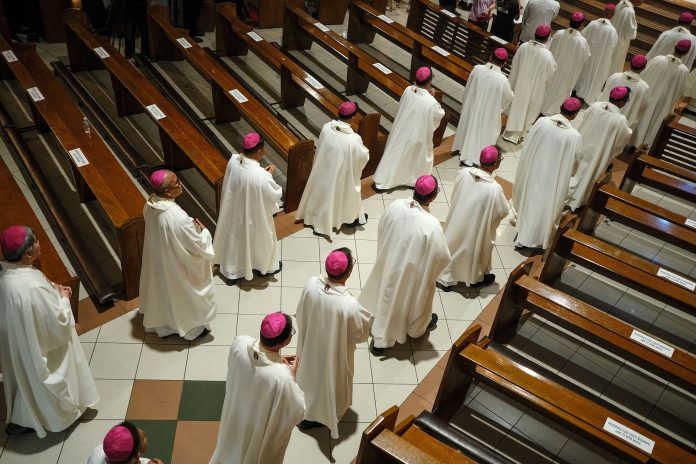
Catholic bishops in the Philippines backed a people’s initiative seeking an anti-political dynasty law and urged dioceses, parishes, Catholic schools and other Church institutions to help Filipinos understand and participate in the campaign.
The Catholic Bishops’ Conference of the Philippines (CBCP) said in a pastoral statement dated Sept. 25 that it welcomed and supported the Dapat Isa Lang People’s Initiative as “a peaceful, lawful, and democratic effort by citizens to move our nation toward the fulfillment of this long-delayed constitutional duty.”
The bishops called on dioceses, parishes, Catholic schools and universities, religious communities, lay organizations and people of goodwill to support the initiative and help explain its purpose and provisions.
Church institutions were encouraged to provide opportunities for respectful dialogue, promote “truthful and responsible information” and, where appropriate, assist efforts that enable people to participate in the constitutional initiative.
The CBCP said the 1987 Constitution mandates the state to guarantee equal access to opportunities for public service and prohibit political dynasties as defined by law, but the provision has remained unfulfilled for nearly four decades.
While acknowledging that many members of political families have served with integrity and dedication, the bishops said the concern was not the competence of individual politicians or families.
Instead, they pointed to “a system that allows political power to concentrate and be repeatedly passed among members of the same families,” which they said narrows opportunities for other qualified citizens, weakens political competition and makes accountability more difficult.
“No family, however capable or respected, has a permanent claim to public office,” the CBCP said, adding that political leadership should remain open to Filipinos who possess “the competence, integrity, and desire to serve.”
The bishops described political dynasties as “a moral and ethical concern,” warning that the common good suffers when public authority is treated as private privilege and political opportunities are effectively reserved for a few.
Concentrated political power, they said, also leaves institutions responsible for accountability vulnerable to “patronage, favoritism, and particular interests.”
The CBCP called for “a genuine, meaningful, and effective Anti-Political Dynasty Law” that would give effect to the constitutional mandate.
At the same time, the bishops stressed that their support was not aimed at specific political figures or groups.
“Our support is not directed against any particular family, political party, candidate, or public official,” the statement said, cautioning that the initiative should not become “an occasion for hatred, retaliation, or partisan division.”
The bishops said the campaign should instead raise the question of how public service can become more accessible to Filipinos and how political authority can remain “service rather than possession.”
Lay Catholics were also urged to participate responsibly in the democratic process by studying the proposal and asking difficult questions.
The CBCP called on them to “resist misinformation, coercion, vote-buying, intimidation, and political pressure,” while those whose conscience leads them to support the initiative should do so “freely, peacefully, and responsibly.”
Political reform, the bishops said, was not simply about changing laws but also about renewing an understanding of “authority as service, office as trust, and politics as a vocation for the common good.”
“Our country needs strong families. But we also need strong democratic institutions,” the CBCP said, warning that the strength of political families should enrich the nation rather than restrict the participation of others.
The pastoral statement, titled “A Time to Open the Doors of Public Service,” was signed by Archbishop Gilbert A. Garcera of Lipa, president of the CBCP.
After almost 40 years, the bishops said, the constitutional command against political dynasties “should no longer remain merely an aspiration.”
“The time has come to give it genuine meaning in law and in political life.”