International and local rights groups said the Philippines’ unsuccessful bid for a seat on the United Nations Security Council reflects growing international concern over alleged human rights violations under President Ferdinand Marcos Jr.
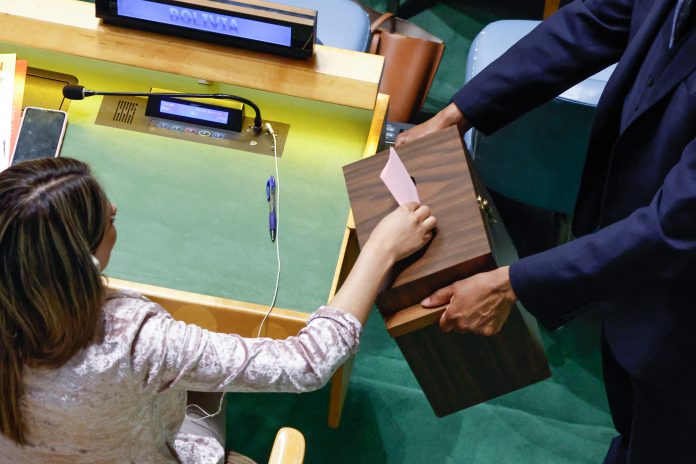
The International Coalition for Human Rights in the Philippines (ICHRP) welcomed the outcome of the June 3 vote at the United Nations General Assembly, where Kyrgyzstan defeated the Philippines for the lone Asia-Pacific seat on the council for the 2027-2028 term.
Kyrgyzstan secured 142 votes in the fourth round of balloting, while the Philippines received 49. Manila needed 128 votes, or a two-thirds majority of member states present and voting, to win the seat.
“When the Philippine bid was launched in December 2023, the Philippine Ambassador to the UN claimed that his government was a ‘partner, pathfinder and peacemaker’, but the UN General Assembly should know now that President Marcos Jr’s government is at war with its civilians, at war with the Duterte family, and drowning in corruption scandals,” said Peter Murphy, chairperson of ICHRP.
Murphy said the result reflected the administration’s failure to overcome concerns surrounding its international reputation.
“The loss of this bid shows the failure of Marcos Jr to sanitize his family’s bad reputation as well as that of his own administration. This poor reputation follows the notoriety of his predecessor, Rodrigo Duterte, now committed to trial for the crime against humanity of murder at the International Criminal Court (ICC),” he said.
The Philippine government, however, said it respects the decision of UN member states and remains committed to advancing peace and international cooperation.
“We thank the international community for the support and goodwill extended to the Philippines throughout our candidacy,” Foreign Affairs Secretary Ma. Theresa Lazaro said after the vote.
“Our campaign was anchored on our longstanding commitment to peace, dialogue, international law, and cooperation among nations. These remain principles that the Philippines will continue to uphold and advance in the global community,” she added.
Lazaro said the Philippines would continue working with other nations in pursuit of peace, stability, sustainable development, and a rules-based international order.
The Council for People’s Development and Governance (CPDG) also opposed the Philippine bid, citing what it described as continuing human rights violations under the Marcos administration.
“The Council for People’s Development and Governance oppose granting the Philippine government a seat at the UN Security Council as this will legitimize the ongoing impunity on grave human rights violations,” the group said in a June 3 statement.
CPDG spokesperson Liza Maza said the country’s human rights situation should have weighed heavily against its candidacy.
“The cases of extrajudicial killings, attacks on activists, red-tagging and militarization campaigns in the rural areas reflect a continuing dismal human rights record under President Marcos Jr. This is magnified by a climate of impunity, where perpetrators of violations are rarely held to account and victims are denied justice,” Maza said.
“Granting the Philippines a seat in the UN Security Council will only legitimize these ongoing abuses and convey the wrong signal to the global community—that grave human rights violations can be disregarded without consequences,” she added.
ICHRP also pointed to the April 19 military operation in Toboso, Negros Occidental, in which 19 people were killed.
“ICHRP is particularly angered by the massacre of 19 Filipino people by the Armed Forces of the Philippines at Toboso, Negros Occidental, on April 19 this year. Nine of those killed were civilians,” Murphy said.
“Evidence from independent missions and autopsies reveals disturbing instances of body mishandling and violations of the laws of war, where victims were left to bleed to death. We commend the international community for refusing to reward gross violations of International Humanitarian Law like this,” he added.
Citing data from the human rights alliance Karapatan, ICHRP said there had been 135 cases of extrajudicial killings, 16 enforced disappearances, 826 arbitrary arrests, and 699 political prisoners from the start of the Marcos administration through December 2025.
Murphy also criticized the government’s foreign policy and military cooperation with the United States and its allies.
“Marcos Jr is the opposite of a peacemaker, and he is a pathfinder to disaster for his country and the region,” he said.
The Security Council consists of 15 members, including five permanent members — China, France, Russia, the United Kingdom, and the United States — and 10 non-permanent members elected to two-year terms.
The General Assembly held four rounds of voting before Kyrgyzstan secured the Asia-Pacific seat with 142 votes to the Philippines’ 49. Austria, Portugal, Trinidad and Tobago, and Zimbabwe were also elected to serve on the council beginning in 2027.