
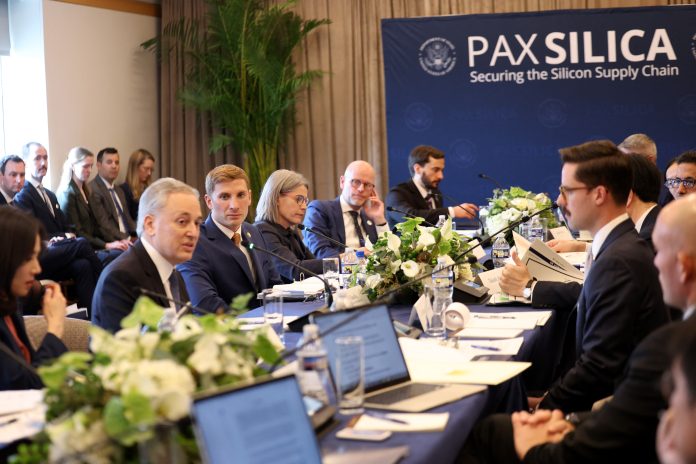
Philippine labor and activist groups have warned that the US-backed “Pax Silica” initiative could turn the country into a strategic outpost for war-linked supply chains while deepening foreign economic control and labor exploitation.
The Ecumenical Institute for Labor Education and Research (EILER) and Bagong Alyansang Makabayan (BAYAN) criticized the program, which promotes the Philippines as a hub for semiconductor production, critical mineral processing, and advanced technology manufacturing linked to US-led supply chains.
EILER said the initiative is being presented as a path toward modernization and industrial growth, but warned that Filipino workers have “heard these promises before.”
“What we are seeing is another export-oriented development model where the Philippines supplies cheap labor, strategic minerals, and investment incentives while foreign companies reap the largest benefits,” said Rochelle Porras, executive director of EILER.
The labor institute said the country’s electronics and semiconductor industries have long been marked by contractualization, low wages, union repression, and unsafe working conditions despite decades of foreign investment.
Porras warned that “without genuine national industrialization and strong labor protections,” Pax Silica would reproduce “the same exploitative conditions under a new geopolitical framework.”
She also cautioned against turning the Philippines into “a mere economic and strategic outpost in the competition between global powers,” saying development policies should prioritize workers, rural communities, and national sovereignty rather than “foreign corporate and military interests.”
BAYAN, meanwhile, described Pax Silica as “war production disguised as development,” arguing that the program aligns the Philippine economy with US strategic and military priorities.
The coalition said the initiative centers on critical minerals such as nickel and cobalt used in semiconductors and advanced electronics, including technologies embedded in drones, missile systems, surveillance networks, and communications infrastructure.
“By embedding production facilities within U.S.-aligned supply chains, the Philippines is being positioned as a support node in war-related production networks, supplying key technological inputs for sustained military operations,” BAYAN said.
The group linked the initiative to expanding military cooperation between Manila and Washington, including Balikatan and Salaknib exercises, the expansion of Enhanced Defense Cooperation Agreement sites, and infrastructure projects under the Luzon Economic Corridor.
“These exercises prepare the military terrain, while Pax Silica consolidates the economic infrastructure that sustains it,” the coalition said.
BAYAN also warned that deeper integration into US-led production networks could heighten the country’s exposure to regional conflict amid escalating tensions between Washington and Beijing.
“Economic integration becomes a pathway to strategic entanglement, placing the country within a system in which competition among major powers poses real risks of war,” the statement said.
In another statement, BAYAN cited the recent visit of US Undersecretary of State for Economic Affairs Jacob Helberg as further evidence of Washington’s growing involvement in the initiative.
“The visit of Undersecretary of State for Economic Affairs Jacob Helberg exposes with greater clarity the real agenda behind the so-called strategic partnership between the United States and the Marcos Jr. regime,” the group said.
BAYAN also raised concerns over reports that US officials sought diplomatic immunity related to projects under the initiative, saying the move “lays bare its intent to transform the Pax Silica hub into a war production enclave serving US military operations.”
Both groups called for an industrial policy centered on national development, labor rights, environmental protection, and democratic control over natural resources, warning that economic planning should not be driven by foreign military and corporate interests.
“The Filipino people must not be reduced to suppliers of raw materials, cheap labor, and strategic territory for imperialist plunder and wars,” BAYAN said.