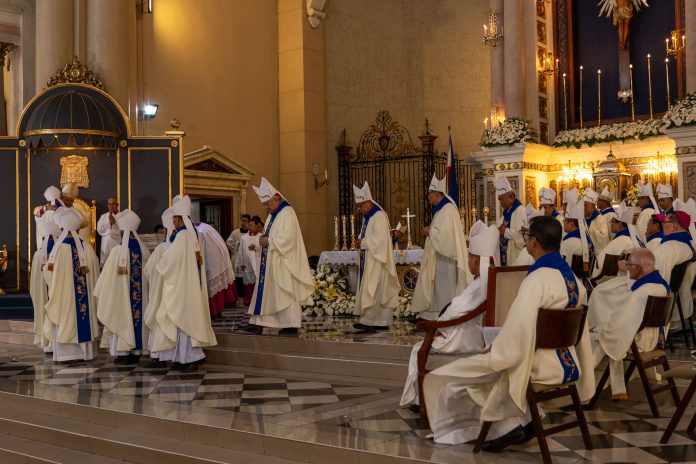
The Catholic bishops in the Philippines have warned that poor Filipino families and overseas workers will bear the heaviest burden of escalating global conflict, as church leaders appealed for peace amid worsening violence in the Middle East and elsewhere.
In a pastoral statement released May 20, the bishops said the humanitarian and economic consequences of war are already being felt in the Philippines, particularly among vulnerable sectors struggling with inflation and economic uncertainty.
“Although distant from our shores, the Middle East crisis is not remote from Filipino lives,” the bishops said. “Many of our brothers and sisters work in the region as Overseas Filipino Workers. Their safety, livelihoods, and futures now weigh heavily on their families at home.”
The prelates warned that rising fuel prices and increasing costs of basic goods could further deepen hardship for low-income households.
“The economic consequences are also being felt in our country through rising fuel costs, higher prices for goods, transportation burdens, and renewed pressures on poor households already struggling to survive,” they said.
The bishops identified those most vulnerable as “daily wage earners, farmers, fisherfolk, transport workers, the elderly, and families with little savings.”
“Thus, what happens overseas affects the Filipino home, the Filipino table, and the Filipino heart,” they added.
Titled “Peace in a Wounded World,” the pastoral statement was issued amid escalating tensions involving the United States and Iran, alongside ongoing conflicts in other regions. The bishops said the Church joins Pope Leo XIV and the global Catholic community in praying for peace.
“With hearts burdened by sorrow and concern, we, the bishops of the Catholic Bishops’ Conference of the Philippines (CBCP), join the Holy Father and the universal Church in praying for peace amid the ongoing crisis and war in the Middle East and elsewhere,” they said.
The bishops warned against the normalization of violence and the growing culture of division fueled by hatred, propaganda, and misinformation.
“We reject the normalization of violence, the targeting of civilians, acts of terror, collective punishment, and all actions that deepen hatred and division among peoples,” they said. “Violence breeds only more violence. War leaves wounds that endure for generations.”
Church leaders also drew attention to the environmental cost of war, saying armed conflict damages not only human lives but the Earth itself.
“The explosion of bombs, missiles, and heavy artillery pollutes the air, darkens the skies with toxic smoke, poisons the soil and water, and destroys forests and farmland,” the bishops said.
“In this way, war becomes not only a cry of humanity but also a cry of the earth,” they added.
The CBCP also urged Filipinos to resist misinformation and ideological polarization, particularly on social media.
“We urge the faithful to resist simplistic narratives, misinformation, hatred, prejudice, and ideological partisanship,” the bishops said.
“The Christian conscience must be formed not by propaganda or social media anger but by the Gospel of Jesus Christ,” they added.
The bishops appealed to political and religious leaders to prioritize diplomacy, reconciliation, and the protection of human dignity.
“To world leaders: choose dialogue over domination, diplomacy over destruction, restraint over retaliation, and moral courage over pride and aggression,” they said.
The prelates also warned against using religion to justify violence and extremism.
“To religious leaders: Christian, Muslim, Jewish, Buddhist, and all peoples of faith — we earnestly urge that religion and the holy name of God never be invoked to justify war, hatred, violence, extremism, or vengeance,” they said.
As part of the Church’s pastoral response, the bishops called on dioceses, parishes, schools, and religious communities to intensify prayers for peace, support OFWs and struggling families, and promote interreligious dialogue and solidarity.
“Let every parish become a sanctuary of prayer and reconciliation,” the bishops said. “Let every family become a cradle of peace, compassion, and hope.”