Communities across the Pacific and the Philippines are turning to community-owned solar power projects as fuel price shocks and supply disruptions expose the risks of dependence on imported fossil fuels.
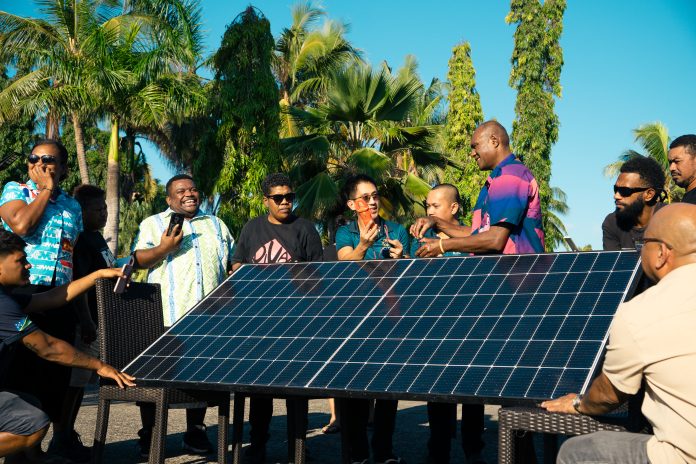
The push was highlighted during the Solar Scholars Training held in Nadi in May, where 14 community leaders from across the Pacific learned how to assemble, install, and maintain solar photovoltaic (PV) systems.
Organized by the Institute for Climate and Sustainable Cities (ICSC) and 350 Pacific, the program concluded with the installation of two community solar systems — one at the Fiji Council of Social Services in Lautoka to support disaster risk reduction efforts and another at a kindergarten in Yavulo Village, Sigatoka, to help reduce electricity costs.
Organizers said the initiative comes as countries across the Pacific and Southeast Asia grapple with energy and economic pressures linked to the US-Israel war on Iran. They said disruptions in global fuel supply chains have contributed to higher fuel costs, inflation, and growing concerns over energy security.
Pacific island states remain among the world’s most diesel-dependent countries for electricity generation because of their geographic isolation and limited shipping connectivity. Some governments in the region have responded through fuel conservation measures and emergency declarations.
The Philippines has faced similar challenges. Earlier this year, the government declared a state of national energy emergency, citing threats to fuel supplies and reserves stemming from global oil market disruptions.
Amid those uncertainties, communities are pursuing locally driven renewable energy solutions. In Eastern Visayas, provincial and local governments began developing renewable energy roadmaps in April to strengthen local energy security and accelerate the adoption of renewable energy.
Arturo Tahup, ICSC’s director for community resilience, said that while the conflict may be far from the Philippines, Fiji, and other Pacific island nations, communities continue to feel its effects through rising fuel and electricity costs and growing pressure on already limited resources.
“There’s a saying that every time the sun rises, there is opportunity, so we should make this crisis an opportunity to create a better energy future for all of us,” Tahup said.
The four-day training combined technical discussions with hands-on workshops, equipping participants with practical skills to develop renewable energy initiatives in their own communities. The program also helped strengthen a regional network of community leaders committed to advancing energy democracy and locally led energy transitions.
For George Nacewa, organizer of 350 Pacific, the training demonstrated that renewable energy projects need not be left solely to technical specialists.
“I think this is one thing that we’ve always dreamt about. It’s like, how can we empower our community to just [make] something built by the hands of ordinary people, not technical experts?” he said.
Nacewa said the program was designed to help communities learn how to assemble, install, and sustain solar systems themselves and replicate those efforts in their own localities.
The training builds on a partnership between ICSC and 350 Pacific that began in 2022 through an online hybrid Solar Scholars program.
Since then, the collaboration has promoted locally led renewable energy solutions and supported community solar installations across the region, reflecting growing efforts to strengthen energy security and reduce dependence on imported fossil fuels.