“Charity” has taken on some derogatory meanings in recent years. People say: “We do not need charity. What we need is justice.”
• “I don’t believe in charity, I believe in solidarity. Charity is so vertical. It goes from top to bottom. Solidarity is horizontal. It respects the other person.” (Eduardo Galeano, renowned Uruguayan leftist)
• “Overcoming poverty is not a gesture of charity. It is an act of justice. It is the protection of a fundamental human right, the right to dignity and a decent life.” (Nelson Mandela)
But their view of “charity” is deficient and skewed, characteristic of all binary thinking. Charity is broader and more holistic than this lopsided understanding. Justice and charity are two sides of the same coin.
“Charity is no substitute for justice denied,” St. Augustine says. Pope Benedict XVI writes in Caritas in Veritate: on the one hand, “justice is the primary way of charity.” On the other hand, “charity transcends justice and completes it.”
Vincent de Paul, the patron saint of charity, says: “There is no act of charity that is not accompanied by justice, or that permits us to do more than we reasonably can.”
To which event does Vincent de Paul trace this direction in his life? Something happened in Vincent’s new parish, Châtillon-les-Dombes, on August 20, 1617 — several months after the Folleville event.
In one conference, St. Vincent told the story to the Daughters of Charity:
“You may learn then that while I was living in a little town near Lyons, to which God had called me to be parish priest, one Sunday, when I was vesting to say Holy Mass, I was told that in an isolated house, a quarter of a league away, everybody was ill. There was not even one of them who could render any assistance to the others, and all were in an inexpressible state of poverty and need. This news touched me to the heart. I did not fail to commend them affectionately to the charity of the congregation in the course of the sermon, and God, touching the hearts of those who heard me, moved them with compassion for the poor afflicted people.”
“After dinner, a meeting was held in the house of a good young lady of the town to see what help could be given there, and everyone present felt disposed to pay them a visit, to console them with words and to help them to the best of their powers. After Vespers, I took along with me a citizen of the town, a very upright man, and we went together for a walk to visit those people. We overtook on the road some ladies who had set out before us, and a little farther on, we met some others who were returning home. As it was summer and the weather was very hot, these good ladies were sitting on the side of the road to rest and refresh themselves.”
“To sum up, my daughters, there were so many of them, you would have said it was a regular procession… I proposed to all those good ladies who had been animated by charity to visit those people, that they should club together to make soup, each on her own day, and not only for them but for all who might afterwards come.”
“And that is the first place where the Confraternity of Charity was established,” Vincent concluded.
If the Folleville event was called a “stampede to the confessional,” Châtillon was a “stampede to the house of the poor.”
If Folleville was the founding event of the missions, Châtillon was the founding event of the Vincentian movement of charity.
Let me reflect on the event and what Vincent might have learned from it — lessons that became the hallmarks of Vincentian ministries throughout the years.
1. Salvation is Caring for the Whole Person and Their Communities
Spiritual needs must be taken care of: that is the message of Folleville. But God’s good news is salvation of the whole person: that is the message of Châtillon. The hungry, the sick, and the distressed do not only need the consolation of the Word of God; they also need to be fed and healed. One cannot preach to a hungry stomach.
The Kingdom of God that Jesus preached also means the well-being of the human being and the communities to which he belongs. In contemporary Church language, evangelization needs to be “integral.” I had one professor who summed up his lesson by saying: “The Kingdom of God = rice.” That is good news to the hungry person on the streets.
There were missionaries who refused to relieve hunger among the poor because they thought their work was only to preach. St. Vincent reprimanded them with this stern warning: “If there are any among us who think they are in the mission to evangelize the poor people but not to alleviate their sufferings, to take care of their spiritual needs but not their temporal ones, I reply that we have to help them and have them assisted in every way, by us and by others.”
2. Empowerment of Lay People and Women
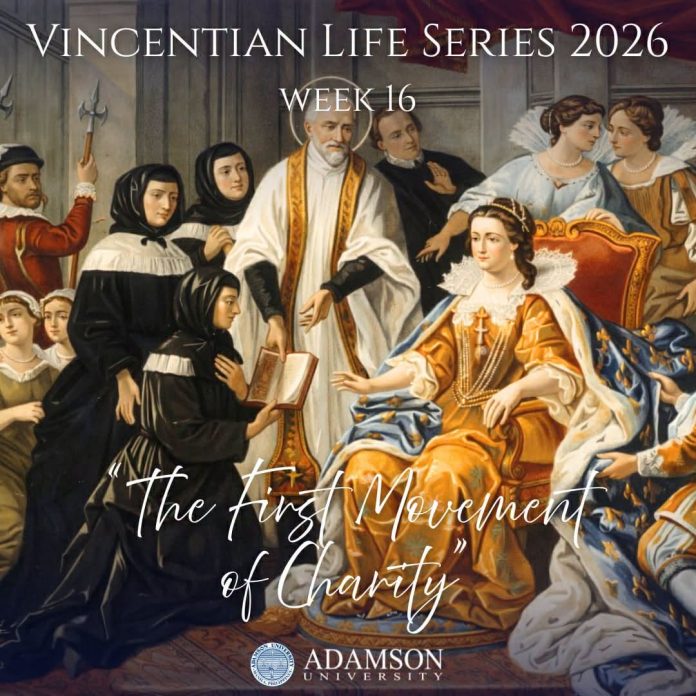
The Châtillon event is the founding moment of the Confraternities of Charity, now called the Association Internationale de la Charité (AIC). St. Vincent organized this lay foundation seven years before he organized his priests of the mission (CM).
This was the first foundation where St. Vincent gave the laity its role and mission in the Church’s reform in 17th‑century France. Originally, the Confraternities were composed of men and women, organized at the end of each parish mission to continue the work, especially the care of the sick poor.
By 1660, at the time of St. Vincent’s death, many Confraternities had already spread throughout France. Some were composed of women alone, some of men alone, and some were mixed. They came from all walks of life: from the queen and the ladies of the court to ordinary parishioners. There were fifteen parish branches in Paris, in the suburbs, and in other cities of France, and later in Turin and Genoa.
Later, the men stopped being members, and the women continued to run the Conferences. Long before feminism became popular, Vincent de Paul had already empowered women and given them a distinguished role in the Church of his time. The Confraternities were later called the “Ladies of Charity,” now composed of more than 100,000 mostly women volunteers worldwide.
3. The Need for Organized and Systematic Help
There were so many who were touched by Vincent’s sermon that Sunday morning that they all flocked to the house of the sick family. That “stampede” needed organization.
“I proposed to all,” Vincent said, “those good ladies who had been animated by charity to visit those people, that they should club together to make soup, each on her own day, and not only for them but for all who might afterwards come.”
They should “club together,” Vincent advised. Charitable work needs to be organized. If poverty is systemic, solutions must be systematic.
The contemporary Vincentian Family advances “systemic change” as its approach to ministry. Systemic change goes beyond direct charitable help to address the root causes of poverty. It empowers people to identify issues and their interconnections, to create solutions rooted in their contexts, to collaborate with others — especially those in the Vincentian Family — and to implement sustainable responses to poverty and exclusion.
St. Vincent lived in France during the absolute monarchy. The struggle for justice against the excesses of the Ancien Régime would come more than a century later in the French Revolution (1789). But Vincent’s vision of charity coupled with justice was far ahead of his time.
The poor person possesses the dignity of a son or daughter of God. Moreover, for St. Vincent, the poor represent the person of Christ. “Go to the poor and you will see Christ there.” All justice, respect, care, and esteem are due them. That is why they are our masters, and we are their servants. This is what is meant by that loaded and often misunderstood word “charity.”
This spirit is summarized in what St. Vincent said:
“Charity is certainly greater than any rule. Moreover, all rules must lead to charity. Since she is a noble mistress, we must do whatever she commands. With renewed devotion, then, we must serve the poor, especially outcasts and beggars. They have been given to us as our masters and patrons.”
Father Daniel Franklin Pilario, C.M., is the President of Adamson University in Manila. He is a theologian, professor, and pastor of an urban poor community on the outskirts of the Philippine capital. He is also the Vincentian Chair for Social Justice at St. John’s University in New York.