
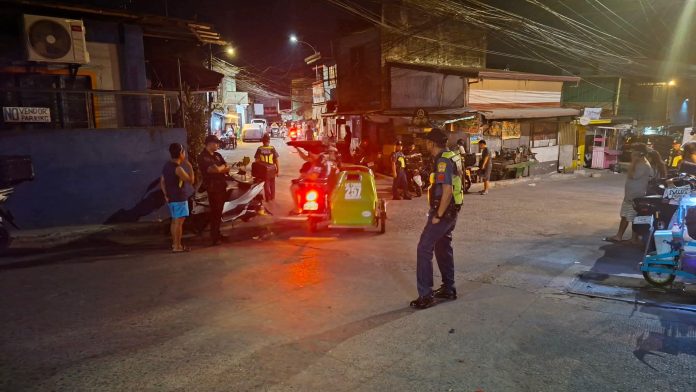
Lawyers and child rights advocates are challenging the government’s “Safe City” crackdown, warning that sweeping enforcement of minor local ordinances in Metro Manila lacks clear legal basis and risks disproportionately targeting the urban poor and minors.
The campaign, led by the Department of the Interior and Local Government (DILG), directs police to strictly enforce local rules on street drinking, shirtless roaming, curfew violations, and late-night karaoke use, commonly known in the Philippines as videoke.
Interior Secretary Juanito Victor “Jonvic” Remulla said the move aims to maintain public order, saying “drinking along the streets are usually the cause of street fights and even sexual harassment, but from now on, we will be prohibiting it.”
He added that authorities would act against those roaming shirtless in public: “If you don’t want to be in trouble, please wear even sandos because we will be running after those who roam around without shirts.”
The campaign also includes stricter curfew enforcement for minors. “If you are not enrolled in school and jobless, then go home. You will be prohibited to stay on the streets after 10 p.m.,” Remulla said.
The National Union of Peoples’ Lawyers (NUPL) said the crackdown raises fundamental legal concerns, particularly where arrests or detention are made for violations that may carry only fines.
“We raise a basic legal question: if these alleged violations are punishable only by fines, why were people arrested or taken into custody at all?” the group said.
It added that authorities must identify the specific ordinance and legal basis for each apprehension, stressing that “Secretary Jonvic Remulla cannot create crimes by press conference” and that police “cannot hide behind vague references to existing ordinances.”
Citing the Supreme Court ruling in Ridon v. People, the group said violations punishable only by fines cannot justify warrantless arrests.
Child rights advocates raised concerns over the impact on minors under blanket curfew enforcement.
“As we have documented/witnessed in the past, blanket curfew policies will only lead to arrests and further abuses of children who are already at risk,” said Atty. Gian Miko Arabejo of the Children’s Legal Rights and Development Center.
He recalled cases where minors were detained in overcrowded facilities, “with youth locked up like sardines, taking turns in sitting and lying down to sleep,” after being picked up for curfew violations.
“This violates the rights of children and further discriminates and places young people at risk for torture/abuse,” Arabejo said.
The group urged authorities to shift from punitive measures to social support. “Instead of implementing a curfew and initiating mass apprehensions of children in street situations, we strongly urge the DILG to strengthen the capacity of the barangays to provide services and support aimed to address the root causes driving these children to the streets,” said CLRDC Executive Director Rowena Legaspi.
NUPL also pointed to the social context behind the crackdown, saying many of the cited violations reflect daily life in densely populated, low-income communities.
“It is crystal clear,” said NUPL president Ephraim Cortez, “that this is a crackdown on those living in urban poor communities.”
The group warned that authorities cannot enforce public order by “stretching local ordinances beyond their terms, bypassing constitutional limits, or treating poverty itself as suspicious,” and called for the immediate release of those detained without lawful basis and a full public accounting of all apprehensions.