A friend working in the margins asked me to comment on the ongoing brouhaha about the speech of Cardinal Pablo Virgilio David of Kalookan during last Sunday’s Trillion Peso March Protest (TMP) at EDSA. I begged off at first for a basic reason: I was not there. I was watching it far from the drama that was unfolding, from the luxury of rest, as my diocese opted to ring the bell at 8 p.m. until Christmas as our form of protest.
However, as various reactions were coming out, I began to reconsider reflecting on the words of the good Cardinal. I cringed at the thought of being torn like Sartre’s “loyal dissent” if ever my thoughts would not totally agree with the Prince of the Holy Mother, the Church.
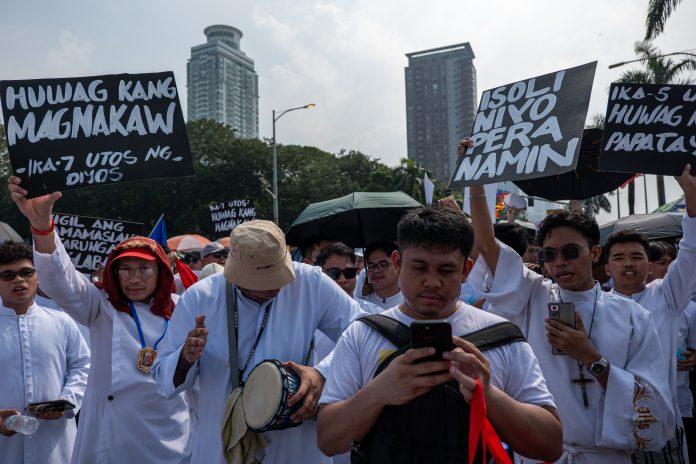
At first, in its entirety, I did not see the division of two groups of people airing out grievances and proposing meaningful reforms. I only saw one protest, but two expressions of two classes of people: the elite at EDSA, and the masses at Luneta.
Fr. Warren Puno (FB: Paring Kinaawaan ng Diyos) identified that those in EDSA demanded principles of reform such as truth and accountability, fidelity to the Constitution, and the promotion of justice and peace. On the other hand, those who came to Luneta were the common people, starving in poverty, suffering due to injustices, demanding the end of the cycle of oppression, and the dismantling of superstructures that breed poverty.
They also proposed, concretely, a People’s Transition Council (PTC). If we look intently, they may be distinct at first, but eventually connect later on into a continuum. It was clear then that there was only one protest, a deep dissatisfaction with the ongoing regime and the corrupt system it thrived on.
Secondly, while Cardinal David was still CBCP president that day (he would be succeeded the following day), he does not represent the entire Catholic Christianity of the Philippines. Perhaps he represents the hierarchy, but not the entire People of God. Having said that, I can also say that his views came from the vantage point of his own circle (I assume that he is well-advised).
I was appalled, but not surprised, that he would refer to the outcome of the Luneta protest’s demand as leading the country to a “banana republic.” If the good Cardinal could not accept the stance of the people protesting in Luneta, he should have at least respected their views. Perhaps he was misinformed, but there was no need to belittle or mock other people’s aspirations, especially if they come from their deplorable situation.
Thirdly, the Cardinal’s speech revealed how poverty divides people into social stratifications, with the poor occupying the greater bottom of the pyramid. More alarming for me is the revelation that the hierarchy is off-tangent from the reality of the people they serve. Or worse, they (we) serve buffered by their (our) comfortable privilege and position amid people drowning in poverty and injustices. Yes, we claim to be the Church of the Poor, but have we known poverty as experienced by these people? We might have rhetorically renounced and denounced poverty but not moved an inch to destroy the structure that builds it. This disconnection from reality, and preference for comfort, becomes obvious when we call for truth and accountability but do not call out the higher-ups to resign. How truthful and accountable can the investigation be if those in power remain in control even of documentary evidence, and can easily influence witnesses?
On the issue of peace, the UN report is already alarming, just as former President Rodrigo Roa Duterte’s extrajudicial killings were. And despite the human rights abuses in the ongoing civil war, I have yet to hear a voice from above that calls for the resumption of peace talks or the abolition of the National Task Force to End Local Communist Armed Conflict. Is this due to the monopoly of the military’s narrative that sounds convincing to the bishops? Has our life of comfort and privilege paralyzed our action to shake the status quo of our country?
Lastly, even before the concept of synodality resurfaced, the Church had always been inclusive from the very beginning. She respects diversity and plurality of voices, peoples, and cultures. She is a mother who can reconcile opposing views and positions, especially if they come from the longings of her poor children. It is about time for the hierarchy to listen to the real lives of real people who are languishing on the ground. Let the poor evangelize us in their poverty as we walk together on the path to genuine democracy. It is okay to be imperfect. We are flawed but called, not to play God, but to be prophets. We do not have immediate answers but can facilitate the right questions. People need credible witnesses of truth and integrity more than our cherished social teachings.
Down south in Cebu, they found a new voice in Archbishop Alberto Uy, who spoke eloquently without being condescending to the poor. There was only one venue for their protest, participated in by various groups. Uy walked with the people from the Basilica to Fuente Osmeña. He challenged the people “to be the change they want the world to be.” A day earlier, Archbishop Jose Cabantan of Cagayan de Oro in Mindanao expressed that even the Church should be transparent in its economic activities. He seemed resolute in walking what he is talking about.
The nationwide protests exposed the Catholic Church’s inconsistencies as well as her deep convictions for social order. She is not perfect, but her flaws do not make her less a disciple of the Lord. Even the Church that constantly demands repentance also needs conversion: ecclesia semper reformanda. And it always begins with the reformation of the clergy. The two protests are meant for the government and for the Church. There is a need, as in no other time in our recent history, for synodality that transforms our power into humble service.
Bishop Jose Rapadas of Iligan (Mindanao) already underlined this necessity for our local Church to transition during the last Mindanao-Sulu Pastoral Conference, namely: “from an institution to a community of disciples, from clericalized to participatory Church, from exclusively liturgical to holistic mission, from powerful-aligned to the Church of the Poor.” To do this, we need to go down from our ivory towers and walk with the suffering people.
Two thousand years ago, the Master walked with the poor up to his sacrifice on the cross. The martyred bishop, St. Oscar Romero, once said, “A Church that suffers no persecution but enjoys the privileges and support of the things of the earth is not the true Church of Jesus. A preaching that doesn’t point out sin doesn’t preach the gospel. A preaching that makes sinners feel good, so that they are secured in their sinful state, betrays the gospel.”
Fr. Raymond Montero-Ambray is the Ecology Ministry director and head of the LGBTQIA+ apostolate in the Diocese of Tandag in the southern Philippines. The priest is a staunch environmental and Indigenous Peoples’ rights activist.