
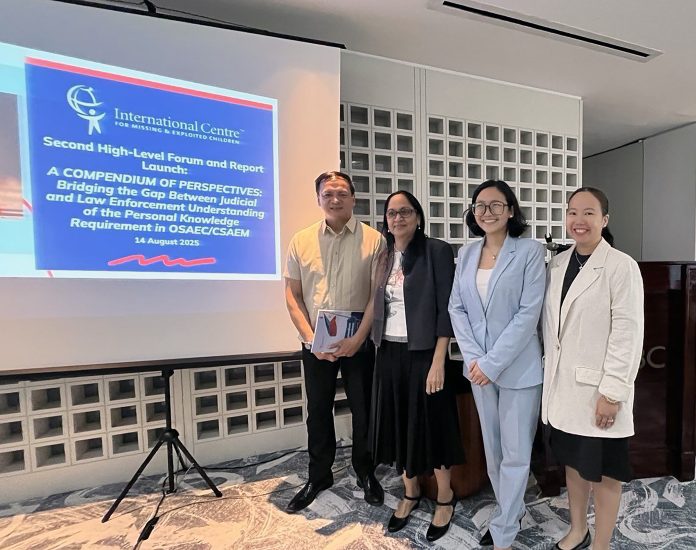
Supreme Court (SC) Associate Justice Jose Midas P. Marquez urged the judiciary, law enforcement, and prosecutors to work more closely in fighting online child exploitation and abuse.
Marquez, who chairs the SC Special Committee on Cybercrime and Electronic Evidence, delivered the keynote address at the launch of A Compendium of Perspectives: Bridging the Gap Between Judicial and Law Enforcement Understanding of the Personal Knowledge Requirement in OSAEC/CSAEM on August 14 at the RCBC Plaza in Makati City.
He described the Compendium as “an early step in our roadmap for action,” saying it would serve as a practical guide for judges and law enforcers. “When we bridge judicial wisdom with law enforcement and prosecutorial experience, we strengthen protection for our most vulnerable citizens,” he said.
The International Centre for Missing & Exploited Children (ICMEC) prepared the Compendium to examine how cybercrime search warrants are applied in cases of Online Sexual Abuse or Exploitation of Children (OSAEC) and Child Sexual Abuse or Exploitation Materials (CSAEM).
It also explains the “personal knowledge” rule, which requires judges to personally determine, through sworn witness testimony, whether a warrant should be issued.
Marquez acknowledged challenges cited in the document, such as limited training and the lack of prosecutor involvement, noting that “these create delays that impact child protection.”
He emphasized that addressing OSAEC and CSAEM requires not just institutional reforms but conviction, saying that the “crisis demands both professional commitment and personal conviction. Child protection in fact transcends legal obligation—it is a moral duty.”
The justice said the Supreme Court has recommended amendments to Republic Act No. 10175 or the Cybercrime Prevention Act to improve coordination between law enforcers and prosecutors.
He added that the SC is updating the Rules on Criminal Procedure and reviewing rules on cybercrime and electronic evidence to meet today’s digital challenges.
Marquez underscored the need for unity, stressing that “even though the courts must remain independent, judges, law enforcement, and prosecutors need to work together to stop this terrible crime against our children.”
“We will not rest until our digital landscape is safe. Our success will be measured by the tangible impact in protecting children,” he said.
He stressed that child exploitation has no place in society and warned that offenders must face the full force of the law, adding that protecting children requires the collective effort of all stakeholders.