
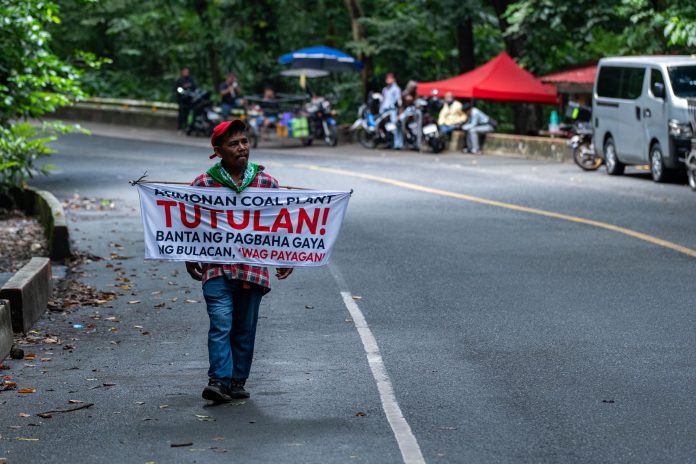
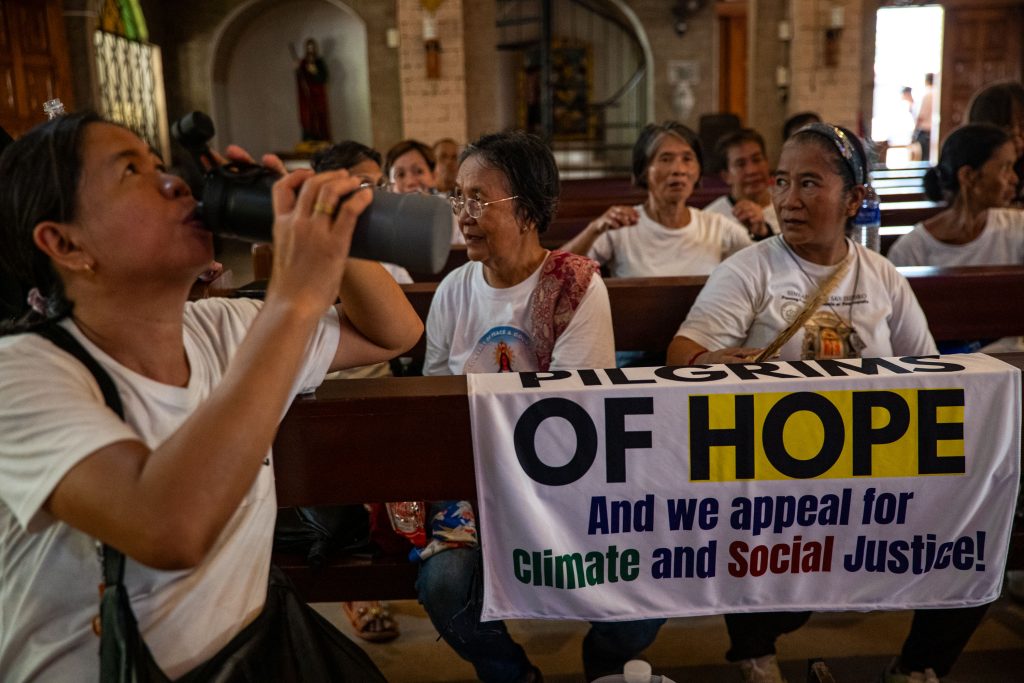
A Church-led pilgrimage set out from Quezon province carrying the “cries” of communities confronting coal development, land disputes, large-scale energy projects, and environmental destruction across Southern Luzon, with organizers seeking to bring their concerns directly to national government agencies.
The Lakbay Panaghoy para sa Kalikasan, Kapayapaan at Katarungan (Pilgrimage of Lament for the Environment, Peace and Justice) began Oct. 5 in Atimonan, Quezon, and is scheduled to pass through communities, parishes, and schools in Quezon and Laguna before reaching Metro Manila.
Fr. Warren Puno, director of the Ecology Ministry of the Diocese of Lucena and convenor of the South Luzon Laudato Si Convergence, said the pilgrimage is carrying grievances from communities affected by projects involving energy, land, and the environment.
“We are carrying the cries of different communities, especially here in Atimonan, where a coal-fired power plant has been opposed for more than a decade and, because of community action, has still not pushed through,” Puno told LiCAS News in Filipino at the start of the walk.

The pilgrimage builds on a protest walk held in Quezon in November 2025. This year’s action expands its focus beyond energy, extraction, and deforestation to include land, farmers’ and labor rights, according to its concept note.
Atimonan is the proposed site of a 1,200-megawatt coal-fired power plant by Atimonan One Energy of Manila Electric Co. (Meralco).
Communities and environmental advocates have opposed the project for more than a decade. Opposition to the proposed coal plant dates back to June 2015, when the first street prayer march against the project was held. Organizers of this year’s pilgrimage are calling for the project to be stopped.
On Oct. 6, Church and environmental groups brought their concerns to the Quezon provincial government, urging the Sangguniang Panlalawigan (Provincial Board) to reject reliance on an environmental impact assessment conducted for the project in 2014.
“A1E’s environmental impact assessment was conducted in 2014, before the Paris Agreement where international commitments to mitigate global temperature rise were set,” Puno said in a statement.
He called on the provincial board to require Atimonan One Energy and the Department of Environment and Natural Resources’ Environmental Management Bureau to conduct another assessment.
“Given the climate crisis today, we call on the Sangguniang Panlalawigan to demand A1E and the DENR – Environmental Management Bureau to reconduct the EIA for the Sangguniang Panlalawigan to have an idea of the destructive impacts of the A1E coal plant,” Puno said.
Ivan Andres, deputy head of research and policy at the Center for Energy, Ecology, and Development (CEED), said stronger safeguards should include assessments of air and water quality, marine biodiversity, heavy metal concentrations, and socioeconomic impacts.
Organizers said they addressed a letter to the provincial board but were prevented from entering the office of Quezon Gov. Angelina “Doktora Helen” Tan when they attempted to submit a separate letter.
Puno said government officials should listen to communities raising concerns over projects that could affect their health and environment.
“If elected officials are genuine with their mandate of public service, then they must not rely on a 12-year-old study, and instead hear the cries of their people for greater protections,” he said.
The Atimonan coal project is only one of the issues being carried along the pilgrimage route.
Puno said young people were among those worried about the future as environmental destruction continued.
“We also carry the cries of young people who are afraid of what kind of future awaits them because of the continuing destruction of our Mother Earth,” he told LiCAS News in Filipino.
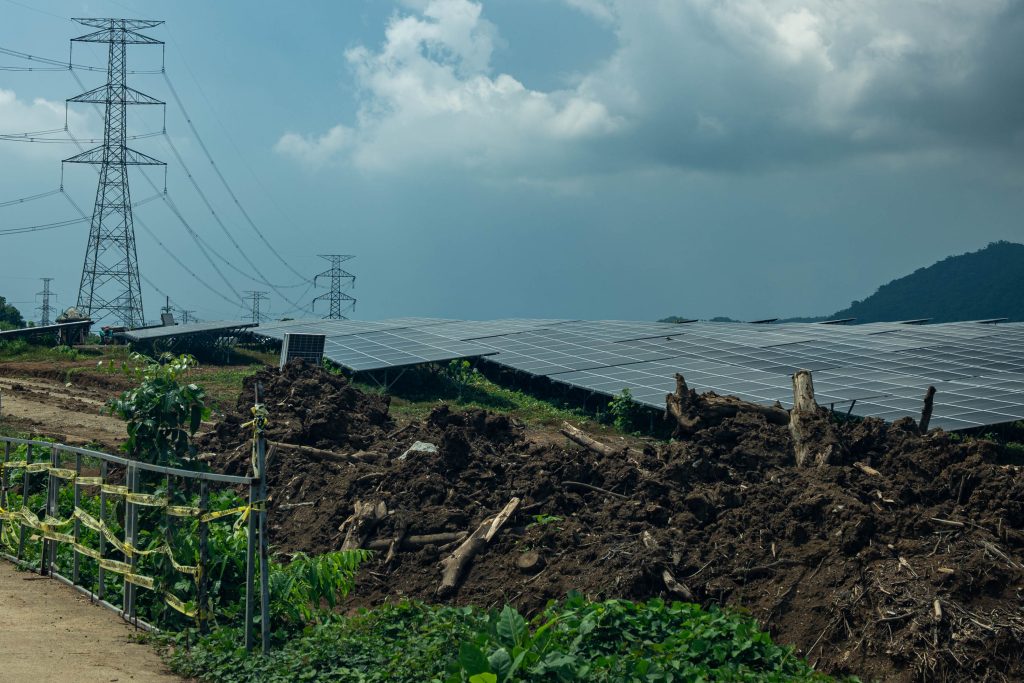
In Pagbilao, Puno raised concerns over hundreds of hectares of agricultural land being used for large solar farms and called instead for distributed renewable energy.
“Here in Pagbilao, our call is not for these large-scale projects because hundreds of hectares are being turned into solar farms,” he said in Filipino. “What we are calling for is distributed renewable energy.”
The pilgrimage is also carrying concerns over quarrying in Quezon, a land dispute involving farmers in Sariaya, the proposed 1,400-megawatt Ahunan hydropower project in Pakil, waste-to-energy projects in Laguna and threats to Laguna Lake.
Puno said the different struggles reflected the difficulty affected communities face in making their concerns heard by decision-makers.
“We see that the cries of people from different sectors, of the poor, and especially of nature, which cannot speak for itself, are not being heard by many, particularly by those who make government policies meant to protect Mother Earth,” he said in Filipino.
He said the pilgrimage also reflected the Church’s understanding of stewardship over creation.
“In the places we have passed and those we have yet to pass, we can see how creation has been desecrated, as though human beings think they are the creators rather than stewards,” Puno said in Filipino.
CEED, one of the groups supporting the pilgrimage, said the proposed Atimonan plant reflected wider problems associated with coal dependence.
“Permitting the A1E coal plant to proceed would only lead to the exacerbation of our already many struggles stemming from coal dependence: expensive electricity, unreliable power supply, ecological harms, and impaired adaptation to intensifying climate harms,” said Gerry Arances, CEED executive director.
The pilgrimage is scheduled to continue through Quezon and Laguna before reaching Metro Manila. Organizers plan to visit the departments of Energy, Agriculture, Agrarian Reform, and Environment and Natural Resources on Oct. 12 to seek dialogues and deliver community protest letters.
Puno said the difficulty of walking under the heat was small compared with what affected communities were enduring.
“This sacrifice is very small compared with what different communities are experiencing, especially from the effects of climate change and global warming,” he said in Filipino.