
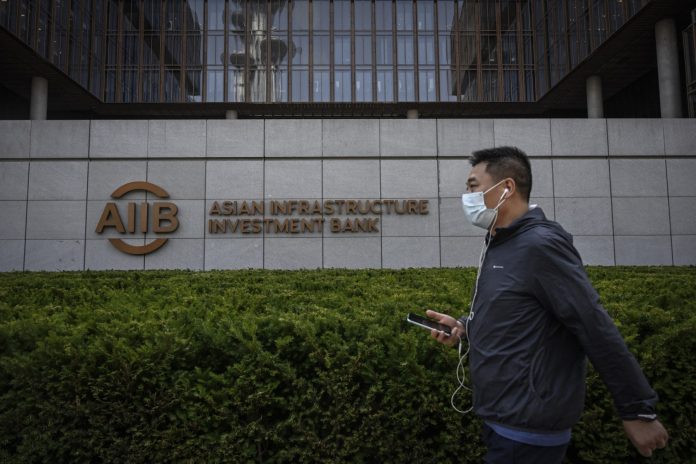
Civil society groups called on the Asian Infrastructure Investment Bank to use its 2027 energy strategy review to set a clear, time-bound exit from fossil fuels, including an end to new gas and liquefied natural gas financing.
They also urged the bank to strengthen safeguards for large hydropower and other infrastructure projects and improve access to remedy for affected communities.
The NGO Forum on ADB raised the demands during the 2026 AIIB Annual Meeting in Doha, Qatar, as the bank prepared to enter its second decade.
The Forum said the 2027 review of AIIB’s Energy Sector Strategy would test whether the bank was prepared to move its financing more firmly toward a low-carbon transition.
While acknowledging increased renewable-energy financing since the adoption of the 2022 strategy, the group said the policy still recognizes a possible transitional role for fossil gas and allows financing for some gas-related infrastructure.
Nazareth Del Pilar, Just Transitions Advocacy Officer of the NGO Forum, said the review should show whether AIIB was prepared to move away from fossil fuels and other technologies the group considers false climate solutions.
“The 2027 energy review tests whether AIIB’s ‘Sustainable Energy for Tomorrow’ slogan means structural reform away from fossil fuels and false solutions, or just a smokescreen for more gas, heavy hydro, and unproven abatement technologies,” Del Pilar said.
She also called for a properly resourced consultation process that would allow meaningful participation by communities, civil society groups, human rights advocates and environmental defenders, while addressing concerns over the 2022 Energy Sector Strategy update.
The Forum also pressed AIIB to reassess its support for large-scale hydropower, especially in environmentally and geologically fragile areas.
It cited Nepal’s Trishuli river corridor, where major hydropower facilities have been affected by recent disasters, including the AIIB-backed 216-megawatt Upper Trishuli-1 Hydropower Project, which has received up to $90 million in financing.
AIIB is also considering up to $200 million in financing for the proposed Dudhkoshi Storage Hydroelectric Project.
The Forum called for a halt to new large-scale hydropower financing pending a broader review of climate, geological, biodiversity and community risks.
Indira Shreesh, founder and chair of INWOLAG, said Indigenous Peoples should not be treated as an afterthought in decisions involving rivers and ancestral lands.
“Indigenous Peoples have lived with and protected the Trishuli and Dudhkoshi river systems for generations, yet they are too often treated as an afterthought in hydropower decisions,” Shreesh said.
She said AIIB must guarantee free, prior and informed consent before financing is approved and ensure Indigenous communities have access to remedy when their lands, livelihoods and cultural heritage are harmed.
Concerns were also raised over the BH Hydropower Project in Pakistan, financed by AIIB and the Asian Development Bank.
The Forum said affected communities had reported problems involving safeguards, inadequate land compensation and damage to homes caused by tunnel blasting.
According to Hussain Jarwar, chief executive officer of Indus Consortium, “AIIB should take emerging climate-related challenges into account and provide targeted support to address impacts on local communities.”
Jarwar said those impacts “have further exacerbated the hardships faced by affected communities” and called on AIIB to ensure fair compensation and effective remedial measures.
Civil society groups also questioned whether projects presented as climate or transition investments were consistent with AIIB’s environmental goals, including waste-to-energy projects.
Mayang Azurin, deputy director for campaigns of the Global Alliance for Incinerator Alternatives-Asia Pacific, said AIIB should reassess whether its waste-to-energy financing remained consistent with its Energy Sector framework.
She said the bank should examine whether such projects undermine greenhouse-gas reductions, shift pollution onto communities and create long-term lock-in.
“This reassessment must be undertaken before a project is approved and policy development processes are finalized, not after communities have already borne its risks,” Azurin said.
The Forum also called for stronger access to AIIB’s Project-affected People’s Mechanism, saying communities must be able to raise concerns before projects cause irreversible harm.
AIIB public information showed no registered submissions to the mechanism as of June 2026. The Forum said the figure did not prove an absence of remedy but raised questions about whether communities knew about the mechanism and could access it.
Hemantha Withanage, international convenor of the NGO Forum on ADB, said communities must be treated as primary stakeholders in climate and infrastructure financing.
“10 years down the road, AIIB is still behind in listening to the voices of communities on the ground. AIIB must accept that communities on the ground are the primary stakeholders in its climate and infrastructure financing,” Withanage said.
He added that “Community rights must be upheld, and accountability is fundamental to the sustainability of AIIB projects.”
Rayyan Hassan, executive director of the NGO Forum, said accountability mechanisms should be accessible before projects are approved.
“An accountability mechanism only matters if communities can actually reach it before irreversible harm occurs. AIIB must ensure that people know about the PPM before project approval, have access to project information in languages and formats they understand, and can raise concerns without intimidation or procedural barriers,” Hassan said.
According to Hassan, “In AIIB’s second decade, accountability must become an early-warning and prevention mechanism — not simply a remedy sought after communities have already paid the price.”