
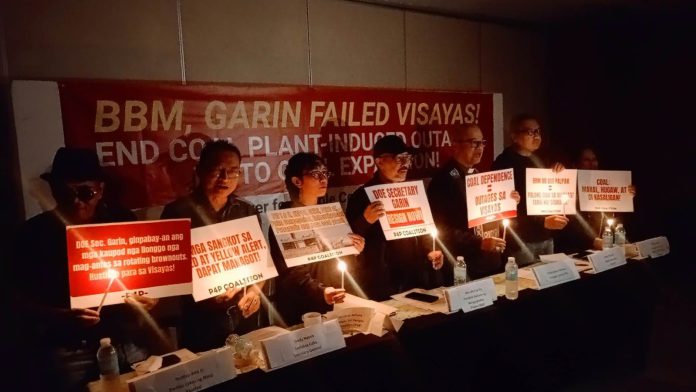
Consumer groups in the Visayas claimed the government had failed to curb repeated coal-plant outages that have triggered persistent power alerts and driven up electricity costs six months into its declaration of an energy emergency.
The Power for People Coalition-Visayas said the region recorded 43 red alert days and 107 yellow alert days since May. The coalition called for an investigation into the outages and demanded the resignation of Energy Secretary Garin.
Teody Navea, secretary-general of Sanlakas-Cebu, said prolonged outages had disrupted small businesses, education and communities dealing with extreme heat and disasters.
“It’s like we were abandoned. These outages are killing small businesses and livelihoods. Our youth’s schooling,” said Navea in a translation provided by the coalition.
“Half a year on, how come this administration, and Secretary Garin, did nothing?” he added.
P4P attributed the supply constraints primarily to unplanned shutdowns at coal-fired power plants.
The coalition said Units 1 and 2 of Therma Visayas Inc. were reported on outage 110 and 98 times, respectively. Panay Energy Development Corp.’s Unit 3 was reported on outage 74 times, while the Cebu Energy Development Corp. coal plant recorded 13 outages.
P4P criticized the Department of Energy for proposing increased coal use, including as much as 5 gigawatts of new capacity, despite the recurring shutdowns.
“The DOE seems intent on making a fool of consumers. Will any doctor who is faithful to his duty tell a poisoned patient to drink more poison?” said Aaron Pedrosa, secretary general of Sanlakas.
Pedrosa said energy authorities should instead ask “who stands to benefit from these outages.”
“And for all these spikes in costs, consumers bear the greatest burden,” he said.
P4P said distribution utilities and electric cooperatives had turned to the Wholesale Electricity Spot Market to procure electricity as outages worsened.
According to the coalition, the average WESM rate in the Visayas stood at ₱5.22 per kilowatt-hour before the alerts and rose to ₱11.56 per kWh during alert periods. It said the settlement rate for coal in the region reached as high as ₱45.63 per kWh.
P4P also said some parent companies of plants that went on outage owned facilities selling electricity through the spot market during the same period.
Fara Gamalo, secretary general of the Freedom from Debt Coalition-Eastern Visayas, said consumers were paying higher electricity rates despite unreliable service.
“We pay soaring power rates and get brownouts in return,” said Gamalo in a translation provided by the coalition.
Gamalo said consumers in Eastern Visayas had long sought a transition to “cheaper and more reliable renewable energy sources” but remained burdened by high coal prices and poor service.
P4P called on the government to investigate those responsible for the outages, impose penalties and blacklist coal companies it considers abusive.
“Marcos Jr’s declaration of a national energy emergency has so far been meaningless. They failed to protect consumers from bill shocks and rotating brownouts,” said Luke Espiritu, president of the Bukluran ng Manggagawang Pilipino.
Espiritu said the government should investigate the outages before calling for Garin to step down.
“Secretary Garin, who has exposed herself as no more than a servile backer of coal and fossil fuel oligarchs, needs to step down. Resigning would be her greatest act of service to consumers at this point,” he said.
Bishop Gerry Alminaza, president of Caritas Philippines and a native of San Carlos City in Negros Occidental, said electricity was essential to communities and should be treated as a public service.
“Energy is crucial for our society to run, and for all humanity,” said Alminaza.
He called on the government to provide “affordable, clean, and community-centered energy” and uphold accountability.
P4P campaigner Krishna Ariola said repeated coal-plant failures should not be ignored or used to justify expanding dependence on coal.
“The failures of coal plants and the generation companies behind them must neither be ignored nor go unpunished,” said Ariola.
Ariola also warned that the upcoming Super El Niño could increase pressure on coal plants and the electricity system as temperatures and consumer demand rise.
“With the El Niño, coal plants are in danger of more forced outages, even more so as rising temperatures mean higher electricity needs from consumers. We must curb these outages from occurring without delay,” Ariola said.
In Negros, Rustico Ano of Partido Lakas ng Masa-Bacolod said consumers would continue opposing additional coal projects while pushing for renewable energy.
“DOE and the whole administration failed Visayas. We will continue calling for an end to these outages and for a stop to coal projects,” said Ano.
Ano questioned why Negros continued to import electricity from Cebu and Panay and rely on coal when the island had renewable energy resources that could support a transition.