
Indigenous leaders and rights advocates have trained a national cohort of community paralegals to monitor revised consent rules amid concerns that mining, energy and Pax Silica-related projects could weaken protections for ancestral domains.
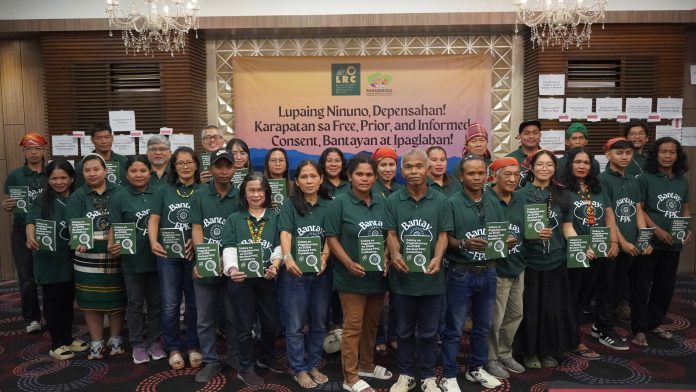
Thirty Indigenous leaders and rights advocates from 12 provinces completed a national paralegal training workshop in Quezon City focused on monitoring and documenting possible human rights violations linked to the rollout of the 2026 Revised Free, Prior, and Informed Consent Guidelines.
The Legal Rights and Natural Resources (LRC), which organized the training under its Palihang Panumduman program, said the revised guidelines could shorten timelines, diminish remedies and allow bypasses of the FPIC process.
Leon Dulce, LRC campaigns support and linkages coordinator and one of the training facilitators, said the new community paralegals were prepared to document Indigenous rights violations “anticipated from the shortened timelines, diminished remedies, and bypasses of the impending new 2026 FPIC Guidelines.”
Dulce linked the revised rules to the expansion of critical minerals and advanced manufacturing projects under the Pax Silica Declaration.
“The new FPIC Guidelines come at a time of an emerging critical minerals and advanced manufacturing rush spurred by the Pax Silica Declaration. The potential economic and industrial corridors of the Pax Silica agreements are expected to cut sharply across Ancestral Domains throughout the country,” Dulce said.
LRC said Indigenous communities have opposed provisions in the revised guidelines that they fear could disrupt customary consensus-building and decision-making processes. It also cited the Energy Virtual One Stop Shop Act and Executive Order 122 on Critical Minerals as policies creating faster permitting processes for industries involved in Pax Silica.
Participants in the training cited cases in their communities where they said FPIC requirements had not been met.
Rica Torres, spokesperson of the Ayta organization Mansaway, said Indigenous communities in Capas, Tarlac, had not been consulted about a Pax Silica project and learned about it only through news reports.
“Unfortunately, in the case of the Tarlac Pax Silica project, no consultation has been conducted, as mandated by the Indigenous People’s Rights Act. Our indigenous communities in Capas, Tarlac have only found out about it in the news, without any information on what the project will cover, violating the essence of FPIC,” Torres said.
Timuoy Walter Timol, head claimant of the Gutalac Baliguian Siocon Ancestral Domain, raised concerns over unresolved ancestral domain applications and possible critical minerals mining.
Timol said the National Commission on Indigenous Peoples had “ignored for the longest time our applications for ancestral domains, which we have applied for back in 1988.”
He also expressed concern that “critical minerals mining will continue in the lands that belong to our tribe” and called for a moratorium if the new FPIC guidelines are implemented “so that we can ensure genuine consensus.”
Ephin Falyao, a Balangao-Ilyas youth leader and national coordinator of Siklab Philippine Indigenous Youth Network, cited an environmental investigation into the Olongapo Solar Farm of Aboitiz.
Falyao said the investigation “confirmed that no consent was given by Indigenous communities.” He also said proponents failed to provide comprehensive and complete information about the project’s potential impacts.
“Many have reported that they were not included in the consultation and decision-making process and only found out about the project when it began construction,” Falyao said.
LRC also launched a briefer on the 2026 Revised FPIC Guidelines to help Indigenous communities, paralegals and rights advocates understand the new rules and their implications for the FPIC process.