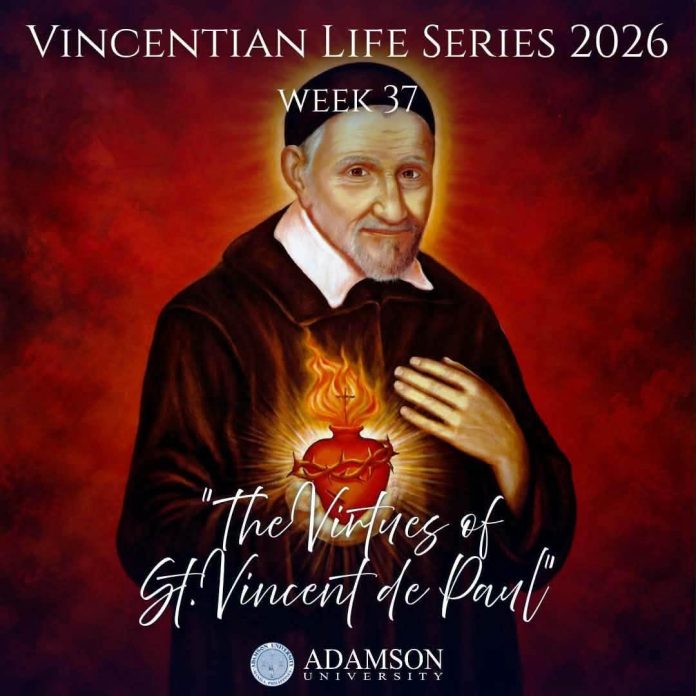
Since we started in the last series on the values that St. Vincent wants his followers to live, I will continue to reflect on the virtues that he practiced in his personal life.
These reflections mainly come from the first biography of St. Vincent de Paul, written by Louis Abelly and published in 1664 — barely four years after Vincent’s death.
Since this work is not very accessible to many today, I think it will help us recover some of its lessons and insights so that it may guide us in our journey to know St. Vincent more deeply.
Before we discuss the virtues individually, let us first talk about our main source — the biography by Louis Abelly. There have been many biographies of St. Vincent, but Abelly’s was the first. For the earliest biographies, for instance, you can refer to this: Cf. John E. Rybolt, C.M., “The Earliest Biographies of Saint Vincent de Paul,” Studia Vincentiana 3, no. 2 (2025): 212–245, https://doi.org/10.35312/9ea98m94.
Despite its shortcomings, Abelly’s account has obvious advantages because it is nearest to the source — St. Vincent himself. Msgr. Louis Abelly knew St. Vincent personally, as he was his co-worker and close friend. For some time, he lived with St. Vincent. He personally observed him live his life and ministry and interviewed people who also knew him during his lifetime.
Abelly did not belong to the Congregation of the Mission. He was a diocesan priest. Vincent endorsed him for different positions in the Parisian Church — from being a vicar in one of the dioceses to being the chaplain of the galleys, the navy of that time. He also joined the group of priests who attended the Tuesday Conferences organized by St. Vincent in his house.
Thus, when the Vincentians needed someone who could write about his life after his death in 1660, they requested Abelly to do it and put at his disposal all the sources they had collected about the life, works and conferences of St. Vincent.
Originally published in French, it was translated into English as The Life of the Venerable Servant of God Vincent de Paul: Founder and First Superior General of the Congregation of the Mission (1664), 3 volumes, ed. by John E. Rybolt, CM, trans. by William Quinn (New City Press, New Rochelle, New York, 1993).
But using Abelly’s account is not without problems for modern historical scholarship. For one, the first biography lacks historical distance. Abelly was, in fact, a personal acquaintance of St. Vincent and was requested by the first missionaries and his friends to write it.
One extreme objection is that Abelly did not really write it; he just lent his name to the work. This was disproven by Pierre Coste, Vincent’s foremost biographer in modern times.
Another set of objections concerns the hagiographical bent of Abelly’s work. It was the main historical account for the canonization process. In his account, Vincent was “St. Vincent” from childhood. Thus, it also contains pious exaggerations and some reluctance to admit that he had faults, toning down data that might have undermined his pious image.
However, Coste weighs in on Abelly’s biography: “[W]hatever may be said of [Abelly’s] imperfections, which are serious enough in form though trifling in matter, Abelly’s life of Saint Vincent, which we have almost verbatim accounts of persons who were actual witnesses of what they related, should and will, we trust, remain the chief source on which future biographers will draw.” If there were objections, they were about its repetitive or meandering style, but not about its authenticity.
Thus, in the following series, we will follow how Abelly described St. Vincent and his virtues. At the outset, Abelly gave five general observations on the virtues of St. Vincent.
First, St. Vincent was a simple man. He practiced the virtues that people consider common — humility, patience, graciousness, mortification, care for the neighbor, love of the poor — “but his practice of them was uncommon.” In short, he did ordinary things extraordinarily well. He once said: “It is not enough to do good. It must be done well.”
Second, “his life of virtue has no limits.” In modern language, his virtues are not a zero-sum game. His life is not “either-or” but “both-and.” Beyond binaries, he holds seemingly opposing virtues together in tension.
For example, on the one hand, he was humble about himself. But, on the other hand, he could also assert himself strongly if he thought that the “interests of God” needed to be sustained. An illustration of this is his strong assertion that his missionaries go to the Madagascar missions even when his friends discouraged him. On the one hand, he was so busy helping the poor, yet he exuded serenity and tranquility. He once said: “We should be Carthusians at home and apostles in the field.” He exemplified both Martha and Mary in his life.
Third, he did not only know the virtues; he put them into practice. Christian life is not theoretical; it must be practical. The fruit of prayer is not mystical abstraction but concrete application. Virtues that are tested are most durable in our lives. “The virtues which have taken deep root in the heart are those battered by the storms of temptation, and practiced despite difficulty and repugnance of nature.”
Fourth, St. Vincent truly “hungered and thirsted for justice.” He never believed that he had fought enough to achieve such a noble task. The fight for justice, therefore, is an integral part of Vincentian life. Vincent once said: “There is no charity without justice.”
Fifth, he tried his best to conceal his own virtues, but these were “well known to all who lived with him. He alone was unaware of his own goodness, for his humility seemed to be a veil hiding this from his own eyes… Although good works filled his days, he never spoke of himself except in the most degrading terms, usually saying how great his need was for the mercy of God…” In contemporary language, Vincent was quite self-reflexive. He thought that his word was not the last word. The last word belongs to God and the poor.
In the following series, my attempt to recover the virtues of St. Vincent resonates with the recovery of virtue ethics in philosophy and theology. In the spirit of the philosopher Aristotle, virtue ethics emphasizes that, beyond merely following rules or assessing morality by its effects, being human is measured by building good character and developing good habits.
Instead of asking, “What should I do?” or “What effects do I need to achieve?” we need to ask, “What kind of person should I be?” Actions are right not because they obey rules or because they are productive, but because they emerge from good and virtuous character.
Education, thus, is not aimed at forming obedient individuals or knowledgeable and efficient professionals. These are important. But equally important is the learning and formation of habits through consistent and regular practice.
“To know what virtue is, is not enough,” Aristotle says, “we must endeavor to possess and to practice it, or in some other manner actually ourselves to become good.”
In the language of the Adamsonian 3Cs, COMPETENCE is not enough. We must have consistency and maturity of CHARACTER. We do not only train good engineers or prominent scientists, outstanding nurses or excellent IT experts. They should also be honest professionals and responsible human persons.
Both competence and character are the seedbeds of a Vincentian life of CHARITY.
Father Daniel Franklin Pilario, C.M., is the President of Adamson University in Manila. He is a theologian, professor, and pastor of an urban poor community on the outskirts of the Philippine capital. He is also the Vincentian Chair for Social Justice at St. John’s University in New York.