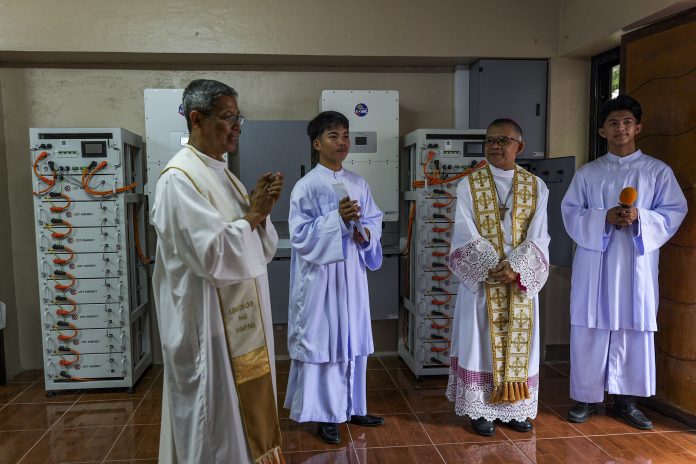
The Diocese of Calapan has brought solar power to 19 of its 43 parishes and facilities, reaching nearly half of its three-year target within eight months.
The initiative comes as Oriental Mindoro continues to depend on fossil fuels for electricity, with diesel-driven rates reaching as high as ₱18.29 per kilowatt-hour this year.
Bishop Moises Cuevas of Calapan said the diocese had reached nearly half of its target under a three-year plan to solarize key institutions and services in local communities.
“19 out of the 43 parishes and facilities within the Diocese are already using solar energy,” Cuevas said, adding that several Catholic schools are also preparing to shift to solar power.
“This is a realization of our advocacy, our commitment to pursue renewables as a model for other institutions to follow,” the bishop said.
The Center for Energy, Ecology, and Development (CEED), one of the convenors of REnew Mindoro, said Oriental Mindoro’s dependence on fossil fuels has exposed residents to high electricity costs.
“Every centavo increase is yet another reason to make the switch to renewable energy,” said Gerry Arances, CEED executive director.
Arances said solar power was “not an abstract, distant concept far from the public’s reach” but “a viable solution to our energy challenges, with the solarization of communities at the center of the energy transition.”
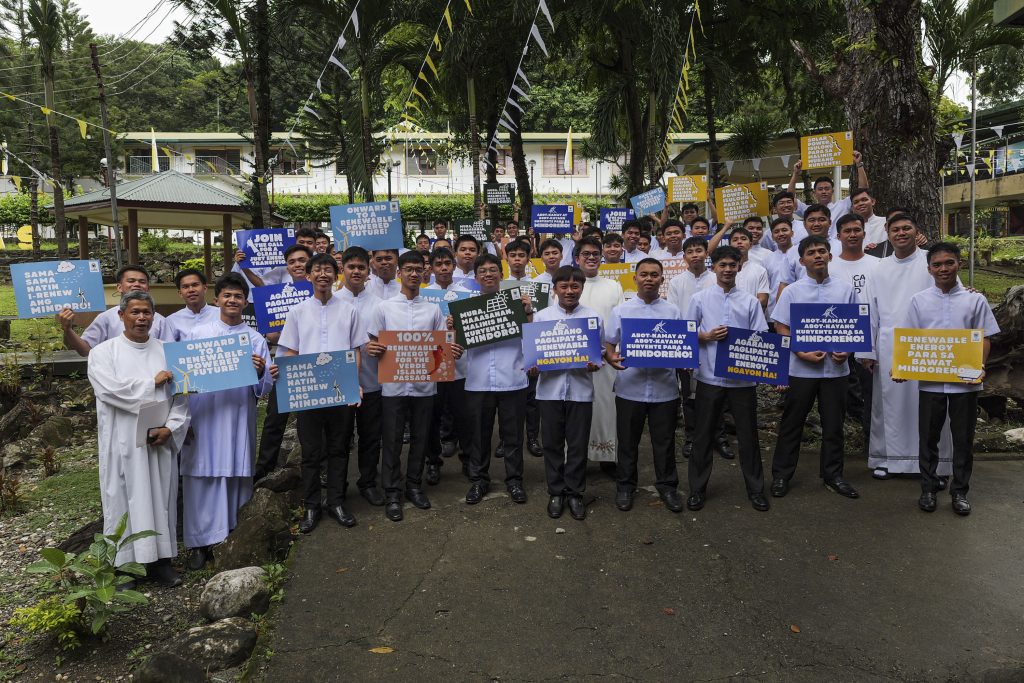
Bishop Cuevas said the program should eventually extend beyond Church facilities to schools, local governments and households, particularly Indigenous Peoples and communities most affected by costly and unreliable electricity.
“Solarization can and must be extended towards other parishes, to schools, to local government units, and to households all over the island, especially for indigenous peoples and those most vulnerable to expensive, unreliable electricity,” he said.
“When we provide such access to renewables, we then support the dignity and well-being of our people,” the prelate added.
The bishop said the transition would require participation from institutions beyond the Church.
“However, we must not do this alone, because caring for creation is a shared moral responsibility to be carried by the Church, schools, the private and public sectors, financiers, and local government,” he said.
The diocese is also linking its solarization program to the Season of Creation and efforts to protect the Verde Island Passage from the environmental effects of fossil fuels.
Fr. Edwin Gariguez, lead convenor of Protect Verde Island Passage, said the diocese’s solar projects were “a concrete response” to the call to care for the environment.
“The Verde Island Passage must not be treated as an expendable resource far removed from our livelihoods and communities, but as a call to action for all Mindoreños,” Gariguez said.
“When we switch away from fossil fuels towards community-centered solar energy, we thus protect our lands, our waters, and our communities against the pollutants and environmental degradation brought by coal, gas, and diesel,” the priest said.