
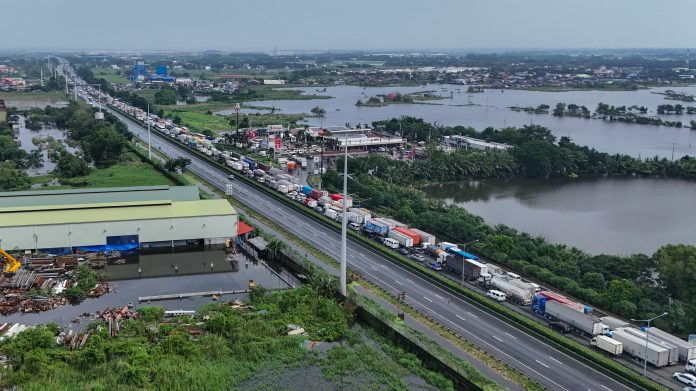
Cardinal Pablo Virgilio David called for an investigation into NLEX Corporation and raised the possibility of collective legal action after spending nearly five hours trapped on the expressway because of flooding in the San Simon area.
In a social media post, the bishop of Kalookan questioned whether the tollway operator had adequately fulfilled its obligations to motorists, citing repeated flooding and the lack of sufficient warning before drivers reached affected sections.
“Perhaps it is time for affected motorists to explore a collective legal action and ask the Toll Regulatory Board to investigate whether NLEX Corporation has adequately fulfilled its obligations to the motorists from whom it collects tolls,” he wrote.
The prelate said motorists deserve “a clear explanation, an effective early-warning and diversion system,” as well as consideration of refunds or toll credits when they are allowed to enter and pay for the expressway even when management already knows that traffic ahead has become “virtually impassable.”
The cardinal said he spent almost five hours caught in traffic because of flooding in San Simon, with vehicles barely moving and motorists unable to leave the expressway.
“It reached the point when some of us could no longer hold our bladder and had to pee into a bottle inside the vehicle,” he wrote.
“I could only imagine how much worse the ordeal must have been for women, children, elderly passengers and people with medical conditions,” he added.
David said flooding in the area was not unforeseen, noting that San Simon has repeatedly flooded during the rainy season.
“NLEX management knows where the vulnerable sections are. It has real-time information on road and traffic conditions,” he wrote.
He questioned why motorists were not adequately warned before entering the expressway or before reaching the flooded section, particularly those driving sedans and other low-clearance vehicles.
“This is not merely an inconvenience. It is a question of motorists’ rights and public accountability,” David said.
He said motorists pay substantial tolls with the expectation that the expressway will provide “a reasonably safe, properly maintained and efficiently managed facility.”
David acknowledged that NLEX cannot prevent typhoons or extraordinary rainfall but said management can anticipate flooding in known flood-prone areas, monitor water levels, warn motorists early, and divert traffic before thousands of vehicles become trapped.
“And after years of recurring flooding in the same place, surely we have the right to ask: What permanent engineering solution has been undertaken, and why has it not solved the problem?” he wrote.
David said motorists were not asking the tollway operator to control severe weather, but to properly manage recurring and foreseeable problems.
“This is not asking the impossible. We are not demanding that NLEX control the weather. We are demanding that it properly manage a tollway despite the weather—especially when the problem is recurring and foreseeable,” he said.
He said motorists should not be expected to endure the same ordeal year after year.
“We pay the toll. We have a right to safe roads, adequate warning and accountable management.”