The social action arm of the Catholic Church in the Philippines has called for the immediate suspension of the Talim Wind Power Project until environmental requirements are met.
Caritas Philippines stressed that energy projects must only proceed if an independent scientific assessment is completed and affected communities are given meaningful participation in decisions.
Bishop Gerardo Alminaza of San Carlos, president of Caritas Philippines, said the Church supports the transition from fossil fuels to renewable energy but warned that clean energy projects should not come at the expense of communities and ecosystems.
“We therefore call for the immediate suspension of all activities connected with the Talim Wind Power Project until full environmental compliance,” he said in a statement.
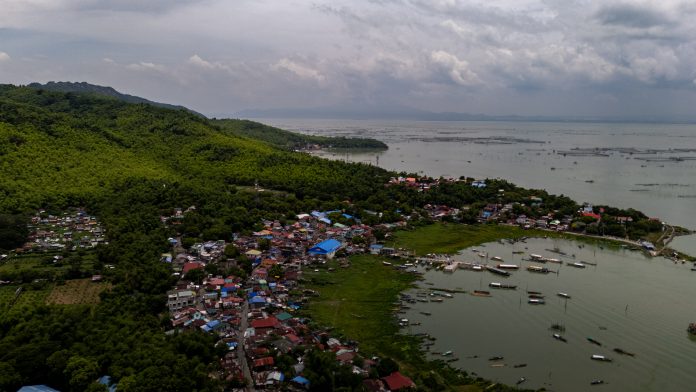
The project proposes 34 wind turbines with a generating capacity of up to 218.75 megawatts across parts of Binangonan and Cardona in Rizal province. Its project area covers about 3.4 million square meters and includes access roads, transmission facilities, and a substation.
Community organizations estimate that more than 40,000 residents and fisherfolk could be affected, according to the statement.
Residents have reported tree cutting, disturbed vegetation, flooding in coastal communities, and biodiversity loss around Mount Tagapo.
They have also raised concerns over possible effects on fishing grounds, farms, homes, drainage, and community safety.
The prelate said that “these reports require independent verification” and must not be treated as settled scientific findings before a credible investigation.
He cited a municipal inspection that found grading and earthmoving had taken place, and that vegetation and slopes had been disturbed.
Some required environmental documents were also unavailable at the project site, while the inspection recommended temporarily suspending earthmoving and grading pending compliance.
Alminaza said the findings “warrant caution and independent assessment before further work proceeds.”
Kapit sa Talim Association Inc. has sought environmental and hazard assessments, emergency-response plans, permits, monitoring reports, local resolutions, and records of consultations with affected communities.
Alminaza said residents should have access to information about projects that could affect their environment and livelihoods.
“People should not have to appeal to Malacañang for information about a project that could transform their environment and livelihoods,” he said.
“They have the right to know what has been approved, what risks have been identified, and whether safeguards are being followed,” he added.
He acknowledged company initiatives, including the donation of 1,000 school chairs and livelihood opportunities for residents, but said such programs could not substitute for environmental safeguards and meaningful participation.
“Corporate social responsibility cannot prove that communities have accepted the project,” Alminaza said.
He urged the government to withdraw its approvals if an independent investigation finds that the project has caused, or is likely to cause, serious and irreversible harm.
Citing mapping by the Center for Energy, Ecology, and Development, Caritas said 257 wind projects are proposed nationwide with a combined potential capacity of 90,311 megawatts. Of these, 216 are onshore, 35 are offshore and six have both components.
Alminaza said the renewable energy transition must not reproduce environmental damage and social injustice.
“Clean energy must not come at the cost of communities and creation,” he said.
“We need not choose between protecting the climate and protecting communities. We must protect both,” he added.