One of the spiritual writers of our time, Henri Nouwen, writes about spiritual direction: “We also need guides: spiritual friends, a spiritual director, or a spiritual accountability group that can function for us as a safe place to bare our souls.”
He further said: “The goal of spiritual direction is spiritual formation—the ever-increasing capacity to live a spiritual life from the heart. A spiritual life cannot be formed without discipline, practice, and accountability.”
Who we are in our spiritual journey is largely influenced by our spiritual directors, especially during the early stages of that journey.
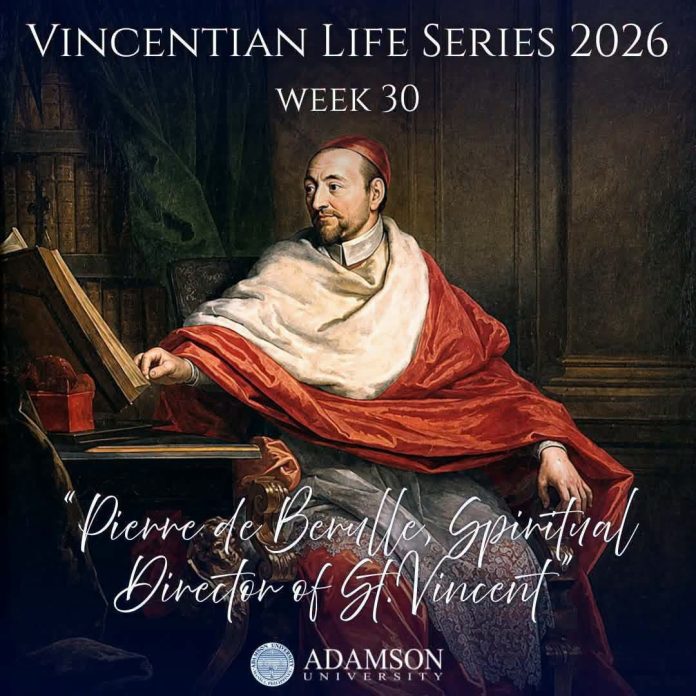
Pierre de Bérulle was Vincent de Paul’s spiritual director from 1609 to 1617. Later, however, Vincent parted ways with him, perhaps because of disagreements. Whatever the reasons were, Bérulle’s role in Vincent’s spirituality cannot be discounted.
He was Vincent’s spiritual adviser during crucial moments in his life. Vincent expressed his esteem for his director to his missionaries on one occasion:
“We should try to study after the fashion of the late Cardinal Bérulle, who as soon as he grasped the truth, gave himself to God either to do such and such a thing or to enter into such and such a sentiment or elicit appropriate acts, and by these means, he acquired such solid holiness that his like could scarcely be found.”
Bérulle was an important figure in the French school of spirituality. He belonged to the contemplative spiritual circle of Port-Royal, which promoted Carmelite spirituality in Paris during his time. Among his friends were Michel de Marillac and Madame Acarie.
Bérulle also founded a congregation of men called the Oratorians in Paris and became its superior general. He was later named a cardinal and served as chaplain to King Henri IV. He was a man of considerable influence.
How did Vincent meet Bérulle?
We know that Monsieur Vincent became the parish priest of Clichy, where he first experienced the joy of pastoral ministry. It was Bérulle who endorsed him for the post after the parish priest, Fr. Bourgoing, decided to enter the Oratorians. By then, Bérulle was already Vincent’s spiritual director. Vincent was serving as the aumônier of Margaret de Valois, the estranged wife of Henri IV.
After a short stay in Clichy, it was also Bérulle who instructed Vincent to return to Paris to become the tutor of the De Gondi children. This experience was crucial to Vincent’s formation. It brought him to the De Gondi estates in Folleville and Châtillon, where he underwent some of his core formative experiences. These eventually led to the establishment of the Congregation of the Mission. It was Bérulle’s hand and influence that led him there.
Vincent remained under the influence of Bérulle for seven or eight years, probably until about 1618. Vincent said of Bérulle, “He was one of the holiest men I have ever known.”
He later parted ways with his director. There is no known evidence of friction between these two great men. There was, however, a gradual divergence in the theological and pastoral directions of their spiritualities.
Central to Bérullian spirituality is the mystery of the Incarnation. Jesus Christ—the God made human—is the only way to return to the Father. We should “honor Him and his states of life,” “subsist in Him” and “adhere ourselves to Him.” St. Vincent adopted these phrases from Bérulle.
Jesus Christ’s human nature recapitulates the whole of creation. His divine nature is dynamically related to God. He is thus the “perfect adorer of the Father.”
“The very universe, which has come from God returns to God, to being reunited with Him by this divine mystery (of the Incarnation).”
St. Vincent also passed on to us the devotion to the Incarnation that he received from Bérulle (Common Rules, X, 2).
But Vincent went further, developing what is specifically Vincentian. Bérulle’s Christ is the Incarnate Word in his glorious humanity, who is the “Perfect Adorer of the Father.” Vincent’s Christ is the Good Shepherd who searches for the lost sheep. He is Christ, the Evangelizer of the Poor.
“There is nothing more Christlike than to go from village to village to help the poor people work out their salvation.”
One of their differences has implications for the meaning of the priesthood. Bérulle’s understanding of the priesthood, as embodied by the Oratorians, was to honor the priesthood of Christ by living a spiritual doctrine. They were not established to fulfill a definite function in the Church. According to Bérulle, the priesthood is a state of oblation and adoration in the spirit of Jesus, the Perfect Adorer of the Father.
Vincent’s priests, however, had to go to rural areas in the spirit of the Good Shepherd, with an effective concern for the lost sheep. Their dynamic motto was: “Evangelizare pauperibus misit me.” [He sent me to preach the good news to the poor.]
Fr. Hugh O’Donnell, CM, comments on the relationship between Vincent and Bérulle. He writes:
“I began to reach the conclusion that Vincent’s separation from Cardinal de Bérulle was not something he chose to do, rather it was something he had to do. He received a lot from de Bérulle [but] he was led in another direction… For de Bérulle, God was elsewhere. He regarded life in terms of taking what was happening in front of him and bringing it to the Divine liturgy before the throne of God.”
“Vincent’s experience led him in the opposite direction,” O’Donnell continues. “For Vincent, God is here and the Divine liturgy is in front of us. God is here! That’s why we can say the Poor are our Masters. God is here! God is here in poor people, in our experiences, in events and in the persons who are in our presence and in whose presence we are.”
By reading Bérulle, we come to understand the wider theological and spiritual context of Vincentian spirituality. We can thus understand St. Vincent more deeply when he says:
“Go to the poor and you will find God.”
Or, in another saying, “You can leave God for God” [for God in the chapel is also the God present in the poor].
Or, “The poor are our lords and masters; we are their servants.”
Father Daniel Franklin Pilario, C.M., is the President of Adamson University in Manila. He is a theologian, professor, and pastor of an urban poor community on the outskirts of the Philippine capital. He is also the Vincentian Chair for Social Justice at St. John’s University in New York.