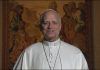
Mission is foremost in the mind of the present Church. When Pope Leo XIV first appeared on the balcony of St. Peter’s Basilica, these were among the first words he said:
“We must seek together how to be a missionary Church, a Church that builds bridges (and) dialogue, always open to receive (people), like this square, with open arms – everyone, all those who need our charity, our presence, dialogue and love.”
The same concern for mission was present in the mind of his predecessor, Pope Francis. Evangelii Gaudium is the title of Pope Francis’ first apostolic exhortation, issued in 2013. It was intended to serve as the platform of his papacy. He wanted to emphasize that mission is the identity of all Christians. For him, mission is the identity of the Church.
This statement is at the heart of Evangelii Gaudium: “My mission of being in the heart of the people is not just a part of my life or a badge I can take off; it is not an ‘extra’ of just another moment in life. Instead, it is something I cannot uproot from my being without destroying my very self. I am a mission on this earth; that is the reason why I am here in this world” (EG, 273).
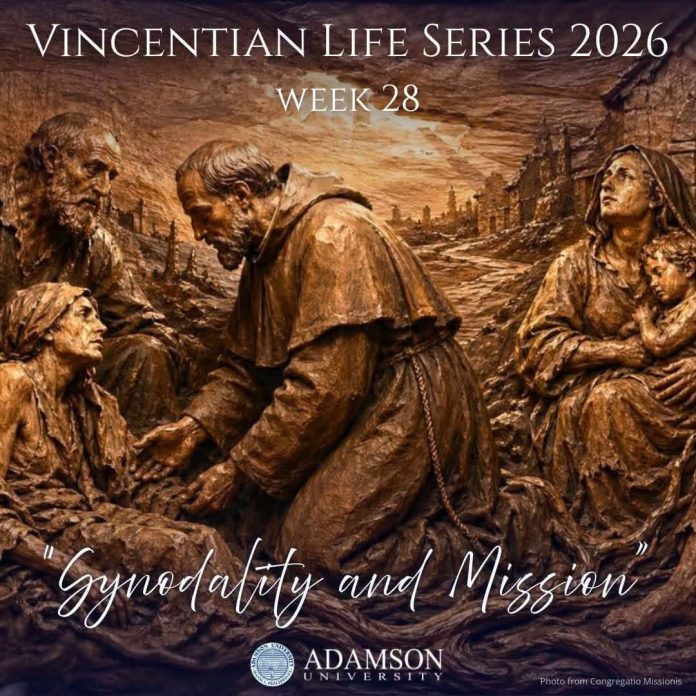
Mission is also at the heart of each Vincentian and of the entire Vincentian Family. The main purpose of our existence is mission. When Vincentian priests began giving missions in the rural areas of France, the people called them “priests of the mission.” St. Vincent wanted our houses to be called “houses of the mission.” He also commanded that each house, including seminaries, assign at least two priests to the mission.
Mission is not only a task that we perform. It is our sharing in the work of Jesus. In one conference, Vincent said: “And if one would ask our Lord: What have you come to do on earth? ‘To help the poor.’ And something else? ‘To help the poor.’ Now, He had only poor persons in His company and He devoted himself very little to cities, almost always conversing with and instructing village people.”
We are thus fortunate to belong to a family that shares in the purpose of the Incarnation. Mission is the reason God became human: “misit me evangelizare pauperibus” [he sent me to preach the good news to the poor].
“To work for the salvation of poor country people is the main purpose of our vocation, and all the rest is only accessory to it… Aren’t we very blessed, my dear confreres, to live authentically the vocation of Jesus Christ? For who lives better the way of life Jesus lived on earth than missionaries?” (Oct. 25, 1643, CCD 11, 121).
Even toward the end of his life, Vincent wanted to go on mission, even to the most dangerous places, such as Madagascar. In a letter to Father Charles Nacquart, who was sent to Madagascar, where many Vincentians died at sea, from disease or through martyrdom, he wrote: “What more can I say to you… there is nothing on earth I would like more than to go with you and be your companion, if only I could.”
St. Vincent’s theological view anticipated what would become contemporary Protestant missiology by nearly 400 years. He spoke of the Congregation of the Mission as participating in the mission of the Father and the Son in the world.
Mission among the poor was, first of all, the mission of the Father in Jesus, and it is the sign of the coming of the Messiah into our midst. When Vincent began explaining to his confreres the Common Rules on the purpose of the Congregation of the Mission, he placed Jesus at the center. Jesus is our model “in the way He acted, what he did, His ministries, and His aims.”
In another forward-looking intuition, St. Vincent anticipated contemporary missiology’s vision of mission as transformative action.
Pope Francis’ understanding of “new evangelization” is not merely about strategies for proclaiming the faith. He believed that the new evangelization should, above all, proclaim the “social message” of the Gospel. This constitutes nearly half of the content of Evangelii Gaudium. The Gospel is, first of all, Jesus’ proclamation of the Kingdom of God in action.
Without neglecting personal conversion and transformation, St. Vincent cautioned his followers against falling into a binary division of evangelical work—one spiritual and the other corporal.
As it is in the Gospels, mission for Vincent is integral and holistic.
“If there are any among us who think they’re in the Mission to evangelize poor people but not to alleviate their sufferings,” St. Vincent explains, “to take care of their spiritual needs but not their temporal ones, I reply that we have to help them and have them assisted in every way, by us and by others, if we want to hear those pleasing words of the Sovereign Judge of the living and the dead, ‘Come, beloved of my Father; possess the kingdom that has been prepared for you, because I was hungry and you gave me food to eat; I was naked and you clothed me; sick and you assisted me.’”
This basic Vincentian intuition was later elaborated through subsequent theological developments in the Church under many different names: integral evangelization, the preferential option for the poor, justice and peace, and care for creation. All of these are present in the social teaching of the Church. Contemporary missiology also appears in parallel forms, such as mission as inculturation and contextualization, liberation and development, common witness and dialogue.
Let us be concrete. If we want to take mission in our times seriously, the Vincentian Family today needs to make Catholic social teaching the primary site of our evangelization: human dignity and human rights, solidarity with laborers and Indigenous peoples, justice, peace, the integrity of creation, the empowerment of the poor, and the protection of the vulnerable.
In the end, synodality is not about us—not about communion among ourselves or our participation in our own isolated worlds. It is about those whom we, the Church, have excluded. Synodality sends us on mission to those whom the world has rejected: the poor, the hungry, the distressed and even the cosmos—all those forgotten by this self-referential and anthropocentric world.
Father Daniel Franklin Pilario, C.M., is the President of Adamson University in Manila. He is a theologian, professor, and pastor of an urban poor community on the outskirts of the Philippine capital. He is also the Vincentian Chair for Social Justice at St. John’s University in New York.