
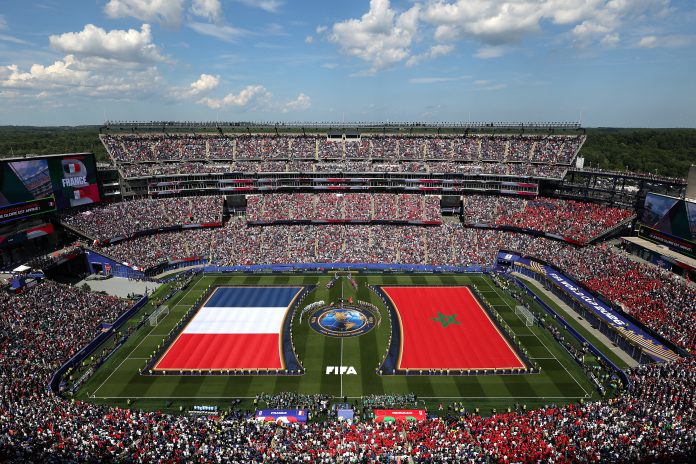
With the FIFA World Cup 2026 now well underway, the final is just around the corner. As a former footballer who still delights in the beautiful game from the comfort of a television screen, I confess I no longer have the stamina for midnight vigils. Checking the morning results is enough.
Yet beyond the scores lies something far deeper.
Viewed through the lenses of social psychology and anthropology, this global tournament is a mirror of modern humanity—a world bound by real-time communication, pulsing with the shared ecstasy of victory and the collective grief of defeat.
Consider Mexico City’s historic Azteca Stadium. Perched 2,200 meters above sea level with a capacity of over 87,000, it stands as a monument to football history.
It was here in 1970 that Italy defeated Germany 4–3 in a thrilling semifinal often called “the Match of the Century,” before Pelé led Brazil to a spectacular 4–1 final victory.
Sixteen years later, the same pitch saw Diego Maradona orchestrate Argentina’s 3–2 triumph over Germany.
To the casual observer, these are merely sporting milestones. But to scholars of human behavior, they are something far more profound: the liturgy of a global, secular religion.
1. The Anthropological Lens: Sacred Spaces and Collective Effervescence
Using the framework of the foundational sociologist Émile Durkheim, the parallels between the World Cup and religious practice are striking.
Durkheim coined the term collective effervescence to describe what happens when a community gathers for a shared ritual—singing anthems, wearing uniform colors, and moving in unison.
At the precise moment a national team scores, the boundaries of the individual ego dissolve. The solitary “me” gives way to a transcendent “us.”
In this light, a stadium is not merely an achievement of modern engineering; it functions as a cathedral. The players become a kind of priesthood performing precise rituals, and the ball itself becomes the sacred object.
When this sacred order is shattered, the fallout is devastating.
When Brazil constructed the Maracanã Stadium for the 1950 World Cup, it was intended as a monument to national greatness. Victory celebrations were already planned.
Thus, their shocking 2–1 final loss to Uruguay was not just a defeat. It was felt as a desecration of the sacred.
What should have been paradise turned instantly into purgatory, with reports of heart attacks and suicides in a nation whose worldview had been shattered.
2. The Social Psychology Lens: Identity and “Psychological Death”
Social Identity Theory helps explain this national trauma. Human beings anchor their self-worth in the groups they belong to.
For decades, football was where Brazil felt equal, if not superior, to the economic powers of Europe and North America. Success on the pitch became the country’s greatest source of global prestige.
“When the national team suffers a catastrophic defeat, fans do not merely process a lost match; they experience a form of psychological death.”
This explains the collective paralysis during Brazil’s infamous 1–7 semifinal loss to Germany on home soil in 2014.
The sheer brutality of the scoreline triggered waves of stress and depression across an entire population. It was a real-time dismantling of national identity.
3. The Sociological Lens: Imagined Communities and the Ritual Calendar
From a sociological viewpoint, football also heals social wounds. The theorist Benedict Anderson called nations imagined communities—millions of strangers who feel a deep brotherhood.
For 90 minutes, the inequalities between wealthy districts and impoverished favelas fade. Under the yellow-and-green jersey, all citizens are equal.
This four-year World Cup cycle works like the myth of the eternal return in classical theology.
It is a sacred calendar offering societies recurring chances for redemption and rebirth.
Brazil’s tragic 1950 loss left a generational scar known as the “stray dog complex”—the feeling that the nation was structurally flawed.
Pelé’s triumph in 1958 healed that wound and began an era of five World Cup titles.
However, the 2014 collapse reopened it, coming amid severe economic and political crises. The sporting failure mirrored a fracturing social structure.
The Internal Grammar of the Human Heart
Ultimately, the World Cup shows that even in an era dominated by advanced technology, algorithms, and artificial intelligence, we remain Homo religiosus—beings who hunger for ritual.
We may have traded ancient stone temples for concrete stadiums, and old gods for athletic heroes, but the inner language of the human heart remains unchanged.
We still long to escape our isolation and merge into something greater than ourselves.
The triumphs and tragedies in these sporting cathedrals are more than mere entertainment. They are the spiritual autobiography of humanity. They remind us that when our highest cultural anchors fail, we stare directly into the abyss of lost meaning.
As the 2026 World Cup unfolds across the stadiums of Mexico, Canada, and the United States, the billions watching on screens large and small are not just spectators. We are active participants in a timeless human liturgy.
Dr. Seri Phongphit is an acclaimed Thai philosopher, social innovator, and prolific author dedicated to grassroots empowerment. A Catholic born and raised in the Archdiocese of Tharae-Nongsaeng in northeast Thailand, he holds an M.A. from Rome and a Ph.D. in philosophy from Germany. Moving beyond traditional academia, he pioneered transformative local development models, most notably founding The Village Foundation and the University of Life project to cultivate community self-reliance and honor local wisdom.