A Catholic-backed coalition urged senator-judges to uphold transparency and public accountability as the Senate opened the impeachment trial of Philippine Vice President Sara Duterte on Monday.
As the Senate convened as an impeachment court, the Church People–Workers Solidarity (CWS) said impeachment “is a constitutional process designed to uphold public accountability” and “must neither be reduced to political theater nor manipulated for partisan advantage.”
The statement, signed by Bishop Gerardo Alminaza of San Carlos, chairperson of CWS, said the allegations surrounding Duterte’s use of confidential and intelligence funds “raise serious questions that deserve a full, transparent, and impartial examination.”
The coalition said accountability should not end with Duterte’s impeachment, insisting that it must extend to “everyone involved in every form of corruption.” “Our position remains consistent: Lahat ng sangkot, dapat managot,” it said.
The House of Representatives impeached Duterte in May on allegations that include misuse of public funds, bribery, unexplained wealth, and an alleged threat against President Ferdinand Marcos Jr. Conviction requires the vote of two-thirds of the Senate and would remove her from office and permanently disqualify her from holding public office.
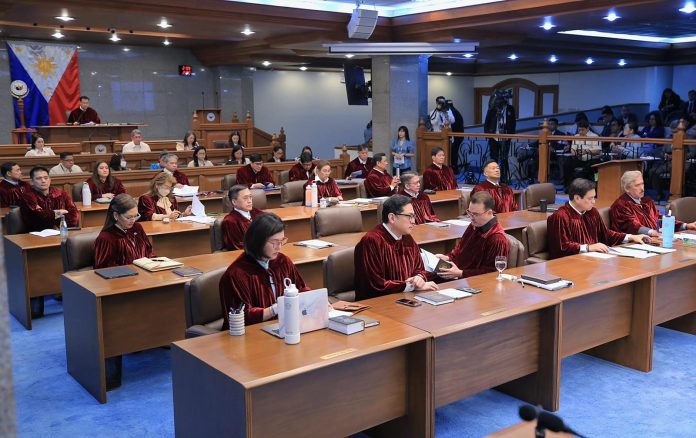
The Senate formally opened the trial on Monday, with senator-judges spending much of the first session debating transparency measures and constitutional questions before hearing any evidence.
The impeachment court heard opening statements from both the prosecution and the defense, but did not call witnesses.
Duterte was absent and appeared through her lawyers. Earlier in the day, she said her decision to “appear through counsel rather than testify personally does not diminish accountability or imply a lack of transparency.”
In his opening statement, Senate President Sherwin Gatchalian reminded senator-judges of their oath “to do impartial justice according to the Constitution and the laws of the Philippines.”
“This means that every decision we make must be based solely on the Constitution, our laws, the rules of this Court, and the evidence presented, without bias or partiality,” Gatchalian said.
He urged the impeachment court to ensure a fair and transparent process.
“Due process and fair play must remain paramount at every stage of this trial. Let us be firm in the search for truth. And let us remain faithful to the rules of this Court, the rule of law, and above all, the Constitution,” he said.
Public access to evidence quickly emerged as one of the day’s main issues after Senator-judge Bam Aquino sought assurances that documentary evidence would be made available without delay.
“[If) this is made available to the public six months from now or one year from now, that defeats the purpose of having this made public,” Aquino said.
Impeachment Court Presiding Officer Francis “Chiz” Escudero responded that documentary evidence was already being uploaded despite the volume of records and said the clerk of court would endeavor to make presented evidence available in real time, except for the journal, which requires the body’s approval before publication.
Senator-judge Risa Hontiveros also argued against holding executive sessions during the trial.
“I join with the presiding officer in the call that he made which, I believe, is the default also of the impeachment trial court for transparency. The executive session is only for Congress acting in its usual legislative functions and impeachment trials do not contemplate executive sessions,” she said.
The proceedings also exposed differing interpretations of the Constitution over who should preside over the impeachment court.
Senators Loren Legarda, Robin Padilla, Pia Cayetano, and Alan Peter Cayetano argued that the Senate President should preside, warning that changing the arrangement could undermine the validity of the proceedings.
“I do not want this impeachment trial declared null and void. I do not want delays. I do not want walkouts. Why can we not simply follow the Constitution?” Alan Peter Cayetano said.
Senator-judge Kiko Pangilinan disagreed, arguing that “The Constitution does not provide that the Senate President must preside in cases of impeachment trial.”
In its statement, CWS urged senator-judges to discharge their constitutional duty with “independence, integrity, and courage,” saying “conscience—not political loyalty, personal ambition, or partisan interest—guide every decision.”
The coalition also called on Filipinos to remain “vigilant, informed, prayerful, and engaged,” adding that democracy cannot survive without citizens who insist on “truth, transparency, and accountability.”
It reiterated that public office is “a sacred trust” and renewed its appeal for governance marked by integrity, transparency, genuine public service, and a preferential option for the poor.