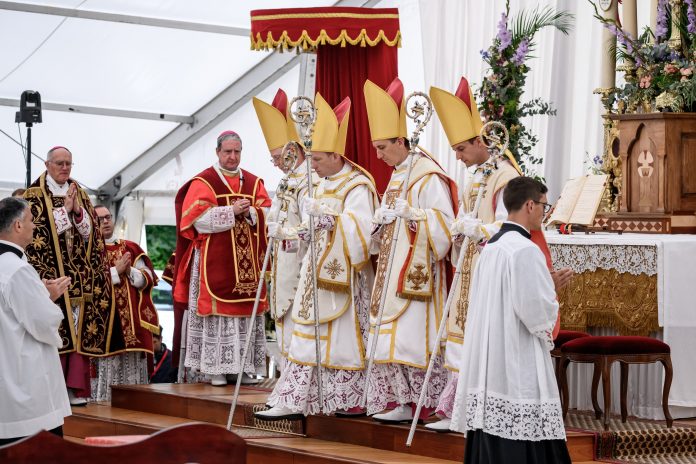
People are asking how to understand the recent excommunication of the Society of Saint Pius X (SSPX) that hit the headlines. They are asking how can a church which prides itself in synodal processes can still declare excommunication at present. Before we present an opinion or take a position in the present debate, it might be good to take stock of its long complex history.
Just this month, on July 2, 2026, Pope Leo XIV excommunicated the Society of St. Pius X (SSPX) after they ordained four new bishops without expressed permission from the Pope.
Before this event, the pope wrote them a personal letter to “please turn back”. Despite this, they proceeded with the ordination in the open field at Econe, Switzerland with more than a thousand faithful followers attending.
But this is not the first time. In June 1988, Archbishop Michel Lefebvre, the founder of the group, consecrated four new bishops without permission from John Paul II for which he gained excommunication. His group — the SSPX — was declared a schismatic group. A “schism” (which means “rift” or “split”) happens when there is a disagreement between doctrine, discipline or leadership in the church.
However, in 2009, Pope Benedict XVI lifted the excommunication to give way to their reconciliation with the church. But the developments went the other way in the recent events under Pope Leo XIV. This disobedience in policy — permission from Rome to ordain a bishop — actually proceeds from a deeper divergence in doctrine and theology.
It is helpful to understand this complex story.
1. (RE)READING VATICAN II
In the halls of Vatican II in 1962, there were already real debates, some of them very dramatic leading to walk-outs, between the so-called “progressives” and “conservatives”.
On the one hand, those who wished to preserve the status quo were a minority but they held crucial positions in the Curia (the present Congregation of the Doctrine of the Faith [CDF] then called “The Holy Office”). They prepared the drafts for discussion (schema) and controlled the Council agenda.
On the other hand, the bishops who wanted change were influenced by the brewing renewal movements then (liturgical, biblical, ecumenical, patristics) and listened to emerging theologians during that time (Rahner, Congar, Schillebeckx, Ratzinger, etc.). They were not many but they were able to slowly rally the majority.
Colorful anecdotes abound on the clash of these two contending paradigms in the Council. The first encounter already started on the first day – October 13, 1962. The Council fathers were asked to vote on a pre-selected list of bishops to head the different commissions. Most of the names in the list were members of the Roman Curia.
Cardinal Liénart of France rose up and, in a prepared speech, proposed that they first meet in caucuses as bishops conferences in order to select their own candidates. It was seconded by Cardinal Frings of Germany – whose theologian-consultant was the young priest, Fr. Joseph Ratzinger, the future Pope Benedict XVI. This suggestion was greeted with a long applause indicating the sentiment of the assembly – of which a vote is no longer necessary. After barely 15 minutes of session that first day, the moderator adjourned the meeting to give in to the proposal.
In the words of the young Fr. Ratzinger: “a decision of great moment had here been made. The Council had shown its resolve to act independently and autonomously, rather than be degraded to the status of a mere organ of the preparatory commission” (Ratzinger 1966).
There are at least three existing interpretations: for want of a better name, we call them the traditionalists, the progressives, and the reformers (Faggioli 2012). It might be good to lay down their positions vis-à-vis Vatican II since their differing interpretations make our reading of Vatican II a bit confusing but also more exciting.
2. THE TRADITIONALISTS
From the minority conservative wing of the Vatican II debates emerged the ‘traditionalists’ who rejected the Council itself. They could not swallow the change that Vatican II teaches — from its tinkering with the liturgy, religious freedom, relationship with other religions, etc. They think that what happened there was a maneuvering of some northern European bishops, thus, could never be a work of the Holy Spirit.
Some people in this group are also called the ‘sede vacantists’ since the Papacy should have been vacant (sede vacante) from the time Pope Paul VI promulgated the acts of the Council. According to them, by adopting Vatican II, the Church has become heretical or schismatic and Paul VI formally ceased to be a pope. Spread all over the world – in blogs, movements, internet groups, periodicals, etc. – the traditionalists’ foremost representative is the Society of St. Pius X (SSPX) founded by Archbishop Marcel Lefebvre (though Lefebvre was not sede vacantist). His description of his disobedient stance vis-a-vis the pope was that of a son forced to disobey a father’s wrong command).
Lefebvre’s group continued celebrating the Tridentine Mass, rejected Vatican II and thinks that the Catholic Church has been infiltrated by liberals, communists and freemasons. That is why today, they say that it is their group is the one that preserves the Catholic religion from corruption.
When Lefebvre consecrated four bishops to succeed him in his Congregation without permission from Rome, John Paul II excommunicated him and the bishops he ordained. The plot becomes more complicated when Pope Benedict XVI lifted the excommunication of these bishops in 2009, allowed the celebration of the Tridentine Mass for all Catholics and opened the way for their rehabilitation – to the uproar of many European Catholics who knew all along that one of those bishops (Richard Williamson) was openly anti-semitic and denied that the holocaust happened to the Jews.
In the different turn of events, on January 30, 2021 Pope Francis said that there should be no concession to those who deny the teachings of Vatican II. “You can be with the church and therefore follow the council, or you can not follow the council or interpret it in your own way, as you want, and you are not with the church,” the pontiff said in a meeting with a group of catechists connected to the Italian bishops’ conference.
“The council is the magisterium of the church,” said the pope. “On this point we must be demanding, severe. The council cannot be negotiated.” For him, Vatican II is the work of the Spirit. We either follow the Spirit or not.
3. THE PROGRESSIVES
The second group carries the “progressive” line of interpretation of Vatican II. This group tries to advance the direction that the Council took as it was passed by the majority of bishops in the Assembly. As you well know, all the 16 documents were approved with very large majority of votes.
After the Council, these bishops and theologians set to implement Vatican II’s liturgical reform, push structures of collegiality, open the church to dialogue with the modern world and with other religions.
There was euphoria after the Council. Vatican II was considered a decisive “event” (Komonchak), a “rupture” from the previous councils, “the beginning of the beginning” (Rahner), “new Pentecost” (John XXIII, Ratzinger), etc.
But there was also so much to do: to adapt liturgical celebration and formulate new norms, to systematize the new theology, etc. Leading theologians that belong to this group were also the theologian-consultants (calked “periti” or experts) of the Council – Karl Rahner, Marie-Dominique Chenu, Yves Congar, Edward Schillebeeckx, Hans Küng, etc.
This group started a journal called Concilium in 1965 in order to theologically reflect “and continue the work of Vatican II”. Today, Concilium is translated into 5 languages and serves thousands of subscribers all over the world, to which I have the privilege to serve as one of its editors for 12 years. Earlier, Ratzinger was among its first editors. Later, Ratzinger parted ways with them.
This direction of reading Vatican II came to its height upon the election of Pope Francis. He said about the Vatican II: “The Council is the Magisterium of the Church. Either you are with the Church and therefore you follow the Council, or you interpret it in your own away, according to your desire, you do not stand with the Church.”
Pope Leo XIV followed the lead of Pope Francis. He thinks that the Vatican II is the Church’s constant “North Star” and continued its catechesis on the Council to all faithful.
4. THE REFORMERS
The third group is sometimes called the “hermeneutics of reform” (Faggioli 2012; O’Malley 2012). While the progressives are said to advance the hermeneutics of rupture or discontinuity, this group calls for the hermeneutics of reform or continuity.
According to them, Vatican II is not a rupture but is in fundamental continuity with the whole tradition of the Church. Belonging to this group is another set of theologian-consultants of Vatican II – Henri de Lubac, Jean Danielou, Hans Urs von Balthazar and Joseph Ratzinger.
While the second group has Concilium, the journal founded by the group in the 1970s, the reformers has Communio, another journal which they founded. Both theological journals exist until our times.
Some authors define the debate between these two camps as rooted from their different theological pedigrees. While the progressives are neo-Thomists; the members of the third group are neo-Augustinians.
They also differ in method: while the second group reads Vatican II as a challenge to fully engage the modern world and its challenges (aggiornamento), this third group argues for a renewal of the church by going back to the sources (ressourcement).
There are several Catholics who are not members of SSPX but are followers of the Latin liturgy, and followers of this group. They are not also “sede vacantists” but they think that the Tridentine rite is the normal way to celebrate the Mass. Their theology is traditionalist — in their approach to changes in the contemporary world and in their way of dealing with their religious others.
However, this situation became complicated when Pope Francis issued “Traditiones Costudes” (2021) which says that the Vatican II liturgy (and not the Tridentine rite) is the normal expression of worship in the Catholic church. The Tridentine Latin Mass (TLM with priest facing the altar) is still permitted but restricted to a single location in one diocese.
Pope Leo XIV wrote the SSPX leader before the recent episcopal ordination: “Please turn back! I urge you to consider carefully the spiritual good of the faithful, because the schismatic act you are about to undertake would deprive them of the licit and, in some cases, even valid reception of the Sacraments.” We also know that the Vatican outlines some ways for SSPX to go back to the church’s fold even after the schismatic act.
I do not want to justify the recent movement of the SSPX despite the plea from the pope. But we now know that the difficulty is not just liturgical and devotional. It is rooted in the long and complex theological history which was going on for decades.
This makes the reading and rereading of Vatican II today more complex – but also more exciting – than usual. It is good to distinguish these different readings in order to understand the challenges of Vatican II as it is played out in the convoluted theological debates and pastoral movements in our times. But it is also good to study them deeply as responsible Catholic Christians of our times.
Father Daniel Franklin Pilario, C.M., is the President of Adamson University in Manila. He is a theologian, professor, and pastor of an urban poor community on the outskirts of the Philippine capital. He is also the Vincentian Chair for Social Justice at St. John’s University in New York.