Updated: Adds Dicastery for Communication international conference on AI in Rome
Pope Leo XIV warned in his first encyclical that artificial intelligence (AI) is already becoming a social justice crisis, cautioning against concentrated technological power, digital inequality, and the erosion of human dignity.
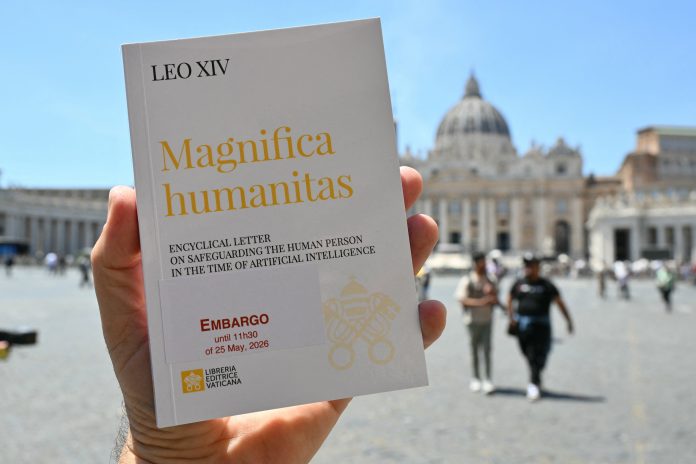
In Magnifica Humanitas, released May 15, the pope said humanity faces a defining choice in the age of AI: “either to construct a new Tower of Babel or to build the city in which God and humanity dwell together.”
The encyclical, focused on safeguarding the human person in a rapidly digitalizing world, presents AI not merely as a technological development but as a moral, political, and social challenge already reshaping daily life, labor, communication, and governance.
“Never has humanity had such power over itself,” Leo XIV wrote, warning that emerging technologies are now deeply embedded in “decision-making processes” and are increasingly shaping “the collective imagination.”
The pope expressed particular concern over the growing concentration of technological influence among private corporations.
“In the past, it was largely up to the State to guide and direct innovation,” he wrote. “Today, however, the main drivers of development are private, often transnational, parties that are endowed with resources and the capacity to intervene that surpass those of many Governments.”
Leo XIV said the issue extends beyond regulation and demands deeper moral discernment about power and its consequences.
“We must realistically ask ourselves who holds this power today and how they use it,” he wrote.
Drawing from the biblical story of the Tower of Babel, the pope cautioned against technological systems driven by profit, uniformity, and domination rather than human dignity and solidarity.
He described Babel as “a project conceived without reference to God, supported by a uniformity that eliminated diversity and that chose homogenization over communion.”
Leo XIV warned against what he called the “Babel syndrome,” which he described as “the idolatry of profit that sacrifices the weak” and “the pretense that a single language — even a digital one — can translate everything, including the mystery of the person, into data and performance.”
Throughout the document, the pope repeatedly stressed that technological progress cannot come at the expense of human dignity, especially for the poor and vulnerable.
He criticized ideologies that measure human value according to productivity or efficiency, calling them “particularly insidious.”
“Persons end up being reduced to a means of achieving results, a resource to be used and exploited, and are no longer recognized as a proper end in themselves who should never be instrumentalized,” the pope wrote.
The encyclical also linked technological transformation to widening social inequalities, warning against systems that exclude entire populations while promising unlimited progress for a privileged few.
Leo XIV called on governments, educators, scientists, workers, and faith communities to take shared responsibility in shaping the digital age around the common good rather than private interests.
“In the era of artificial intelligence, when human dignity is threatened by new forms of dehumanization, ours is the pressing duty to remain profoundly human,” he wrote.
“True progress always stems from a heart open to others, an intelligence willing to listen, and a will that seeks what unites rather than what separates,” he added.
The encyclical was released a week after the Vatican’s Dicastery for Communication convened an international conference in Rome examining the social and ethical consequences of artificial intelligence.
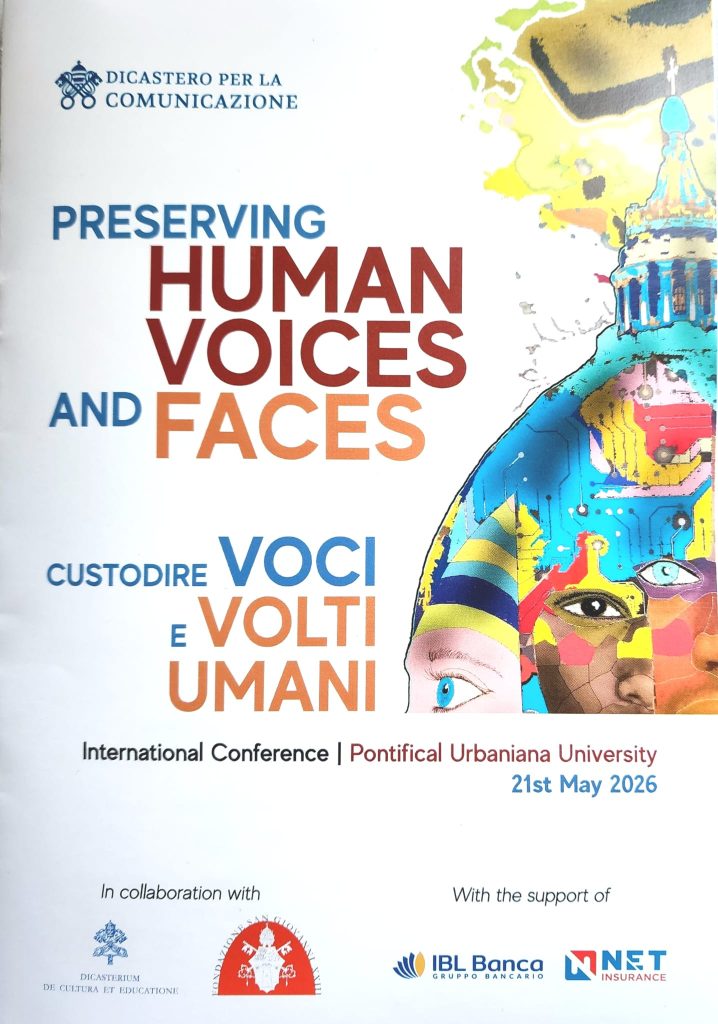
The conference, titled “Preserving Human Voices and Faces,” was held May 21 at the Pontifical Urbaniana University and brought together Church leaders, technologists, academics, and digital rights advocates to discuss the human impact of emerging technologies.
Dr. Paolo Ruffini, prefect of the Dicastery for Communication, said society should strive for “relationship with others that is not just a computation.”
“Human beings can never by reduced to a profile, a datum, an algorithm,” Ruffini said.
Cardinal José Tolentino de Mendonça, prefect of the Dicastery for Culture and Education, urged participants: “Do not give up your capacity to think.”
Among the speakers was Tristan Harris, co-founder of the Center for Humane Technology, who described social media as a “societal catastrophe” driven by companies “racing to the bottom of the brainstem” in pursuit of profit and attention.
Eli Pariser, co-director of New_ Public, said the “hardest problem” in connecting people online was “not technological but economic and governance,” warning that many technology companies prioritize “engagement” and profit over public wellbeing.
Neil Lawrence, DeepMind Professor of Machine Learning at the University of Cambridge, warned that “a wealth of information creates a poverty of attention,” comparing artificial intelligence to an algae bloom that consumes surrounding resources while reducing human diversity and complexity.
Dr. Joy Buolamwini, founder of the Algorithmic Justice League, also spoke about how some sectors of society are “excluded” from opportunities, representation, and recognition through AI systems.
Discussions during the conference focused on how to avoid what participants described as an “anti-human future,” including concerns over the concentration of resources in the global race for AI dominance and the growing social harms linked to algorithmic systems.