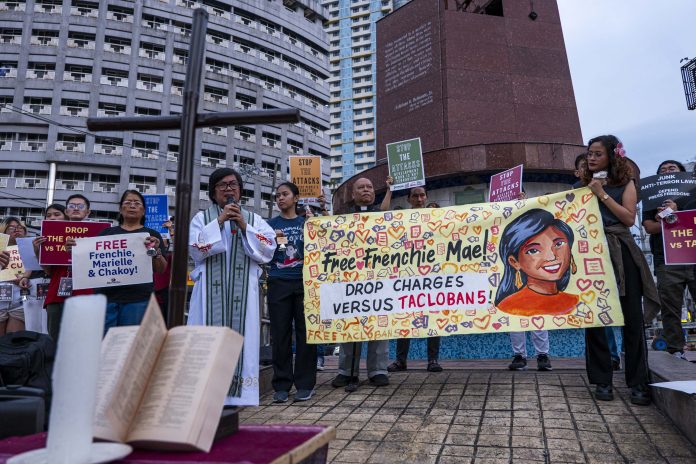
Journalist Frenchie Mae Cumpio is a member of a group of social activists and human rights defenders who were arrested in Tacloban City on Feb. 7, 2020. She and a companion, church worker Marielle Domequil, were charged with illegal possession of firearms. In July 2020, murder and attempted murder charges were filed against Cumpio, and in October 2021, the charge of terrorism financing was added to her case.
In October 2025, the Court of Appeals dismissed Cumpio’s civil forfeiture case related to terrorism financing, finding no evidence linking her to terrorist groups. A few months later, the Regional Trial Court of Laoang dismissed the murder and attempted murder charges against her. In January 2026, her illegal possession of firearms case was dismissed. Allegedly, the military “planted” firearms and ammunition. However, both Cumpio and Domequil were convicted of terrorism financing by Judge Georgina Uy Perez and sentenced to 12 to 18 years in prison. Cumpio’s defense team challenged her conviction on March 23 before the same judge, who has made no decision on the charges or on granting bail. Until now, both women remain detained.
There was widespread shock and protests over this conviction, seen as repression of press freedom and a frame-up. Human rights groups and press freedom bodies have condemned Cumpio and Domequil’s conviction and continued detention, with United Nations Special Rapporteur Irene Khan saying the charges appeared to be “in retaliation for [Cumpio’s] work as a journalist.” Prior to her arrest, Cumpio covered alleged abuses of power perpetrated by the military and was red-tagged along with her colleagues.
Observers say the terrorism financing charge against Cumpio and Domequil was fabricated, and their case was pursued to satisfy the Philippine government’s need to find suspects to charge and convict, as the country sought to get off the gray list of the Financial Action Task Force (FATF). Being on that list blocked international transactions of money transfers by Filipino tycoons suspected of money laundering and others accused of terrorist financing, and the government was doing little or nothing about it. FATF inspectors said the Philippines was under “increased monitoring due to deficiencies in their anti-money laundering and counter-terrorism financing (AML/CFT) systems.”
This is because some politicians, police officers, and corrupt businessmen are deeply involved in these crimes themselves, especially laundering stolen cash. They could not admit their guilt and instead found suspects and charged them with crimes to show the FATF they were compliant with international regulations and to get the Philippines off its gray list.
The Department of Justice (DOJ) filed more charges against suspects using Republic Act (RA) 10168, or the Terrorism Financing Prevention and Suppression Act of 2012, and secured convictions against six more people. They were convicted on 114 counts of terrorism financing as efforts intensified from around 2024 to 2025. As a result, community workers providing donations of food or money to alleviate poverty and hunger among the 14 million hungry Filipinos, including victims of typhoons, could be branded as criminals.
Innocent people declared guilty
Many other activists and nongovernmental organization workers have been charged with similar crimes but not yet convicted. Some cases have been dismissed by fair and upright judges for lack of evidence, such as those against activists Fritz Labiano, Paul Tagle, and Jazmin Jerusalem, who were declared innocent. But how many more innocent people have been declared guilty to “appease” the FATF and open the doors to unimpeded international money transactions?
The Philippines’ financial elite and their political cronies, with elements in the DOJ as their instruments, “scapegoat” suspects to get off the gray list and remain off it. After the sudden surge in filing terrorism financing charges and convictions in 2025 and 2026, the FATF removed the Philippines from the gray list in February 2025. These convictions were likely encouraged by tycoons and their political allies to escape the task force’s monitoring.
The government is increasingly using the law to silence community workers and journalists. The outcry over the injustice of these alleged frame-ups and convictions has been widespread. “Frenchie’s case is significant globally and emblematic of the challenges faced by journalists worldwide,” said Beh Lih Yi of the Committee to Protect Journalists during a briefing at the University of the Philippines Diliman on Jan. 20, 2026. Five UN special rapporteurs, including Khan and Ben Saul, called Cumpio’s conviction “deeply troubling” and urged the court to grant bail during the appeal process. Reporters Without Borders denounced the verdict as a “devastating failure” of the Philippine justice system, noting that its own investigations found the accusations inconsistent and that the conviction showed a “blatant disregard for press freedom.”
The International Press Institute condemned the “sham trial” and called for Cumpio’s immediate release, noting that she was held without trial for six years in pretrial detention. Justice in some courts, observers note, does not move at all. The National Union of Journalists of the Philippines said the conviction “does not bode well” for the media’s ability to report without reprisal. They described the acquittal on firearms charges as only a “partial victory” and vowed to continue the fight. The organization Altermidya expressed outrage over “glaring evidence of fabricated charges” and warned the verdict deepens a “climate of impunity.”
Human rights alliance Karapatan told the media that the conviction was a “deliberate plot” to punish those engaged in journalism and humanitarian work, claiming the court treated “lies as proof.” The National Union of People’s Lawyers said the case sent an “unmistakable message” that legitimate civic activity could now be recast by authorities as terrorism financing.
Not all money launderers are convicted, especially government officials. We recall the case of a retired police officer who served as comptroller of the Philippine National Police (PNP). On Oct. 11, 2008, he, his wife, and seven police generals were intercepted at Moscow’s international airport by customs personnel, who found 105,000 euros (approximately P6.9 million at the time) in their carry-on bags. Russian authorities confiscated the money. The seven officers were part of a delegation of eight senior PNP officials — dubbed the “euro generals” by the media — returning from an Interpol conference in Saint Petersburg. They were accused of money smuggling and laundering funds from the PNP intelligence fund. The case was later reduced to violations of currency declaration laws, as the amount exceeded the $10,000 limit allowed without declaration.
From 2008, court hearings were delayed for 14 years. In October 2022, the Sandiganbayan found the general guilty of violating Bangko Sentral ng Pilipinas rules on foreign currency declaration and ordered him to pay a P200,000 fine. His wife was acquitted for lack of evidence, while the other generals were not charged with money laundering and walked free.
However, a critical journalist and a church worker doing legitimate work, safeguarding the truth and helping the poor, were convicted and sentenced to up to 18 years in prison. If that is not a travesty of Philippine justice, what is?
Note: Any original information, stories, or news articles posted on this site that are authored by the Preda Foundation and Father Shay Cullen may be shared, copied, or reproduced without further permission, in support of truth, freedom of expression, and the public’s right to know.
LiCAS News was granted permission to republish and adapt this article by Father Shay Cullen in the spirit of truth-telling and the pursuit of justice.
Irish missionary Father Shay Cullen, SSC, founded the Preda Foundation in Olongapo City in 1974 to promote human rights and the rights of children, especially victims of sexual abuse.
The views expressed in this article are those of the author and do not necessarily reflect the editorial stance of LiCAS News.