
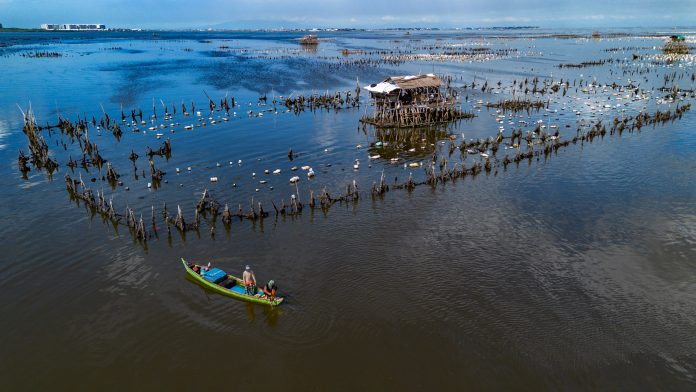
Fisherfolk groups and environmental advocates called on the government to provide immediate fuel subsidies and pursue alternative energy solutions as rising fuel costs threaten livelihoods and food supply.
“It is troubling to see our fisherfolk face the risk of being pushed further into poverty as the cost of fuel continues to rise,” said Father Edwin Gariguez, lead convenor of Protect VIP.
The priest warned that fisherfolk “carry the heavy burden of providing for their families while ensuring our country’s food supply does not run empty.”
He urged authorities “to not turn a blind eye to the struggles of the fisherfolk sector and provide immediate and adequate subsidies to ease them of the burden of this crisis.”
Diesel prices are expected to exceed ₱130 per liter, while gasoline may rise past ₱100 per liter this week, further straining coastal communities already facing declining fish catch and rising operating costs.
Fisherfolk in Batangas said they are earning less as they travel farther to sea, consuming more fuel while bringing home smaller catches.
“We fisherfolk already earn very little, and now it’s even harder with the continuous increase in diesel prices,” said Benito De Castro, president of Bukluran ng Mangingisda sa Batangas. “We hardly earn anything anymore because when we go out to sea, we really have to travel farther, which consumes more diesel.”
“On top of that, our fish catch is already declining, not like before when the sea was abundant,” he added.
The group said the government’s ₱3,000 annual fuel subsidy for fisherfolk is insufficient.
“Our appeal is for us fisherfolk to be given immediate support,” De Castro said. “We’re already earning almost nothing from fishing, and the continuous rise in prices only makes things worse.”
“A Php 3,000 annual subsidy is not enough – in reality, it’s just loose change, equivalent to only Php 8 a day or Php 250 a month. That’s not enough to support our families.”
The Department of Agriculture has warned that retail prices of rice, pork and chicken may increase by at least 50 percent within 180 days, raising concerns over food supply.
On March 25, President Ferdinand Marcos Jr. declared a state of national energy emergency amid the ongoing Middle East conflict. Electricity rates are also expected to rise starting April.
Environmental groups said the crisis highlights the risks of continued reliance on fossil fuels, particularly in ecologically sensitive areas such as the Verde Island Passage.
“The US-Israel war on Iran shows that our dependence on fossil fuel – and its expansion in biodiverse areas like the VIP – not only threatens vulnerable ecosystems but also compounds economic pressures due to its market volatility,” said Gerry Arances, executive director of the Center for Energy, Ecology, and Development.
He urged the government to “fully explore its vast renewable energy potential and help coastal communities cope with this crisis by introducing sustainable energy alternatives,” citing estimates that Mindoro could generate about 34 gigawatts from solar and wind.
Gariguez renewed the call for urgent government action.
“This Holy Week, we call on the government to embody compassion and prioritize those most affected by the crisis. Our fisherfolk communities must not be left to carry this burden alone,” he said.
“As this crisis is expected to persist in the coming weeks,” he added, “urgent response is needed: adequate fuel and basic goods subsidies and the introduction of renewable energy sources for coastal communities.”