Migrant rights group accused the Philippine government of failing to protect overseas Filipino workers (OFWs) as the escalating conflict in the Middle East threatens the safety and livelihoods of more than two million Filipinos in the region.
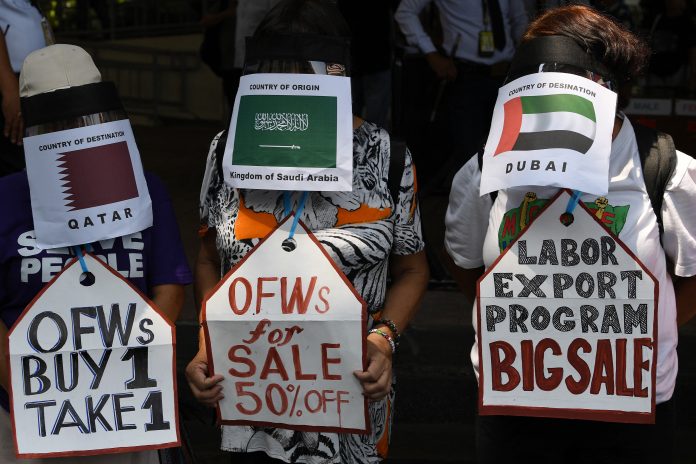
On Monday, Migrante International staged a protest outside the Department of Migrant Workers (DMW), marking one month since the US-Israel-led attacks on Iran began on Feb. 28, and demanded accountability over what it described as government inaction and neglect.
The protest comes as intensifying hostilities in the Middle East disrupt jobs, income, and mobility for Filipino migrants across the region, exposing gaps between official repatriation efforts and the realities faced by workers, including those stranded, undocumented, or unable to leave their employers.
The demonstration also launched a series of coordinated protest actions to be held by Migrante chapters and Filipino migrant organizations in different countries during Holy Week.
The group warned that escalating tensions are affecting OFWs in sectors such as tourism, airport operations, and services, where companies have shifted to work-from-home arrangements, scaled down operations, or temporarily closed, leaving many unable to send financial support to their families.
Domestic workers, meanwhile, face extended working hours and forced labor, while thousands of Filipino seafarers remain stranded at sea, according to the group.
Migrante said the government has neglected to protect the rights and welfare of vulnerable sectors, including undocumented workers, women, and seafarers, amid the worsening economic impact of the conflict.
“The Marcos government itself is putting our fellow Filipinos in danger because of its severe neglect and lack of a comprehensive plan to address the thousands who will lose their livelihoods due to the crisis. It is the government’s fault why our fellow Filipinos are more afraid to return home than of falling missiles and drones, because they know their families will face hunger and hardship if they come back,” said Josie Pingkihan, Migrante International deputy secretary general.
Government data show that at least 3,248 Filipinos had been assisted in returning home from the Middle East as of March 29.
On the same day, authorities facilitated the return of 338 Filipinos from the United Arab Emirates aboard a government-chartered flight, including 203 OFWs, 125 family members, and 10 stranded Filipinos.
They were received by officials from multiple agencies and provided financial assistance, medical support, temporary shelter, and transportation back to their home provinces.
On March 31, another 99 Filipinos returned safely from Kuwait, with authorities likewise extending assistance upon arrival. The government said 198 affected OFWs, including 22 dependents, have so far been repatriated from Kuwait.
Labor Secretary Hans Leo J. Cacdac underscored inter-agency coordination in assisting affected migrants, following directives from President Ferdinand Marcos Jr. to ensure their safety and welfare.
The Department of Migrant Workers earlier reported that 2,630 OFWs had been repatriated as of March 24. Migrante, however, said longstanding barriers continue to prevent many workers from leaving their host countries, especially during crises, leaving them stranded for extended periods.
The group also criticized policies it said impose additional burdens on distressed workers, citing a directive from the Migrant Worker Office in Dubai requiring OFWs who lose their passports without proper documentation to first report to local police before seeking assistance.
“During the COVID-19 pandemic, many Filipinos in the Middle East experienced long processes and delays before they were able to return home. At that time, assistance from the government was very limited or often nonexistent. Government hotlines were also difficult to reach. Now, these same problems are happening again. Our fellow Filipinos who are undocumented, who have pending cases, or whose employers refuse to let them go home are struggling and are being made to suffer further by the government,” Pingkihan added.
Migrante also criticized what it described as inadequate and inaccessible welfare assistance, as well as discriminatory practices in relief distribution.
“There are undocumented Filipinos in Bahrain who were denied assistance and had to call out the government just to receive services. Meanwhile, those who are not OWWA members received very little food assistance compared to those with OWWA membership. Where is the DMW’s budget going? Is this what OFWs get in return for their huge contribution to the economy?” Pingkihan said.
The group also opposed President Ferdinand Marcos Jr.’s Executive Order No. 110, which declared a national energy emergency and directed the DMW to ensure the “reemployment and redeployment” of displaced OFWs.
“In times of war and crisis, the president’s mindset is only to ensure the continued trading and selling of Filipinos as cheap labor abroad so that remittances continue to flow. The real role of the DMW has become that of a recruiter, not a protector,” Pingkihan said.
Migrante maintained that Filipino migrants continue to face systemic barriers and insufficient protection.
“How many wars or crises must our fellow Filipinos endure before the government wakes up?” Pingkihan added.