
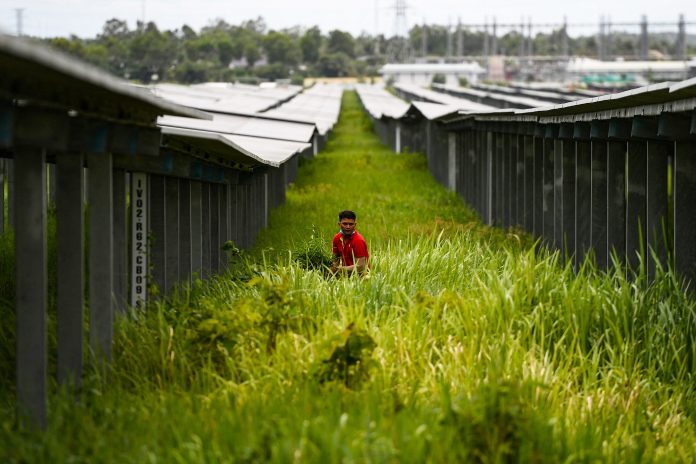
Vietnam could avoid nearly USD 600 million in fossil fuel imports as its solar power helps cushion the impact of war-driven energy price spikes, a new analysis found.
The study by Zero Carbon Analytics shows how Vietnam’s expanding solar capacity reduces its exposure to volatile fossil fuel markets as the Iran conflict drives up global energy prices across Asia.
Global markets have been rattled by escalating attacks on energy infrastructure in the Middle East. According to a report by Agence France-Presse, crude oil prices surged more than five percent after Iran launched strikes on Gulf facilities and warned of further attacks, pushing Brent crude to as high as $112.86 per barrel.
The escalation follows retaliatory strikes linked to the US-Israel attacks on Iran and has effectively disrupted flows through the Strait of Hormuz, a key route for about a fifth of global oil and gas supply.
The renewed volatility has heightened fears of inflation and rising energy costs worldwide, with Asian markets among those hit by falling equities and surging fuel prices.
Liquefied natural gas prices in Asia rose to USD 16 per million British thermal units as of March 11, up 49 percent from late February, while benchmark coal prices climbed to USD 150 per tonne, the highest since November 2024.
Against this backdrop, Vietnam’s 25.9 terawatt-hours of solar generation could help the country avoid about USD 594 million, or roughly VND 15.6 trillion, in fossil fuel imports if current price levels persist for a year, the report said.
Most of the potential savings would come from reduced coal imports estimated at USD 545.4 million, with a further USD 49.3 million from avoided gas imports.
The analysis said these avoided costs could fund annual healthcare expenses for about 2.2 million people.
“Vietnam’s solar power is already delivering a clear economic benefit by reducing the country’s exposure to volatile fossil fuel markets. When global energy prices spike because of geopolitical conflicts, domestic renewables provide a crucial buffer,” said Amy Kong, energy transition researcher at Zero Carbon Analytics.
Vietnam has emerged as Southeast Asia’s leader in renewable energy. In 2024, solar and wind generated 38.7 terawatt-hours of electricity, accounting for about 13 percent of the country’s power mix, the highest share among major economies in the region.
The rapid expansion was driven by policy support, particularly a feed-in tariff introduced in 2017, which helped solar capacity grow from 28 megawatts to 16.7 gigawatts by 2020.
Despite this progress, the country remains heavily dependent on fossil fuels. Coal accounted for more than half of electricity generation in 2024, with about half of that supply imported. Plans to expand liquefied natural gas capacity could further increase reliance on imported energy.
“Vietnam has shown how quickly solar power can scale with the right policies. But the country still relies heavily on imported fossil fuels, which leaves the economy exposed to global price shocks,” said Yu Sun Chin, senior Asia regional researcher at Zero Carbon Analytics.
The findings highlight wider implications for Southeast Asia, where many countries depend on imported fossil fuels to meet growing demand.
“Expanding domestic clean energy like solar and wind can help provide stable power while reducing reliance on volatile imported fuels. Solar power is already among the cheapest sources of electricity in much of Southeast Asia. Scaling it up — alongside batteries and grid upgrades — can help countries cut energy costs while improving energy security,” Chin added.
The analysis underscores a broader regional challenge: as energy-importing economies face rising global prices, expanding domestic renewables could determine how well countries shield households and public spending from future shocks.