
The social action arm of the Catholic Church in the Philippines has backed calls to cancel mining permits linked to violations and expressed solidarity with communities resisting large-scale mining.
Caritas Philippines made the statement as environmental groups marked Anti-Mining Solidarity Week 2026.
Bishop Gerardo Alminaza of San Carlos, president of Caritas Philippines, said the Catholic Church stands with communities defending their lands and ecosystems.
“Caritas Philippines stands in deep solidarity with mining-affected communities who are courageously defending their lands and protecting our common home,” Alminaza said.
March marks the anniversary of the Philippine Mining Act of 1995, a law long criticized by environmental advocates for prioritizing mining investments over ecological protection and community rights.
Alminaza said the issue of mining goes beyond environmental damage and reflects a broader economic system driven by extraction.
“What we are witnessing today is not simply an environmental issue. It is part of a wider system of extractivism, a model of development that treats the earth as a warehouse of resources to be exploited for profit, often at the expense of communities and future generations,” he said.
He warned that large-scale mining destroys forests, pollutes watersheds, and undermines the livelihoods of farmers, fisherfolk, and Indigenous peoples.
Alminaza said the impacts extend beyond local environmental damage, noting that the industry also sustains a global economy heavily dependent on fossil fuels and unsustainable extraction.
Citing Pope Francis’ environmental encyclical Laudato Si’, the bishop said environmental destruction disproportionately affects poor communities.
“As Pope Francis reminds us in Laudato Si’, the cry of the earth and the cry of the poor are one. When ecosystems are destroyed, it is always the poorest who suffer first and most,” he said.
Alminaza reiterated the Church’s call for a transition away from destructive extractive industries and toward renewable energy, sustainable agriculture, and community-based development that respects both people and creation.
He also pointed to what he described as “ecological debt,” saying communities often bear the environmental costs while corporations profit from resource extraction.
“We therefore support the call to cancel mining permits tainted by violations and the absence of genuine consultation,” Alminaza added.
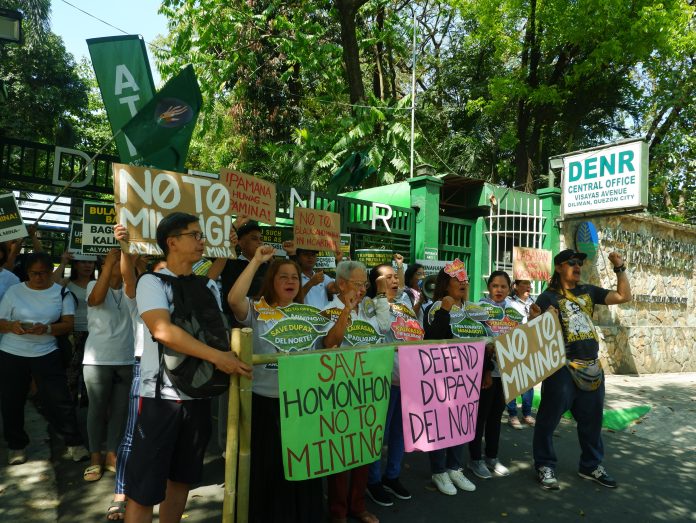
The bishop’s message came after women leaders from anti-mining barricades and members of Alyansa Tigil Mina (ATM) staged a protest outside the Department of Environment and Natural Resources (DENR), demanding the cancellation of mining permits and a halt to mining operations in their communities.
Community leaders traveled from MacArthur, Leyte; Manicani Island and Homonhon Island in Guiuan, Eastern Samar; and Sibuyan Island in Romblon to press their demands.
Carmi Macapagao of Homonhon Environmental Advocates and Rights Defenders (HEARD) said communities would continue opposing mining activities.
“We will persist in protesting against mining activities to preserve our natural resources for the next generations,” Macapagao said.
ATM National Coordinator Jaybee Garganera also called on the government to shift away from extractive development.
“It is high time the government acknowledged the harms of large-scale mining and shifted away from extractivism. Our country needs to pursue a development path that promotes sustainable agriculture and protects the livelihoods and rights of communities,” Garganera said.
Data from the Mines and Geosciences Bureau show that as of Jan. 31, 2026, the government has approved 31 Mineral Production Sharing Agreements, 56 Exploration Permits, and 88 Mineral Processing Permits since 2022.